Prison Statistics India Report 2024
#GS-2 #Indian Polity & Constitution #Constitution #Judiciary #Governance & Social Justice #Good Governance #Poverty #Fundamental Rights #Issues Arising Out of Design & Implementation of Policies #National Crime Records Bureau
Key takeaways
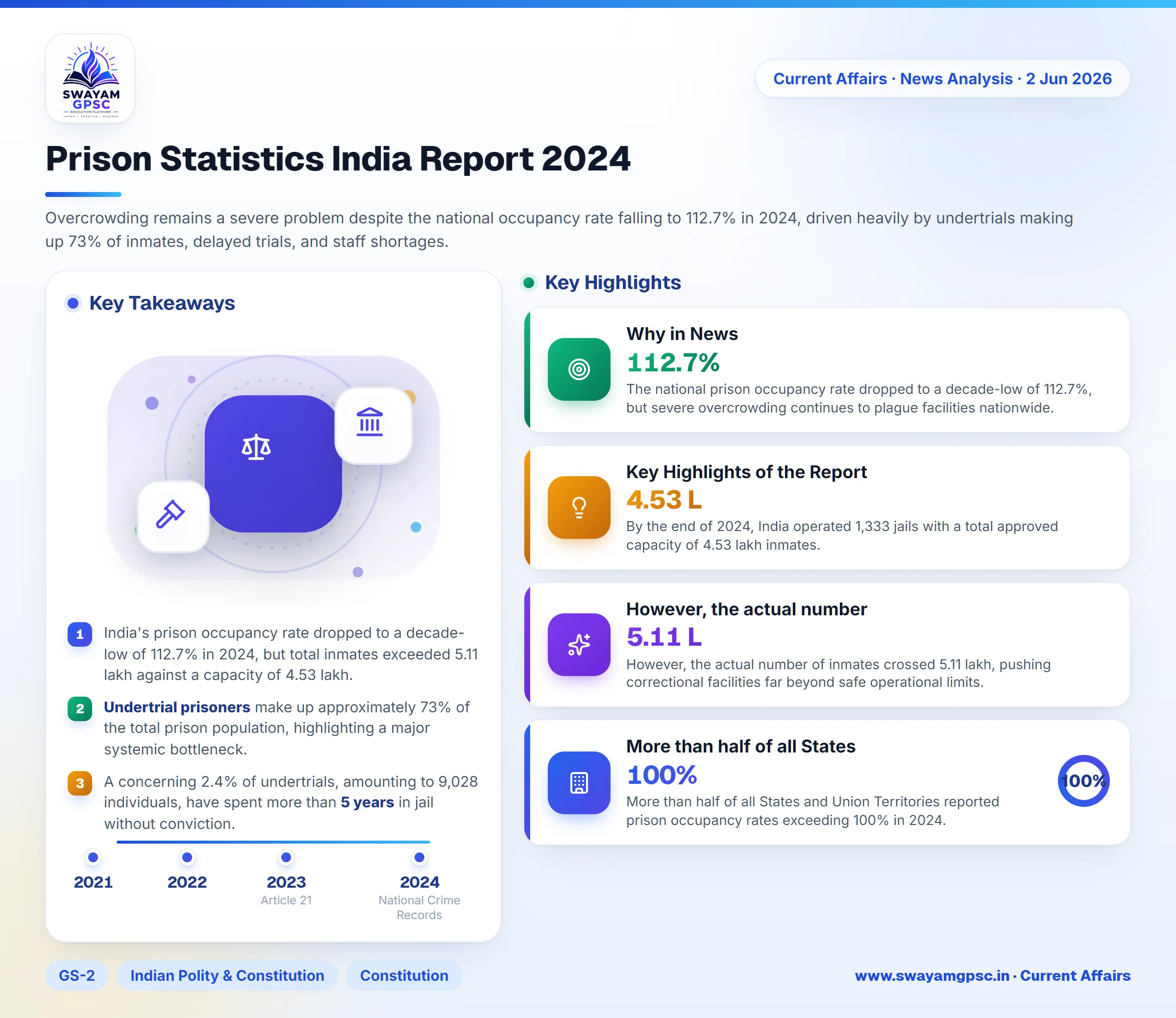
- India's prison occupancy rate dropped to a decade-low of 112.7% in 2024, but total inmates exceeded 5.11 lakh against a capacity of 4.53 lakh.
- Undertrial prisoners make up approximately 73% of the total prison population, highlighting a major systemic bottleneck.
- A concerning 2.4% of undertrials, amounting to 9,028 individuals, have spent more than 5 years in jail without conviction.
- The Bharatiya Nagarik Suraksha Sanhita (BNSS), 2023 introduces Section 479, allowing first-time offenders who serve one-third of their sentence to secure release.
Why in News
- The National Crime Records Bureau published the Prison Statistics India report for 2024 recently.
- The national prison occupancy rate dropped to a decade-low of 112.7%, but severe overcrowding continues to plague facilities nationwide.
- This persistent crisis stems mainly from a massive population of undertrial prisoners, slow expansion of infrastructure, and widespread vacancies in staff positions.
Summary
- Overcrowding remains a severe problem despite the national occupancy rate falling to 112.7% in 2024, driven heavily by undertrials making up 73% of inmates, delayed trials, and staff shortages.
- This congestion violates Article 21 and human dignity while disproportionately harming the poor, which makes urgent reforms like the BNSS 2023, the Model Prisons Act 2023, and bail changes necessary.
Key Highlights of the Report
- By the end of 2024, India operated 1,333 jails with a total approved capacity of 4.53 lakh inmates.
- However, the actual number of inmates crossed 5.11 lakh, pushing correctional facilities far beyond safe operational limits.
- More than half of all States and Union Territories reported prison occupancy rates exceeding 100% in 2024.
- Delhi recorded the highest occupancy rate in the country at 194.6%, followed by Meghalaya at 163.5%, Jammu and Kashmir at 148.3%, and Madhya Pradesh at 147.1%.
- Jammu and Kashmir saw occupancy surge from 78% in 2015 to over 148% in recent years.
- On the other hand, Chhattisgarh successfully reduced its occupancy rate from 234% in 2015 to 127.6% in 2024, alongside similar improvements in Uttar Pradesh.
- Overall prison capacity grew by 24% between 2015 and 2024 through renovations across 2,268 existing prisons and the building of over 120 new facilities.
- Despite this growth, new capacity failed to match the rapid influx of inmates in multiple states.
- Undertrial prisoners accounted for roughly 73% of the total inmate population in 2024.
- This is an improvement from the 77% peak during the pandemic in 2021, but it remains much higher than pre-Covid averages.
- The share of convicted prisoners inside Indian jails dropped from 32% in 2016 to 26.6% in 2024.
- In 14 States and UTs, the concentration of undertrials sits well above the national average.
- Delhi and Bihar recorded the highest undertrial concentrations, with more than 87% of their prison populations awaiting trial.
- While 69.9% of undertrials stayed in jail for up to 1 year, a concerning 2.4% consisting of 9,028 individuals remained locked up for over 5 years without a conviction.
Concerns Associated with Prison Overcrowding
- Hyper-congestion violates Article 21, which protects the right to life and personal liberty.
- In *Hussainara Khatoon v. State of Bihar (1979)*, the Supreme Court ruled that a speedy trial is part of Article 21, meaning prolonged detention without conviction amounts to punitive detention.
- In *Sunil Batra v. Delhi Administration (1980)*, the Supreme Court noted that prisoners keep their fundamental rights, and overcrowded cells inflict cruel and unusual punishment.
- Indian prisons frequently fail to meet the standards set by the United Nations Standard Minimum Rules for the Treatment of Prisoners (The Nelson Mandela Rules).
- The core legal principle that bail is the rule, jail is the exception is broken because courts demand high financial sureties that poor people cannot afford.
- Despite guidelines in *Arnesh Kumar v. State of Bihar (2014)* limiting arrests for crimes carrying under seven years in prison, police continue making unnecessary arrests.
- Lower magistrates often issue mechanical remand orders without checking if detention is truly necessary.
- Key decongestion tools like Section 479 of the Bharatiya Nagarik Suraksha Sanhita (BNSS), 2023 remain underused.
- Overcrowded spaces help spread communicable diseases like tuberculosis and HIV quickly.
- A 46.4% staff vacancy rate among medical professionals directly causes high illness rates and rising unnatural deaths, including suicides.
- Under Trial Review Committees often suffer from red tape and poor coordination among agencies, missing their quarterly review targets.
- Severe space shortages prevent prisons from separating first-time offenders from hardened criminals, which accelerates recidivism.
- Data shows that 86.3% of prisoners belong to the productive age group of 18 to 50 years, meaning their detention pushes families into deep poverty.
- Most undertrials come from marginalized groups like Scheduled Castes, Scheduled Tribes, and Other Backward Classes, and the Law Commission's 268th Report (2017) noted poverty as the main barrier to bail.
- Such conditions violate Article 39A, which promises equal justice and free legal aid.
Government Interventions to Address Prison Overcrowding
- Section 479(1) of the Bharatiya Nagarik Suraksha Sanhita (BNSS), 2023 replaces old CrPC rules and allows first-time offenders who serve one-third of their sentence to be released on bond.
- It forces jail superintendents to officially apply for an undertrial prisoner's release once they complete the required time limit.
- The Model Prisons and Correctional Services Act, 2023 replaces the old Prisons Act of 1894 to focus on rehabilitation instead of pure retribution.
- The 2016 Model Prison Manual was launched to standardize management, medical care, and vocational training across jails.
- The Prisons Development Fund was created in 2018 to help states modernize their prison infrastructure.
- The E-Prisons Project digitizes records and links them with the Inter-operable Criminal Justice System to alert authorities when inmates become eligible for release.
- The Support to Poor Prisoners Scheme helps marginalized undertrials pay their fines and bail amounts.
Way Forward
- As suggested by the Supreme Court in *Satender Kumar Antil v. Central Bureau of Investigation (2022)*, enacting a dedicated Bail Act would reduce judicial delays.
- Establishing fast-track courts for petty crimes can reduce the undertrial population, following recommendations from the Justice Amitava Roy Committee (2018).
- Expanding open prisons like the Sanganer Open Camp in Rajasthan can cut maintenance costs and improve rehabilitation.
- High Courts must strictly enforce rules from *Arnesh Kumar v. State of Bihar (2014)* and use the FASTER system for quick bail transmission.
- The judiciary should use artificial intelligence tools like SUVAS and SUPACE to track undertrial detention periods automatically.
- Prisons must focus on better living conditions and rehabilitation as suggested by the All India Jail Reforms Committee (1980 to 1983).
- States should create separate facilities for women run entirely by female staff, following the Justice V.R. Krishna Iyer Committee (1987) advice.
- Creating an Indian Prisons and Correctional Service would improve overall management as recommended by the Justice A.N. Mulla Committee (1980).
- States should set up funds similar to Andhra Pradesh's 'Cheyutha Nidhi' to pay bail bonds for poor prisoners, as advised by a parliamentary committee in 2023.
Conclusion
- As Justice V.R. Krishna Iyer noted, prisons must be managed with humanism rather than just strict laws.
- The Supreme Court's focus in the Suhas Chakma case, 2024, highlights the need to move from a punitive system to a humane and reform-focused correctional framework.