Pre-Conception and Pre-Natal Diagnostic Techniques Act, 1994
#GS-2 #Governance & Social Justice #Health #Issues Related to Women #Issues Related to Children #Government Policies & Interventions #Quick Facts For Prelims
Key takeaways
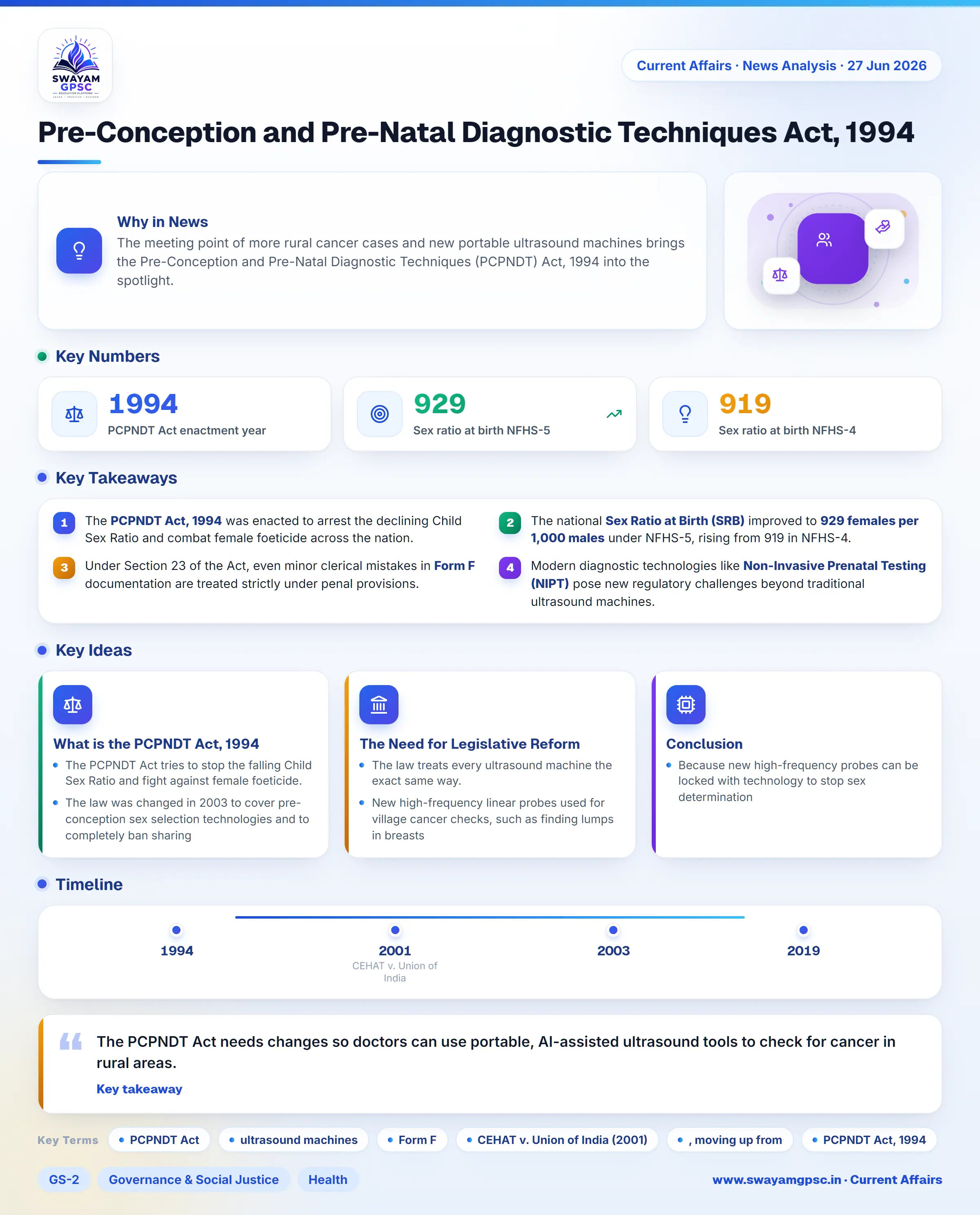
- The PCPNDT Act, 1994 was enacted to arrest the declining Child Sex Ratio and combat female foeticide across the nation.
- The national Sex Ratio at Birth (SRB) improved to 929 females per 1,000 males under NFHS-5, rising from 919 in NFHS-4.
- Under Section 23 of the Act, even minor clerical mistakes in Form F documentation are treated strictly under penal provisions.
- Modern diagnostic technologies like Non-Invasive Prenatal Testing (NIPT) pose new regulatory challenges beyond traditional ultrasound machines.
Why in News
- The meeting point of more rural cancer cases and new portable ultrasound machines brings the Pre-Conception and Pre-Natal Diagnostic Techniques (PCPNDT) Act, 1994 into the spotlight.
- A recent sad case of a patient in a village dying from advanced breast cancer because she could not reach a local diagnostic machine shows we must look at the rules for portable ultrasound devices again.
What is the PCPNDT Act, 1994
- The PCPNDT Act tries to stop the falling Child Sex Ratio and fight against female foeticide.
- The law was changed in 2003 to cover pre-conception sex selection technologies and to completely ban sharing or telling the sex of an unborn child in any case.
- No medical facility can buy or run ultrasound machines without signing up with the State Appropriate Authority.
- Once a machine is set up, moving it outside the registered building is a major crime that brings a jail term of at least three months without bail.
- Clinics must keep very careful records, especially Form F, which has a written note from the pregnant mother saying she does not want to know the sex of the baby.
- The law stops any ads about choosing the sex of a child before conception or before birth.
- It sets up the Central Supervisory Board, State Supervisory Boards, and Appropriate Authorities to check and manage the rules.
- Breaking these rules is a serious, non-bailable crime that cannot be settled out of court, leading to up to three years in jail, fines, and losing a doctor's license.
- Prompted by court orders like the big CEHAT v. Union of India (2001) Supreme Court ruling for strict action, the law has given mixed results over time.
- The Sex Ratio at Birth (SRB) improved to 929 females per 1,000 males at the national level (NFHS-5), moving up from 919 (NFHS-4).
- It successfully stopped the open business of illegal sex test clinics.
- In some areas, not being able to get sex-selective abortions led to higher family sizes as parents kept having children until a boy was born, wasting resources.
- This sometimes led to higher child death rates for firstborn girls because parents spent less money on their health.
The Need for Legislative Reform
- The law treats every ultrasound machine the exact same way.
- New high-frequency linear probes used for village cancer checks, such as finding lumps in breasts, cannot tell the sex of an unborn child.
- Even so, moving these tools is banned, which slows down healthcare in local areas.
- The current rules focus mostly on ultrasound gear and cannot properly regulate Non-Invasive Prenatal Testing (NIPT), which lets people find out the baby's sex through a simple blood test from the mother.
- Under Section 23 of the law, small paper mistakes in Form F are often treated like the real crime of sex determination.
- Although the Supreme Court agreed with this in the Federation of Obstetric and Gynecological Societies of India (FOGSI) v. Union of India (2019) case, doctors say this scares honest radiologists away from giving normal pregnancy care.
- The law must change to allow systems that use Artificial Intelligence, which can be locked with software to check for specific diseases while blocking any view of the baby's sex.
Conclusion
- The PCPNDT Act needs changes so doctors can use portable, AI-assisted ultrasound tools to check for cancer in rural areas.
- Because new high-frequency probes can be locked with technology to stop sex determination, leaders can safely bring life-saving health checks to poor areas without hurting the fight against female foeticide.