Pradhan Mantri Janjatiya Vikas Mission and Tribal Economy
#GS-2 #Governance & Social Justice #Vulnerable Sections #Government Policies & Interventions #Issues Related to SCs & STs #GS-3 #Economy #Tribal Livelihoods
Key takeaways
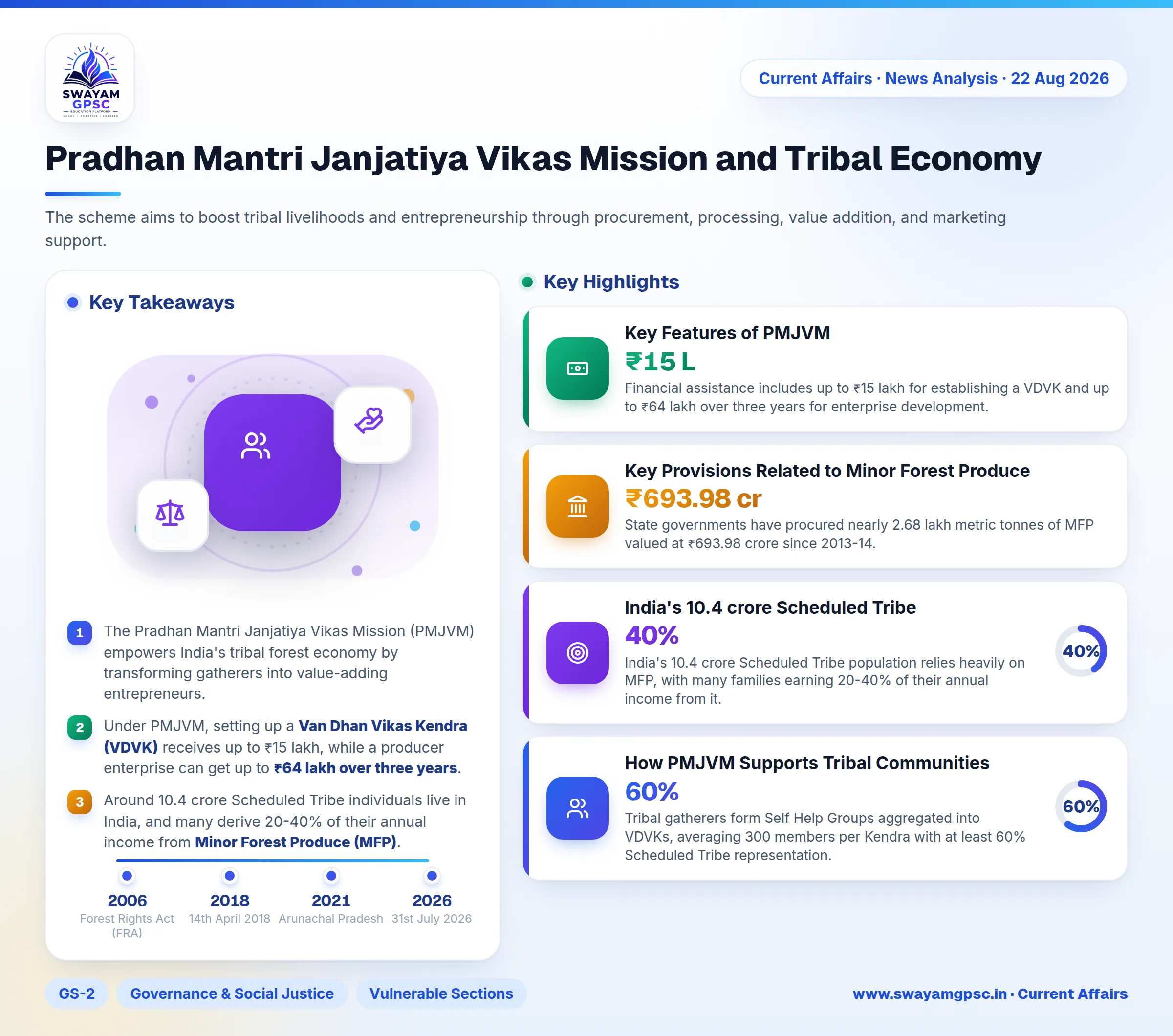
- The Pradhan Mantri Janjatiya Vikas Mission (PMJVM) empowers India's tribal forest economy by transforming gatherers into value-adding entrepreneurs.
- Under PMJVM, setting up a Van Dhan Vikas Kendra (VDVK) receives up to ₹15 lakh, while a producer enterprise can get up to ₹64 lakh over three years.
- Around 10.4 crore Scheduled Tribe individuals live in India, and many derive 20-40% of their annual income from Minor Forest Produce (MFP).
- As of 31st July 2026, authorities sanctioned 4,172 VDVKs, linking 12.48 lakh tribal members and generating ₹168 crore in sales.
Why in News
- The government highlighted how the Pradhan Mantri Janjatiya Vikas Mission (PMJVM) strengthens the tribal forest economy across India.
- The mission organises tribal communities into Van Dhan Vikas Kendras (VDVKs) so gatherers can become active entrepreneurs.
Key Features of PMJVM
- PMJVM is a Central Sector Scheme under the Ministry of Tribal Affairs that combines MSP for MFP schemes with tribal product marketing initiatives.
- The scheme aims to boost tribal livelihoods and entrepreneurship through procurement, processing, value addition, and marketing support.
- TRIFED acts as the central implementing agency alongside various State Implementing Agencies to execute the mission.
- The scheme supports MSP-based procurement of Minor Forest Produce, setting up VDVKs, developing producer enterprises, and building marketing infrastructure.
- Financial assistance includes up to ₹15 lakh for establishing a VDVK and up to ₹64 lakh over three years for enterprise development.
- The mission gives special attention to Aspirational Districts, Particularly Vulnerable Tribal Groups (PVTGs), and Forest Rights Act land-title holders.
Key Provisions Related to Minor Forest Produce
- The Forest Rights Act (FRA), 2006 defines Minor Forest Produce to include non-timber items like bamboo, honey, tendu leaves, mahua, and medicinal herbs.
- The FRA recognizes how forest-dwelling communities depend on natural resources and gives tribal members rights to harvest and sell forest produce.
- The Panchayats (Extension to Scheduled Areas) Act, 1996 (PESA) grants ownership rights over Minor Forest Produce directly to tribal Gram Panchayats.
- The government established Minimum Support Price (MSP) coverage for 87 MFP items under PMJVM to prevent distress sales by tribal gatherers.
- TRIFED purchases non-timber forest items at predetermined MSP rates through state cooperatives and forest corporations.
- State governments have procured nearly 2.68 lakh metric tonnes of MFP valued at ₹693.98 crore since 2013-14.
- India's 10.4 crore Scheduled Tribe population relies heavily on MFP, with many families earning 20-40% of their annual income from it.
- Tribal gatherers often sell raw produce to middlemen at very low prices, earning far less than fair market value or their physical labour.
How PMJVM Supports Tribal Communities
- Tribal gatherers form Self Help Groups aggregated into VDVKs, averaging 300 members per Kendra with at least 60% Scheduled Tribe representation.
- Launched on 14th April 2018, the Van Dhan Yojana provides the main operational framework for VDVKs under PMJVM.
- The program offers training in scientific harvesting, sustainable collection, packaging, and basic processing, along with necessary equipment.
- Tribal groups receive financial aid for working capital, cold storage, transport, and processing tools, connected with NSTFDC and banks.
- TRIFED links VDVKs to weekly markets, e-commerce networks, and corporate partners while providing daily price information.
- By 31st July 2026, official reports confirmed 4,172 sanctioned VDVKs, with 2,911 functional units empowering 12.48 lakh tribal members and generating ₹168 crore in sales.
VDVKs and Tribal Women Empowerment
- Tribal women perform most forest collection work, turning VDVKs into key drivers for economic empowerment among women.
- VDVKs help women process local forest harvests into marketable products such as pickles, powders, jams, and juices.
- In Arunachal Pradesh, the Nyigamane, Ho Yorbe, Medumhagdum VDVK in Leparada district started in October 2021 with 300 women SHG members.
- This group generated sales of around ₹11 lakh since 2022-23, helping reduce their dependency on seasonal farming.
- Women act as joint business owners rather than simple labourers, giving them full control over production, branding, and revenue.
Conclusion
- The Pradhan Mantri Janjatiya Vikas Mission transforms India's tribal economy by combining price protection, technical skilling, and enterprise support.
- By establishing community-owned enterprises, PMJVM advances financial inclusion for women and supports the broader goals of Viksit Bharat@2047.