Political Clearance Rules for Foreign Travel by Public Officials
#GS-2 #Indian Polity & Constitution #Executive #Governance & Social Justice #Current Events #National #Ministry of External Affairs #Political Clearance
Key takeaways
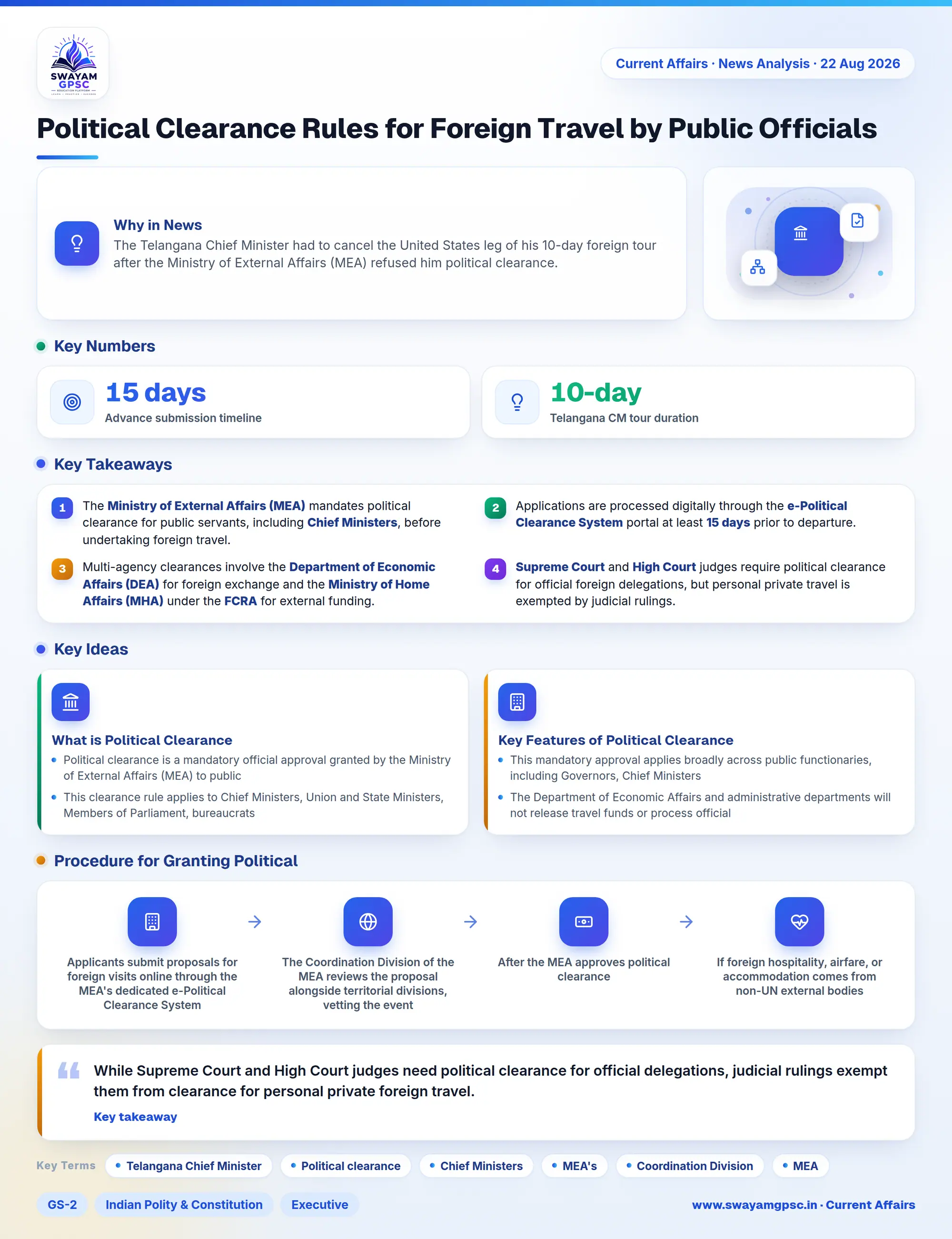
- The Ministry of External Affairs (MEA) mandates political clearance for public servants, including Chief Ministers, before undertaking foreign travel.
- Applications are processed digitally through the e-Political Clearance System portal at least 15 days prior to departure.
- Multi-agency clearances involve the Department of Economic Affairs (DEA) for foreign exchange and the Ministry of Home Affairs (MHA) under the FCRA for external funding.
- Supreme Court and High Court judges require political clearance for official foreign delegations, but personal private travel is exempted by judicial rulings.
Why in News
- The Telangana Chief Minister had to cancel the United States leg of his 10-day foreign tour after the Ministry of External Affairs (MEA) refused him political clearance.
What is Political Clearance and Its Aim
- Political clearance is a mandatory official approval granted by the Ministry of External Affairs (MEA) to public servants before they undertake any official or private foreign travel.
- This clearance rule applies to Chief Ministers, Union and State Ministers, Members of Parliament, bureaucrats, and public sector officials.
- The main objective is to ensure foreign visits by Indian representatives align with national foreign policy, bilateral relations, and diplomatic protocols.
Procedure for Granting Political Clearance
- Applicants submit proposals for foreign visits online through the MEA's dedicated e-Political Clearance System portal.
- The Coordination Division of the MEA reviews the proposal alongside territorial divisions, vetting the event, invitation, protocol reciprocity, and bilateral ties.
- After the MEA approves political clearance, the proposal goes to the Department of Economic Affairs (DEA) for financial and foreign exchange permissions.
- If foreign hospitality, airfare, or accommodation comes from non-UN external bodies, the Ministry of Home Affairs (MHA) must grant clearance under the Foreign Contribution (Regulation) Act (FCRA).
- The Prime Minister or the Cabinet Secretariat gives the final clearance for proposed visits of Union Ministers and Chief Ministers.
Key Features of Political Clearance
- This mandatory approval applies broadly across public functionaries, including Governors, Chief Ministers, Union and State Ministers, civil servants, and PSU executives.
- The Department of Economic Affairs and administrative departments will not release travel funds or process official deputations without prior MEA clearance.
- Assessment criteria inspect the stature of foreign participants to prevent foreign entities from bypassing the Union government to deal directly with sub-national states.
- Authorities evaluate direct institutional appropriateness alongside the political and strategic sensitivity of the host country.
- While Supreme Court and High Court judges need political clearance for official delegations, judicial rulings exempt them from clearance for personal private foreign travel.
- Guidelines from the Cabinet Secretariat and Department of Expenditure require submitting foreign tour requests at least 15 days before departure.