PMJDY Completes 12 Years: Promoting Financial Democracy and Digital Inclusion
#GS-3 #Economy #Banking #Infrastructure #GS-2 #Governance & Social Justice #Good Governance #Current Events #National #Financial Inclusion #Pradhan Mantri Jan Dhan Yojana
Key takeaways
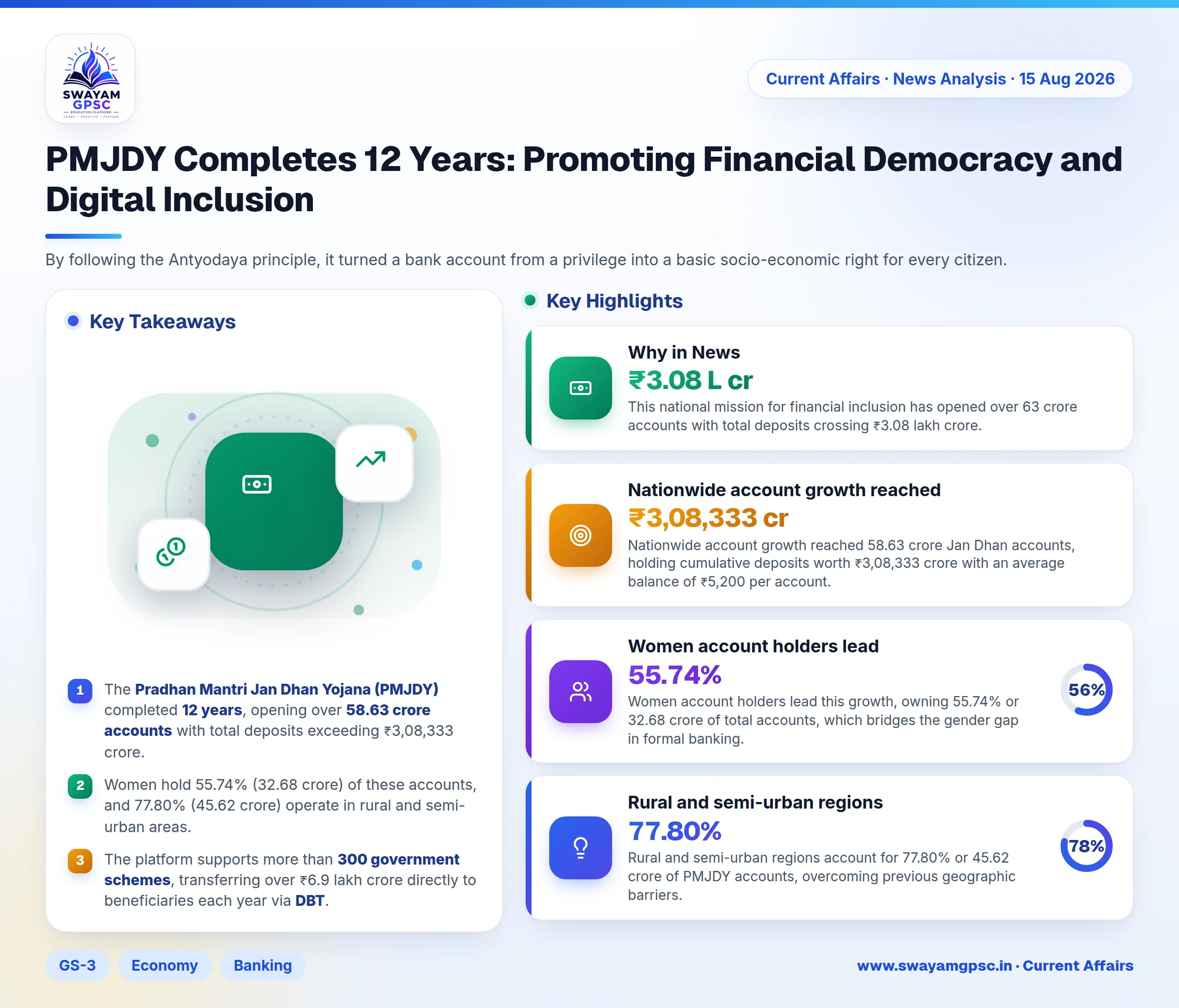
- The Pradhan Mantri Jan Dhan Yojana (PMJDY) completed 12 years, opening over 58.63 crore accounts with total deposits exceeding ₹3,08,333 crore.
- Women hold 55.74% (32.68 crore) of these accounts, and 77.80% (45.62 crore) operate in rural and semi-urban areas.
- The platform supports more than 300 government schemes, transferring over ₹6.9 lakh crore directly to beneficiaries each year via DBT.
- Over 40 crore RuPay debit cards have been distributed, offering account holders an overdraft facility of up to ₹10,000.
Why in News
- The Pradhan Mantri Jan Dhan Yojana (PMJDY) completed 12 years since its announcement by the Prime Minister in 2014.
- This national mission for financial inclusion has opened over 63 crore accounts with total deposits crossing ₹3.08 lakh crore.
- It forms the core foundation of India's Antyodaya vision and Digital Public Infrastructure (DPI) architecture.
- Financial democracy through PMJDY ensures that every family gets equal access to basic banking, credit, insurance, and government welfare transfers.
- By following the Antyodaya principle, it turned a bank account from a privilege into a basic socio-economic right for every citizen.
Key Data and Statistics
- Nationwide account growth reached 58.63 crore Jan Dhan accounts, holding cumulative deposits worth ₹3,08,333 crore with an average balance of ₹5,200 per account.
- Women account holders lead this growth, owning 55.74% or 32.68 crore of total accounts, which bridges the gender gap in formal banking.
- Rural and semi-urban regions account for 77.80% or 45.62 crore of PMJDY accounts, overcoming previous geographic barriers.
- The system serves as the primary banking channel for more than 300 government welfare schemes, transferring over ₹6.9 lakh crore via Direct Benefit Transfer (DBT) annually.
Core Pillars of the Jan Dhan Architecture
- Universal zero-balance banking removed minimum balance requirements so that poverty no longer prevents people from opening a bank account.
- The scheme issued over 40 crore RuPay debit cards, turning traditional passbooks into active digital transaction tools.
- An embedded overdraft facility provides micro-credit up to ₹10,000, giving poor families a safe alternative to high-interest local moneylenders.
- It acts as the essential first layer of the JAM Trinity, linking bank accounts with Aadhaar and mobile phones for smooth DBT and UPI payments.
- The platform simplifies access to government micro-insurance and pension programs like PMJJBY, PMSBY, and Atal Pension Yojana (APY).
Challenges
- Around 15% to 20% of accounts remain inactive or act only as temporary channels to withdraw government subsidies rather than for regular savings.
- Strict bank screening rules and low public awareness mean that very few account holders use the ₹10,000 overdraft facility.
- Remote tribal areas face service disruptions because of poor internet connection, technical glitches in micro-ATMs, and cash shortages.
- First-time rural bank users remain vulnerable to cyber fraud, phishing calls, and ATM card cloning due to low digital literacy.
- Public and private banks face high operational costs when managing millions of low-balance accounts that generate limited fee income.
Way Forward
- Banks should move beyond basic account opening by encouraging micro-recurring deposits, low-cost mutual funds, and small business loans based on transaction history.
- Strengthening the Business Correspondent or Bank Mitra network requires higher commission rates, standard training, and dual-SIM biometric machines for remote areas.
- Gram Panchayats must organize practical financial literacy campaigns to teach new users how to use UPI and RuPay cards safely.
- Automating small insurance renewals for PMJJBY and PMSBY through UPI AutoPay will prevent policies from lapsing unnecessarily.
- Connecting Jan Dhan accounts to the Open Credit Network or OCEN can help street vendors and small farmers get quick, collateral-free micro-loans.
Conclusion
- Over the last 12 years, PMJDY has turned basic banking access into a fundamental right for every Indian citizen.
- By linking over 58 crore citizens to formal banking and supporting the JAM Trinity and UPI, it removed middleman leakages and boosted women's empowerment.
- Expanding this network from simple account access to active financial services will be crucial for achieving the vision of Viksit Bharat@2047.