PM SVANidhi Scheme Restructuring and Key Features
#GS-2 #Governance & Social Justice #Vulnerable Sections #E-Governance #GS-3 #Economy #Banking #Employment #Current Events #National
Key takeaways
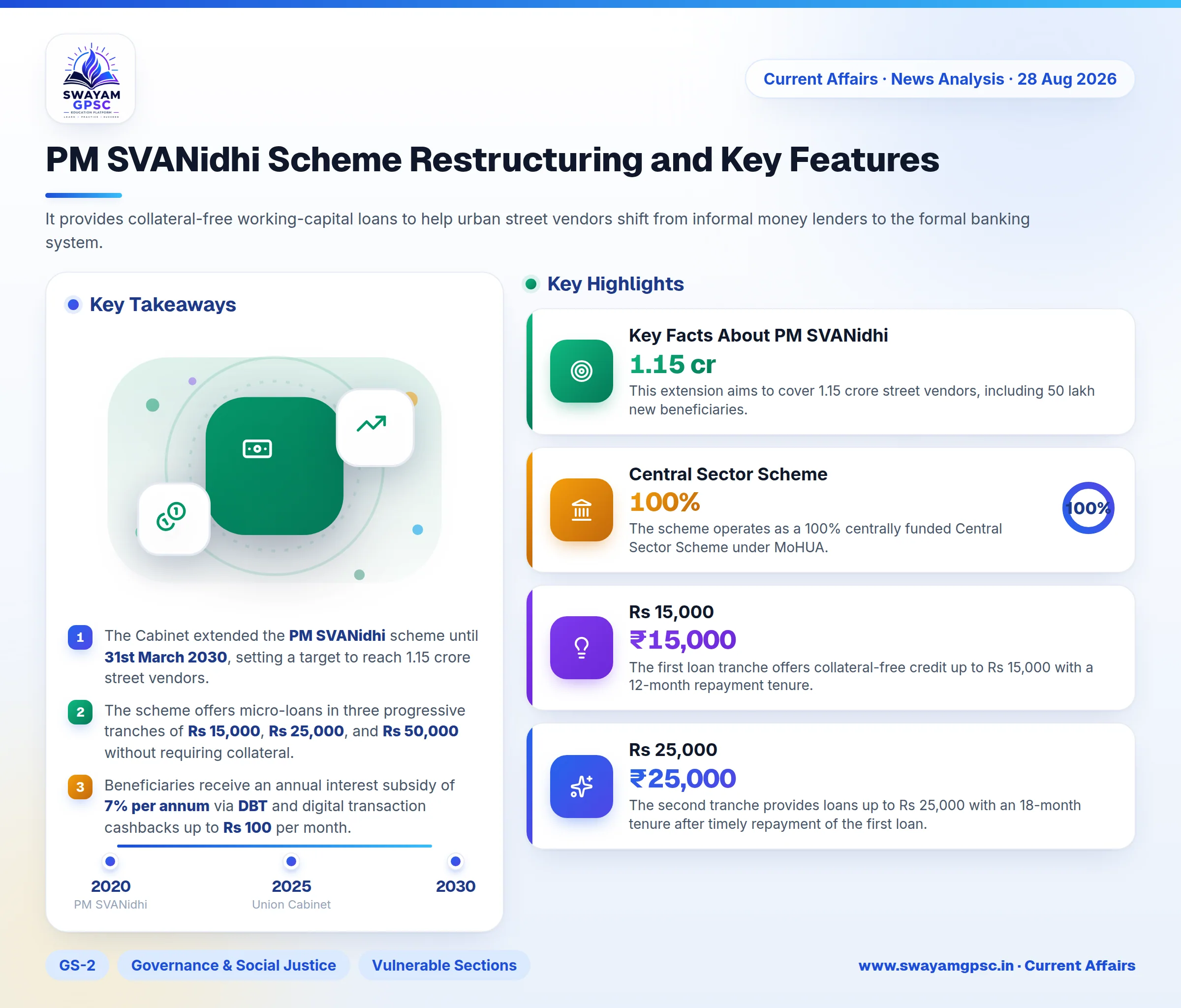
- The Cabinet extended the PM SVANidhi scheme until 31st March 2030, setting a target to reach 1.15 crore street vendors.
- The scheme offers micro-loans in three progressive tranches of Rs 15,000, Rs 25,000, and Rs 50,000 without requiring collateral.
- Beneficiaries receive an annual interest subsidy of 7% per annum via DBT and digital transaction cashbacks up to Rs 100 per month.
- Through 'SVANidhi se Samriddhi', vendor families gain access to 8 major central government welfare programs.
Why in News
- The PM Street Vendor’s AtmaNirbhar Nidhi (PM SVANidhi) scheme has completed 1 year of its restructured phase.
- The scheme has expanded its focus beyond basic working capital loans to cover formal finance, digital inclusion, social security, capacity building, and entrepreneurship.
Key Facts About PM SVANidhi
- The Ministry of Housing and Urban Affairs (MoHUA) launched PM SVANidhi in June 2020 during the Covid-19 pandemic.
- It provides collateral-free working-capital loans to help urban street vendors shift from informal money lenders to the formal banking system.
- The Union Cabinet approved the restructured scheme in August 2025, extending the lending period until 31st March 2030.
- This extension aims to cover 1.15 crore street vendors, including 50 lakh new beneficiaries.
- The scheme operates as a 100% centrally funded Central Sector Scheme under MoHUA.
- Eligible beneficiaries include urban, peri-urban, and rural street vendors, hawkers, and informal service providers like barbers and cobblers operating in Urban Local Bodies (ULBs).
- The first loan tranche offers collateral-free credit up to Rs 15,000 with a 12-month repayment tenure.
- The second tranche provides loans up to Rs 25,000 with an 18-month tenure after timely repayment of the first loan.
- The third tranche offers enhanced credit up to Rs 50,000 with a 36-month tenure and no prepayment penalty.
- Standard bank accounts receive an interest subsidy of 7% per annum credited quarterly through Direct Benefit Transfer (DBT).
- Vendors earn a monthly digital transaction cashback up to Rs 100 to encourage cashless payments.
- Vendors completing the second loan tranche become eligible for a UPI-Linked RuPay Credit Card with a initial limit of Rs 10,000 up to Rs 30,000 for 5 years.
- An end-to-end Digital Lending Platform (DLP) automates loan application, verification, approval, and disbursement processes.
- The Vendor Migration Module allows smooth transfer of Letters of Recommendation (LoRs) when vendors move between ULBs and Census Towns.
- The City Region Approach brings vendors from Census Towns into the formal financial framework.
- Eligibility requires a Certificate of Vending or Identity Card issued by ULBs, or a verified LoR from the Town Vending Committee (TVC).
- The MoHUA launched 'SVANidhi se Samriddhi' to map the socio-economic status of vendor families and connect them to 8 central welfare schemes.
- Key schemes under this integration include PMJJBY, PMSBY, PM Jan Dhan Yojana, BoCW, PM Shram Yogi Maandhan, ONORC, Janani Suraksha Yojana, and PMMVY.
- During the first year of restructuring, institutions disbursed 21.86 lakh loans worth Rs 6,294 crore to 10.56 lakh new beneficiaries.
- Since inception, 78.68 lakh vendors have received more than 1.18 crore loans through PM SVANidhi.
- The PM SVANidhi Startup Challenge promotes solutions for market access, financial tools, and logistics for vendors.
- The government provides up to Rs 4 crore each for 50 Street Food Hubs and an extra Rs 25 lakh for vending zones.
- Events like Lok Kalyan Melas connect vendors with banks, while over 6 lakh food vendors have received safety training from FSSAI.
Frequently Asked Questions
- What is PM SVANidhi? It is a Central Sector Scheme launched on 1 June 2020 by MoHUA to offer collateral-free loans to street vendors.
- What are the loan tranches under PM SVANidhi? The scheme offers sequential loans of Rs 15,000, Rs 25,000, and Rs 50,000 based on timely repayment.
- What is SVANidhi se Samriddhi? It conducts socio-economic profiling of vendors' families to link them with 8 central government welfare schemes.
- How does the scheme promote digital inclusion? It offers monthly cashback on digital transactions and provides a UPI-linked RuPay Credit Card with limits up to Rs 30,000.
- What is the focus of the restructured scheme? The updated scheme extends lending to 31 March 2030 targeting 1.15 crore vendors with a focus on credit, entrepreneurship, and social security.