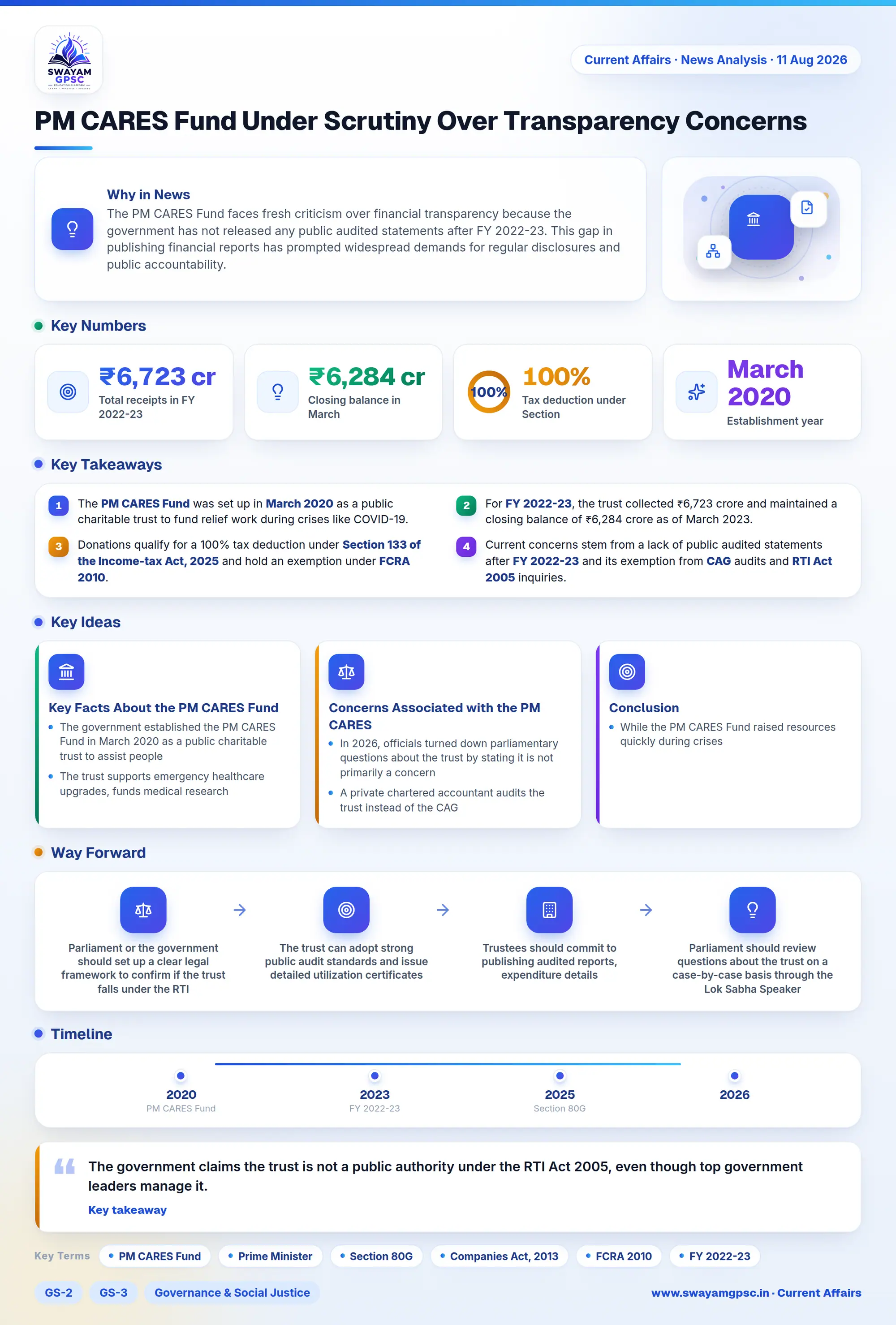
PM CARES Fund Under Scrutiny Over Transparency Concerns
#GS-2 #GS-3 #Governance & Social Justice #Indian Polity & Constitution #Disaster Management #Good Governance #RTI #Disaster Response #Transparency & Accountability
Key takeaways
- The PM CARES Fund was set up in March 2020 as a public charitable trust to fund relief work during crises like COVID-19.
- For FY 2022-23, the trust collected ₹6,723 crore and maintained a closing balance of ₹6,284 crore as of March 2023.
- Donations qualify for a 100% tax deduction under Section 133 of the Income-tax Act, 2025 and hold an exemption under FCRA 2010.
- Current concerns stem from a lack of public audited statements after FY 2022-23 and its exemption from CAG audits and RTI Act 2005 inquiries.
Why in News
- The PM CARES Fund faces fresh criticism over financial transparency because the government has not released any public audited statements after FY 2022-23.
- This gap in publishing financial reports has prompted widespread demands for regular disclosures and public accountability.
Key Facts About the PM CARES Fund
- The government established the PM CARES Fund in March 2020 as a public charitable trust to assist people during emergencies like the COVID-19 pandemic.
- The trust supports emergency healthcare upgrades, funds medical research, and aids people during health crises or natural calamities.
- The Prime Minister acts as the ex-officio Chairperson, while the Ministers of Defence, Home Affairs, and Finance serve as ex-officio Trustees.
- The fund depends entirely on voluntary donations from individuals or companies and gets no direct budget allocation from the government.
- Donors receive a 100% income tax deduction under Section 133 of the Income-tax Act, 2025, which replaced Section 80G.
- Corporate contributions to this trust count as valid Corporate Social Responsibility (CSR) spending under the Companies Act, 2013.
- The government exempted the trust from FCRA 2010 rules, which lets it collect donations from overseas individuals and groups.
- In FY 2022-23, the trust received ₹6,723 crore, spent ₹439 crore, and ended with a balance of ₹6,284 crore on 31st March 2023.
Concerns Associated with the PM CARES Fund
- The government claims the trust is not a public authority under the RTI Act 2005, even though top government leaders manage it.
- In 2026, officials turned down parliamentary questions about the trust by stating it is not primarily a concern of the government.
- A private chartered accountant audits the trust instead of the CAG, leading to calls for stricter public audit mechanisms.
- Public sector undertakings donate large sums through CSR funds, which raises debate over why public scrutiny should remain limited.
- Critics highlight institutional overlap with existing mechanisms such as the PMNRF and the statutory NDRF under the Disaster Management Act 2005.
Way Forward
- Parliament or the government should set up a clear legal framework to confirm if the trust falls under the RTI Act 2005.
- The trust can adopt strong public audit standards and issue detailed utilization certificates, given the heavy involvement of state enterprises.
- Trustees should commit to publishing audited reports, expenditure details, and project balances every year within strict timelines.
- Parliament should review questions about the trust on a case-by-case basis through the Lok Sabha Speaker rather than blocking them entirely.
- The trust should share project allocation criteria, donor categories, and clear outcomes publicly while protecting donor privacy.
Conclusion
- While the PM CARES Fund raised resources quickly during crises, building lasting public faith requires regular disclosures and independent oversight.