Physicist Deepak Dhar Awarded Prestigious 2026 Dirac Medal
#GS-3 #Science & Technology #Achievements of Indians in Science & Technology #Current Events #National
Key takeaways
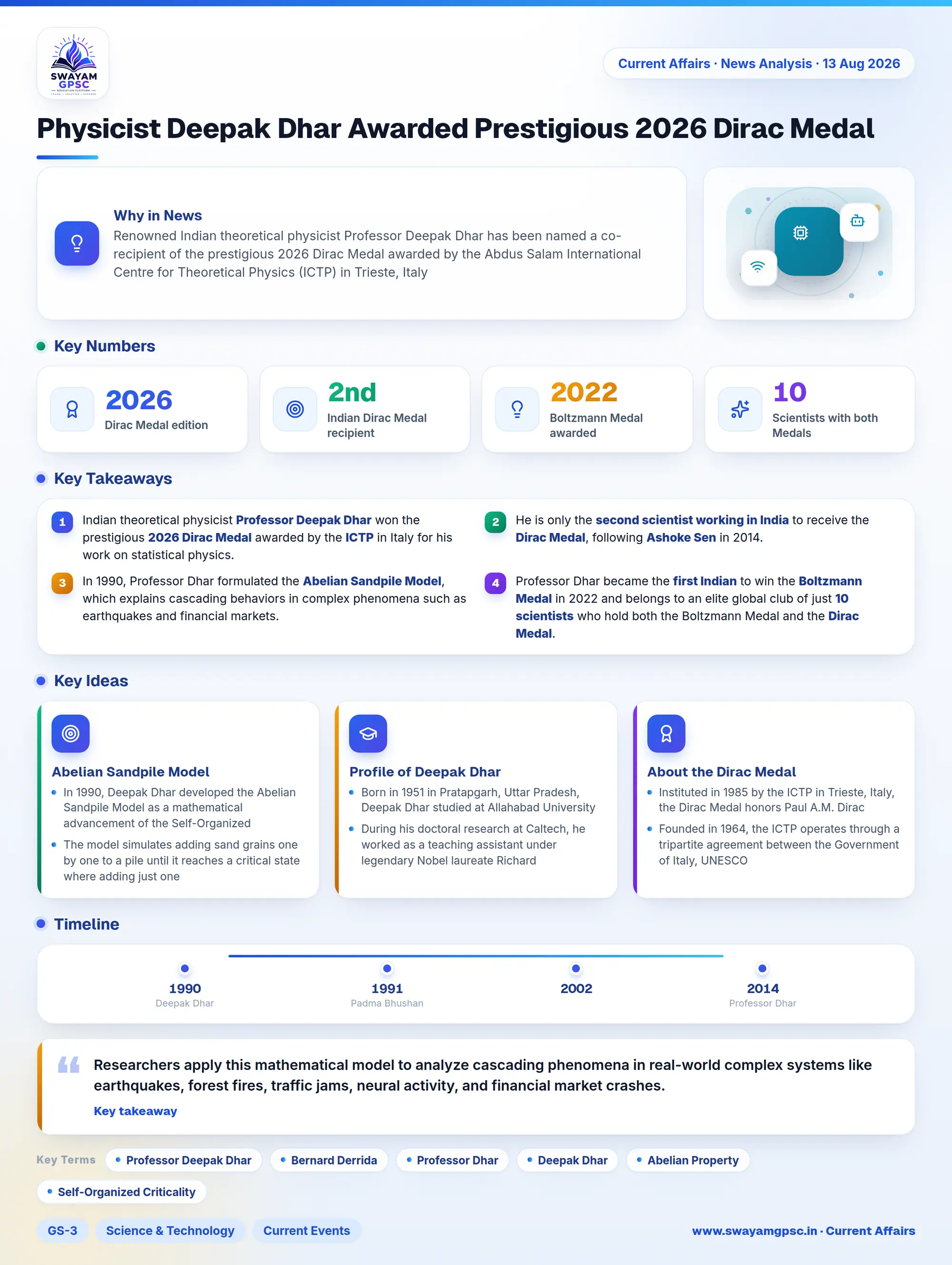
- Indian theoretical physicist Professor Deepak Dhar won the prestigious 2026 Dirac Medal awarded by the ICTP in Italy for his work on statistical physics.
- He is only the second scientist working in India to receive the Dirac Medal, following Ashoke Sen in 2014.
- In 1990, Professor Dhar formulated the Abelian Sandpile Model, which explains cascading behaviors in complex phenomena such as earthquakes and financial markets.
- Professor Dhar became the first Indian to win the Boltzmann Medal in 2022 and belongs to an elite global club of just 10 scientists who hold both the Boltzmann Medal and the Dirac Medal.
Why in News
- Renowned Indian theoretical physicist Professor Deepak Dhar has been named a co-recipient of the prestigious 2026 Dirac Medal awarded by the Abdus Salam International Centre for Theoretical Physics (ICTP) in Trieste, Italy, for his pioneering work in statistical physics and the Abelian sandpile model.
- He shares this global honor with three other physicists, namely Bernard Derrida, Marc Mézard, and Haim Sompolinsky, for their major contributions to non-equilibrium systems.
- With this recognition, Professor Dhar becomes only the second scientist working in India to receive the Dirac Medal, following Ashoke Sen in 2014.
Abelian Sandpile Model
- In 1990, Deepak Dhar developed the Abelian Sandpile Model as a mathematical advancement of the Self-Organized Criticality concept proposed in 1987 by Per Bak, Chao Tang, and Kurt Wiesenfeld.
- The model simulates adding sand grains one by one to a pile until it reaches a critical state where adding just one more grain triggers an avalanche.
- Under the Abelian Property, Dhar proved that the final stable state of the sandpile remains identical regardless of the sequence in which individual grains topple.
- Through Self-Organized Criticality, the model illustrates how complex systems naturally evolve toward a critical state where a tiny disturbance can trigger major cascading events.
- Researchers apply this mathematical model to analyze cascading phenomena in real-world complex systems like earthquakes, forest fires, traffic jams, neural activity, and financial market crashes.
Profile of Deepak Dhar
- Born in 1951 in Pratapgarh, Uttar Pradesh, Deepak Dhar studied at Allahabad University, completed his master's degree at IIT Kanpur, and earned his Ph.D. from Caltech in 1978.
- During his doctoral research at Caltech, he worked as a teaching assistant under legendary Nobel laureate Richard Feynman.
- In 2022, he became the first Indian to receive the Boltzmann Medal, the highest international award in statistical physics, sharing it with John Hopfield.
- He is among an elite group of only 10 scientists worldwide who have earned both the Boltzmann Medal and the Dirac Medal.
- His civilian and scientific accolades include the Padma Bhushan in 2023, the Shanti Swarup Bhatnagar Prize in 1991, and The World Academy of Sciences (TWAS) Prize in 2002.
About the Dirac Medal
- Instituted in 1985 by the ICTP in Trieste, Italy, the Dirac Medal honors Paul A.M. Dirac, a twentieth-century Nobel laureate who made foundational contributions to quantum mechanics.
- Founded in 1964, the ICTP operates through a tripartite agreement between the Government of Italy, UNESCO, and the IAEA, functioning as a UNESCO Category 1 Institute.
- The committee announces the recipient every year on 8th August, which marks the birthday of Paul Dirac, to recognize outstanding work in theoretical physics.
- By custom, the Dirac Medal is not awarded to individuals who have already received the Nobel Prize, Fields Medal, or Wolf Prize.
- Pakistani Nobel laureate Abdus Salam established the ICTP in 1964 to foster scientific collaboration between researchers from the Global South and the wider world.