Persistence of Stubble Burning in North India
#GS-3 #Economy #Agriculture #Environment #Environmental Pollution & Degradation #Conservation #Environmental Impact Assessment (EIA) #Infrastructure #Sustainable Development #Climate Change
Key takeaways
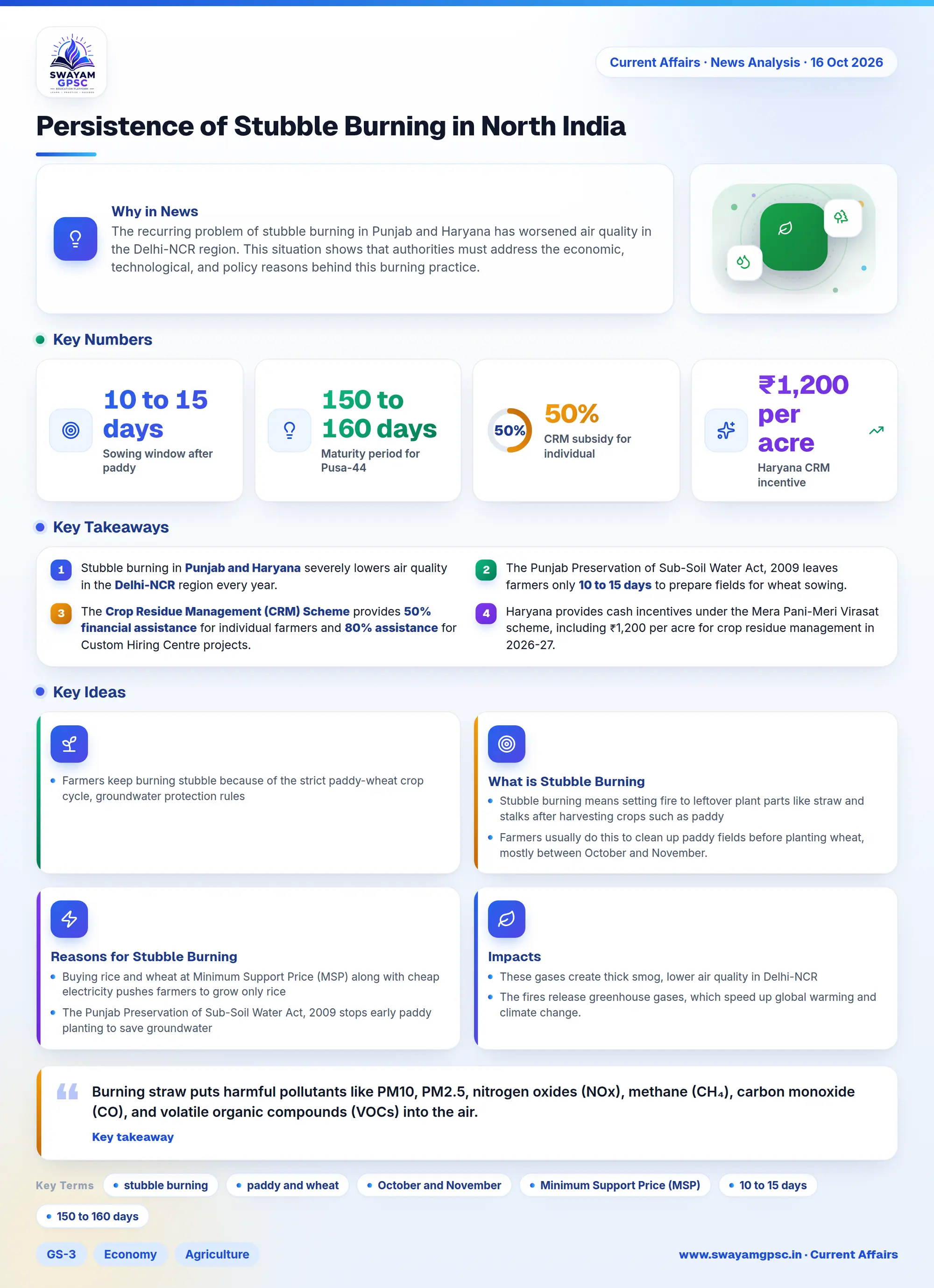
- Stubble burning in Punjab and Haryana severely lowers air quality in the Delhi-NCR region every year.
- The Punjab Preservation of Sub-Soil Water Act, 2009 leaves farmers only 10 to 15 days to prepare fields for wheat sowing.
- The Crop Residue Management (CRM) Scheme provides 50% financial assistance for individual farmers and 80% assistance for Custom Hiring Centre projects.
- Haryana provides cash incentives under the Mera Pani-Meri Virasat scheme, including ₹1,200 per acre for crop residue management in 2026-27.
- The Pusa Decomposer microbial spray breaks down field stubble naturally within 20 to 25 days without requiring open fires.
Why in News
- The recurring problem of stubble burning in Punjab and Haryana has worsened air quality in the Delhi-NCR region.
- This situation shows that authorities must address the economic, technological, and policy reasons behind this burning practice.
Summary
- Farmers keep burning stubble because of the strict paddy-wheat crop cycle, groundwater protection rules, guaranteed crop buying, and high costs of other residue-handling methods.
- Stopping this practice for good needs crop diversification, better money rewards for using straw, cheap technology, and better satellite tracking instead of just giving heavy fines.
What is Stubble Burning
- Stubble burning means setting fire to leftover plant parts like straw and stalks after harvesting crops such as paddy and wheat.
- Farmers usually do this to clean up paddy fields before planting wheat, mostly between October and November.
- This practice is very common in Punjab, Haryana, and parts of Uttar Pradesh.
Reasons for Stubble Burning
- Buying rice and wheat at Minimum Support Price (MSP) along with cheap electricity pushes farmers to grow only rice and wheat instead of trying different crops.
- The Punjab Preservation of Sub-Soil Water Act, 2009 stops early paddy planting to save groundwater, which pushes the harvest season to late October and early November.
- Because of this law, farmers get only a short window of 10 to 15 days before they must plant wheat.
- Long-duration rice types like PUSA-44 take about 150 to 160 days to grow, which puts even more time pressure on farmers.
- Using combine harvesters leaves behind a lot of straw and stalks, making field cleanup expensive and pushing farmers toward burning.
- Burning fields is much cheaper and faster than mixing stubble into the soil or buying heavy machines like balers and shredders.
- Fire also temporarily kills surface weeds, weed seeds, and some pests, even though it is not a good long-term solution.
- Many farmers lack access to cheap machinery, storage space, and other uses like composting and bioenergy production.
Impacts
- Burning straw puts harmful pollutants like PM10, PM2.5, nitrogen oxides (NOx), methane (CH₄), carbon monoxide (CO), and volatile organic compounds (VOCs) into the air.
- These gases create thick smog, lower air quality in Delhi-NCR, and cause breathing problems like asthma and Chronic Obstructive Pulmonary Disease (COPD).
- The fires release greenhouse gases, which speed up global warming and climate change.
- Fire destroys important soil nutrients like nitrogen and sulphur, kills helpful soil germs, and lowers overall soil quality.
- The extreme heat dries out the topsoil, forcing farmers to use more chemical fertilizers later.
Challenges in Controlling Stubble Burning
- Combine harvesters leave behind stubborn straw, which needs special Crop Residue Management (CRM) machinery for quick field work.
- Custom Hiring Centres (CHCs) often run out of machines or delay deliveries during the busy harvest season.
- Rice straw contains a lot of silica, which makes industrial processing difficult, while poor storage and transport networks limit its commercial use.
- Even with government help, high machine prices and costly rental rates make clearing stubble too expensive for small farmers.
- There is no guaranteed purchase price for paddy straw, meaning farmers cannot easily sell it to power plants or factories.
- Assured crop buying under MSP stops farmers from growing other crops, keeping the rice-wheat cycle alive.
- Confusing rules, strict penalties without enough financial help, and different state incentives make it hard to stop stubble burning.
- Satellites like MODIS and VIIRS only pass over at certain times, so they often miss fires that happen during other hours.
- Because of these monitoring gaps, official fire count drops may not match the actual amount of land burned.
- Small farmers often lack proper training and technical advice on how to manage crop residue both on and off their fields.
India's Initiatives to Tackle Stubble Burning
- The Commission for Air Quality Management (CAQM) promotes in-field residue management using Crop Residue Management (CRM) machinery, Custom Hiring Centres (CHCs), and biological decomposers.
- Authorities encourage off-field straw use for biomass power generation, co-firing in power plants, second-generation (2G) ethanol, compressed biogas (CBG), and packaging.
- The government bans burning through satellite checks, field visits, and environmental fines for rule breakers.
- The Crop Residue Management (CRM) Scheme has given 50% financial assistance to individual farmers and 80% assistance for Custom Hiring Centre projects since 2018-19.
- The Happy Seeder machine lets farmers plant wheat right through paddy straw without burning the field.
- The Pusa Decomposer is a natural spray that speeds up how fast straw rots into healthy soil organic matter.
- Machines convert crop waste into biomass pellets for clean energy and create extra income for farmers.
- Pyrolysis turns crop residue into biochar, which helps the soil hold water and store carbon.
- The government promotes short-duration rice types, Direct Seeding of Rice (DSR), and alternative crops to cut down on total waste.
- Haryana gives cash rewards under the Mera Pani-Meri Virasat scheme, offering ₹1,200 per acre for crop residue management, ₹4,500 per acre for DSR, and ₹8,000 per acre for alternative crops in 2026-27.
- Punjab uses mobile tools like i-Khet and Cooperative Machinery Tracker to help farmers find machinery easily.
- Chhattisgarh uses Gauthans to collect crop waste and cow dung to make organic fertilizer.
- Combining polar-orbiting satellites like MODIS and VIIRS with geostationary satellite views helps track fires much better throughout the day.
Strategies India Can Adopt
- A Parliamentary Committee suggested setting a minimum remunerative price for paddy straw so farmers can cover collection and transport costs.
- The government should mix financial rewards and farmer education with fair enforcement rather than relying only on heavy fines.
- Policy makers need to reform MSP rules to help farmers move away from water-heavy rice to pulses, oilseeds, and millets.
- Promoting short-duration rice and Direct Seeding of Rice (DSR) will widen the narrow window between harvesting and planting.
- Authorities should build real-time crop maps, local collection centers, and better transport networks to handle straw efficiently.
- Strengthening Custom Hiring Centres (CHCs) will give farmers cheap and timely access to residue machinery.
- Promoting the Pusa Decomposer breaks down stubble in 20 to 25 days, while machines like Happy Seeders and Super Seeders make burning unnecessary.
- Creating steady markets and fair prices for crop waste ensures farmers get back their labor and transport costs.
- Using labor support similar to MGNREGA, farmer groups, and village collection points will make residue gathering much easier.
- Pairing MODIS and VIIRS satellites with geostationary views will give an accurate picture of actual burned areas.
Conclusion
- Stopping stubble burning needs a complete plan that includes crop diversification, affordable machines, fair cash rewards, and strict rules.
- By improving farmer support, building waste markets, and using better satellites, India can turn crop waste into a useful economic resource for sustainable farming.