Per Drop More Crop: Expanding Micro-Irrigation Coverage in India
#GS-2 #GS-3 #Governance & Social Justice #Economy #Environment #Agriculture #Infrastructure #Sustainable Development #Current Events #National
Key takeaways
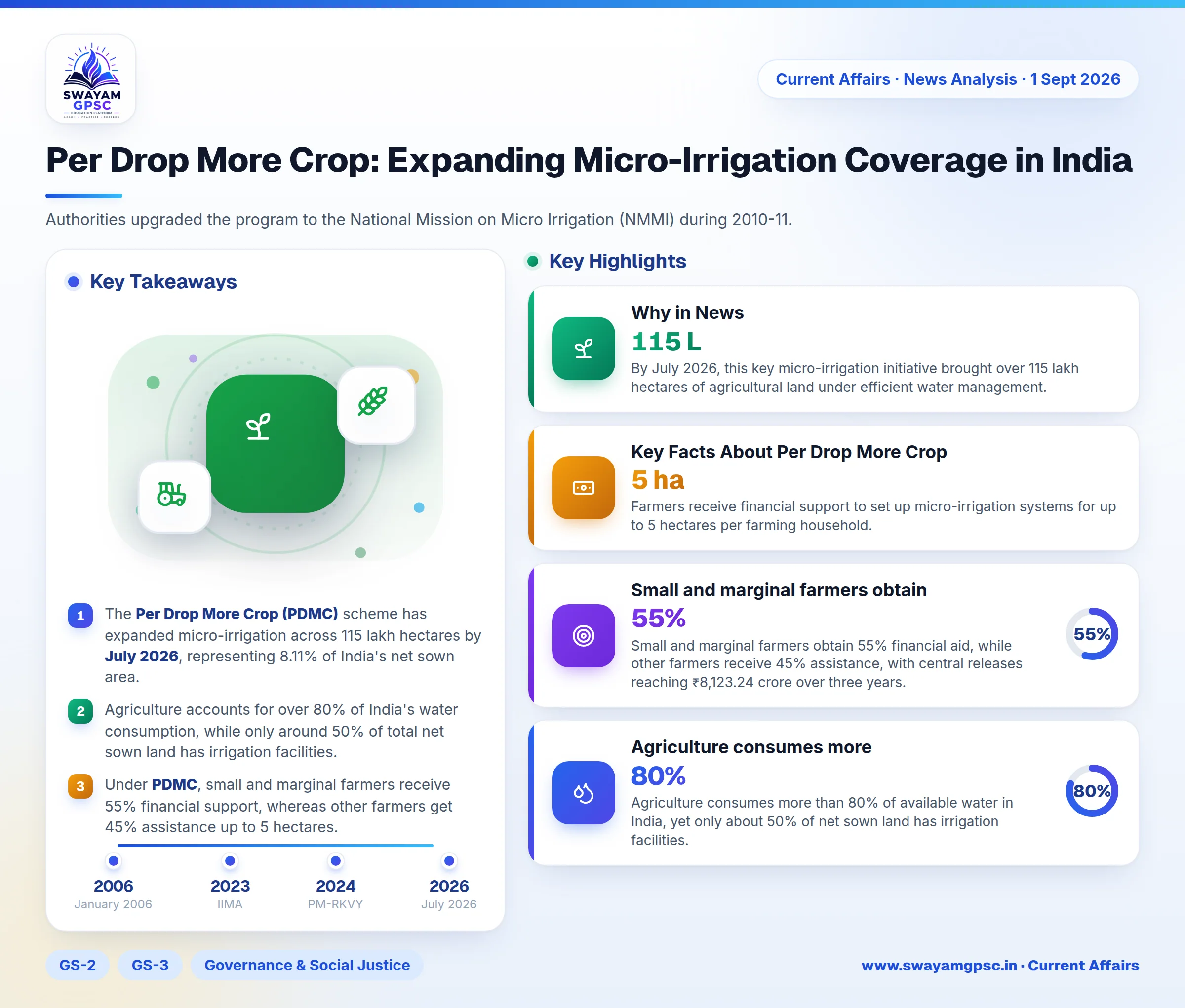
- The Per Drop More Crop (PDMC) scheme has expanded micro-irrigation across 115 lakh hectares by July 2026, representing 8.11% of India's net sown area.
- Agriculture accounts for over 80% of India's water consumption, while only around 50% of total net sown land has irrigation facilities.
- Under PDMC, small and marginal farmers receive 55% financial support, whereas other farmers get 45% assistance up to 5 hectares.
- During 2025-26, central releases under PM-RKVY reached ₹8,957.72 crore, with ₹3,226.36 crore allocated specifically for PDMC.
- According to the Economic Survey 2020-21, adopting micro-irrigation generates water savings of 20% to 48% and increases crop yields by 20% to 38%.
Why in News
- The central government recently highlighted the significant progress made under the Per Drop More Crop (PDMC) scheme.
- By July 2026, this key micro-irrigation initiative brought over 115 lakh hectares of agricultural land under efficient water management.
Key Facts About Per Drop More Crop
- The Per Drop More Crop (PDMC) scheme boosts farm water efficiency by encouraging drip and sprinkler irrigation practices.
- This government initiative started in January 2006 as the Centrally Sponsored Scheme for Micro Irrigation.
- Authorities upgraded the program to the National Mission on Micro Irrigation (NMMI) during 2010-11.
- In 2014-15, the program was integrated into the National Mission on Sustainable Agriculture (NMSA) under the On Farm Water Management (OFWM) component.
- Between 2015-16 and 2021-22, the government implemented it as PDMC under the Pradhan Mantri Krishi Sinchayee Yojana (PMKSY).
- Since 2022-23, PDMC functions under the umbrella of the Pradhan Mantri Rashtriya Krishi Vikas Yojana (PM-RKVY).
- Farmers receive financial support to set up micro-irrigation systems for up to 5 hectares per farming household.
- Small and marginal farmers obtain 55% financial aid, while other farmers receive 45% assistance, with central releases reaching ₹8,123.24 crore over three years.
- Agriculture consumes more than 80% of available water in India, yet only about 50% of net sown land has irrigation facilities.
- PDMC directly targets this gap by preventing water waste and improving crop output across farmlands.
Progress in Scaling Micro-Irrigation Across India
- The scheme expanded coverage across 115 lakh hectares, representing 8.11% of the net sown area in India.
- During 2025-26, states like Maharashtra, Karnataka, Andhra Pradesh, Tamil Nadu, Gujarat, and Rajasthan covered the largest areas under PDMC.
- The scheme benefited around 12.30 lakh farmers in that period, with women making up nearly 20% of the total beneficiaries.
- New operational guidelines allow states to construct micro-level water storage tanks and farm ponds, known as diggis, under the Other Interventions component.
- States can now spend beyond earlier limits of 20% for general states and 40% for Himalayan or North-Eastern regions based on local needs.
Pradhan Mantri Rashtriya Krishi Vikas Yojana (PM-RKVY)
- First launched in 2007-08, the initiative was restructured into PM-RKVY in October 2024 by merging nine distinct agricultural schemes.
- State governments gain flexibility under PM-RKVY to reallocate funds between components according to local agricultural priorities.
- In 2025-26, the center released ₹8,957.72 crore under PM-RKVY, allocating ₹3,226.36 crore directly for PDMC activities.
Drip Irrigation System Under PDMC
- Drip irrigation releases water slowly near crop root zones through lateral tubes, cutting evaporation losses.
- On-line drip systems feature individual drippers mounted on pipes, making them ideal for crops with wide or irregular spacing.
- In-line drip systems contain built-in emitters spaced at regular intervals, supplying water evenly to systematically planted crops.
Sprinkler Irrigation System Under PDMC
- Sprinkler irrigation sprays pressurized water through nozzles, imitating natural rainfall for high-density crops, pulses, and oilseeds.
- Portable sprinklers use movable pipes so farmers can relocate equipment across flat or uneven fields easily.
- Micro sprinklers discharge water across a short radius, protecting delicate leafy vegetables and maintaining micro-climate moisture.
- Mini sprinklers supply water to closely spaced crops like groundnuts or onions while safeguarding crops against cold frost damage.
- Semi-permanent sprinklers feature buried underground main pipes, allowing farmers to shift vertical riser nozzles as needed.
- Rain-guns act as high-pressure sprinklers that discharge 10,000 to 32,000 litres of water per hour across expansive fields quickly.
Focus Areas of PDMC
- The policy focuses on precise water application to increase crop productivity while conserving finite water resources.
- It promotes fertigation, delivering soluble fertilizers through irrigation pipes directly to roots for enhanced nutrient absorption.
- Priority goes to water-stressed and over-exploited groundwater zones across drought-prone agricultural districts.
- The scheme links micro-irrigation setups with tube wells, river-lift installations, and solar-powered pumping systems.
- PDMC combines modern irrigation technologies with other government schemes to deliver maximum water efficiency.
Implementation Framework of PDMC
- At the national level, the National Stewardship Council (NSC) guides strategic planning and operational direction under PM-RKVY.
- State-level implementation relies on the State Level Sanctioning Committee (SLSC) for plan approvals and the Inter-Departmental Working Group (IDWG) for coordination.
- The District Level Implementation Committee (DLIC) supervises ground-level execution and coordinates actions among local offices.
Impact Assessment of PDMC
- A NITI Aayog evaluation for 2020-21 indicated that PDMC raised farmer incomes by 10% to 69% and improved water efficiency by 30% to 70%.
- The Economic Survey 2020-21 reported water savings of 20% to 48%, energy savings of 10% to 17%, and fertilizer savings of 11% to 19%.
- Adopting micro-irrigation practices increased crop yields by 20% to 38%, lifting overall farm profitability.
- A 2023 study by IIMA across six states confirmed that farmers adopt micro-irrigation to combat groundwater decline and secure stable yields.
Conclusion
- The Per Drop More Crop scheme drives a transformation from traditional flood irrigation toward high-efficiency precision farming.
- Covering over 115 lakh hectares, PDMC serves as a vital tool for ensuring long-term water security and improving farm livelihoods across India.