The Payment and Settlement Systems Act, 2007 and UPI Amendment
#GS-2 #GS-3 #Governance & Social Justice #Regulatory Bodies #Economy #Banking #National #UPI #PSS Act 2007
Key takeaways
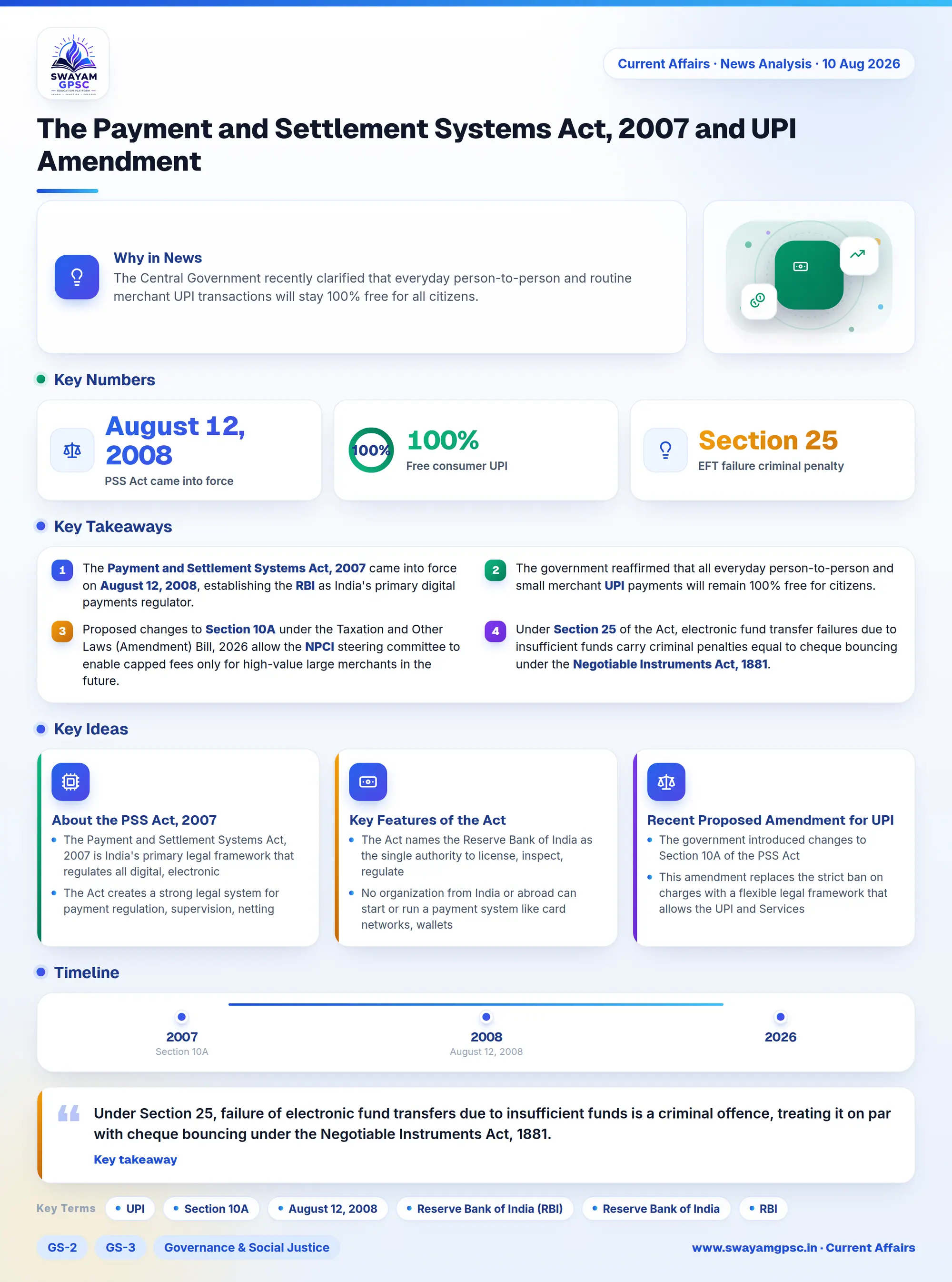
- The Payment and Settlement Systems Act, 2007 came into force on August 12, 2008, establishing the RBI as India's primary digital payments regulator.
- The government reaffirmed that all everyday person-to-person and small merchant UPI payments will remain 100% free for citizens.
- Proposed changes to Section 10A under the Taxation and Other Laws (Amendment) Bill, 2026 allow the NPCI steering committee to enable capped fees only for high-value large merchants in the future.
- Under Section 25 of the Act, electronic fund transfer failures due to insufficient funds carry criminal penalties equal to cheque bouncing under the Negotiable Instruments Act, 1881.
Why in News
- The Central Government recently clarified that everyday person-to-person and routine merchant UPI transactions will stay 100% free for all citizens.
- This statement addresses public worries about proposed changes to Section 10A of the Payment and Settlement Systems Act, 2007 through the Taxation and Other Laws (Amendment) Bill, 2026.
About the PSS Act, 2007
- The Payment and Settlement Systems Act, 2007 is India's primary legal framework that regulates all digital, electronic, and traditional payment systems. Passed in December 2007, it officially came into effect on August 12, 2008.
- The Act creates a strong legal system for payment regulation, supervision, netting, and final settlements while making the Reserve Bank of India (RBI), with help from the Payments Regulatory Board (PRB), the main statutory supervisor.
Key Features of the Act
- The Act names the Reserve Bank of India as the single authority to license, inspect, regulate, and direct all payment system operators across India.
- No organization from India or abroad can start or run a payment system like card networks, wallets, or fund transfers without getting written authorization from the RBI.
- It gives legal backing to netting and settlement finality, meaning financial settlements become final and cannot be cancelled even if a participant goes bankrupt.
- Under Section 25, failure of electronic fund transfers due to insufficient funds is a criminal offence, treating it on par with cheque bouncing under the Negotiable Instruments Act, 1881.
- The law gives the RBI wide powers to set technical standards, inspect computer systems, request operational reports, and conduct on-site audits in India or abroad.
- It provides a formal system to resolve disputes between payment participants, between providers and users, or issues involving the RBI itself.
Recent Proposed Amendment for UPI (2026)
- The government introduced changes to Section 10A of the PSS Act, 2007 through the Taxation and Other Laws (Amendment) Bill, 2026.
- This amendment replaces the strict ban on charges with a flexible legal framework that allows the UPI and Services Steering Committee, led by the National Payments Corporation of India (NPCI), to set small, threshold-based Merchant Discount Rate (MDR) fees if needed in the future.
- Everyday user transactions and routine merchant payments will remain 100% free without any extra cost for ordinary citizens.
- Any future MDR fee will apply only to specific large-merchant transactions above a high threshold, and these fees will stay much lower than regular credit or debit card charges.