Parliamentary Panel Urges Increased Spending on Education
#GS-2 #GS-3 #Governance & Social Justice #Education #Economy #Human Capital
Key takeaways
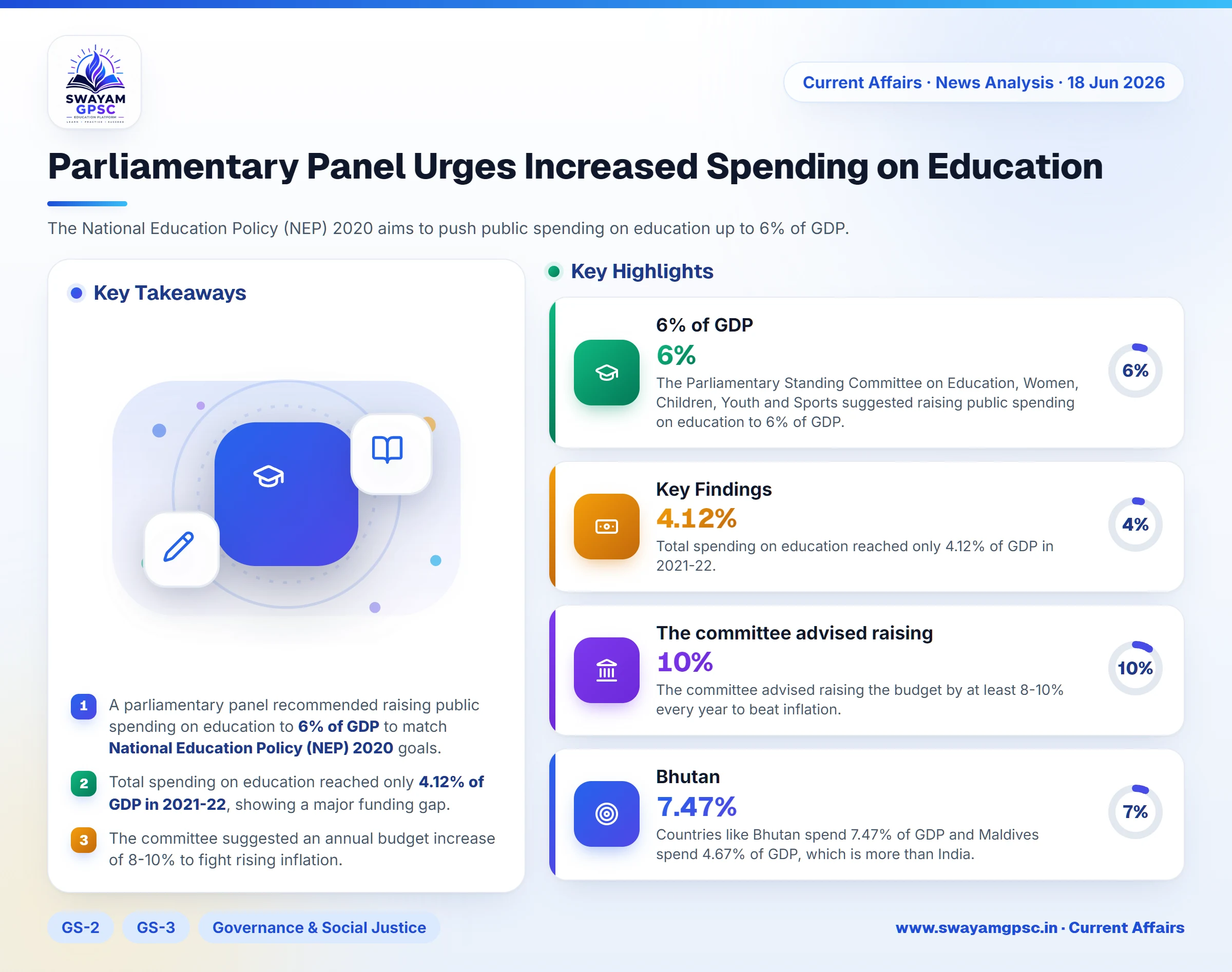
- A parliamentary panel recommended raising public spending on education to 6% of GDP to match National Education Policy (NEP) 2020 goals.
- Total spending on education reached only 4.12% of GDP in 2021-22, showing a major funding gap.
- The committee suggested an annual budget increase of 8-10% to fight rising inflation.
- Countries like Bhutan spend 7.47% of GDP and Maldives spend 4.67% of GDP on education, which is higher than India.
Context and Background
- The Parliamentary Standing Committee on Education, Women, Children, Youth and Sports suggested raising public spending on education to 6% of GDP.
- This recommendation follows the core goals set by the National Education Policy (NEP) 2020.
About the Report
- The Parliamentary Standing Committee on Education, Women, Children, Youth and Sports shared this view in its 381st Action Taken Report focusing on higher education grants for 2025-26.
- The committee checked the funds given to the Department of Higher Education and tracked progress under the National Education Policy (NEP) 2020.
Key Findings
- The National Education Policy (NEP) 2020 aims to push public spending on education up to 6% of GDP.
- Total spending on education reached only 4.12% of GDP in 2021-22.
- The Budget Estimates for Higher Education in 2025-26 saw a smaller jump than the year before.
- The committee advised raising the budget by at least 8-10% every year to beat inflation.
- The Gross Enrolment Ratio for both male and female students grew very slowly between 2018-2023.
- India needs more money to meet the GER goals of the National Education Policy (NEP) 2020 by 2035.
- Countries like Bhutan spend 7.47% of GDP and Maldives spend 4.67% of GDP, which is more than India.
- This comparison shows that India must invest more public money in its education system.
Significance
- Spending more money on education leads to better learning, stronger research, fresh ideas, and higher worker output.
- Good funding helps schools and colleges reach goals for GER, multi-subject learning, digital tools, and internal reforms.
- Investing in education builds better job skills and makes the country more competitive for long-term economic growth.