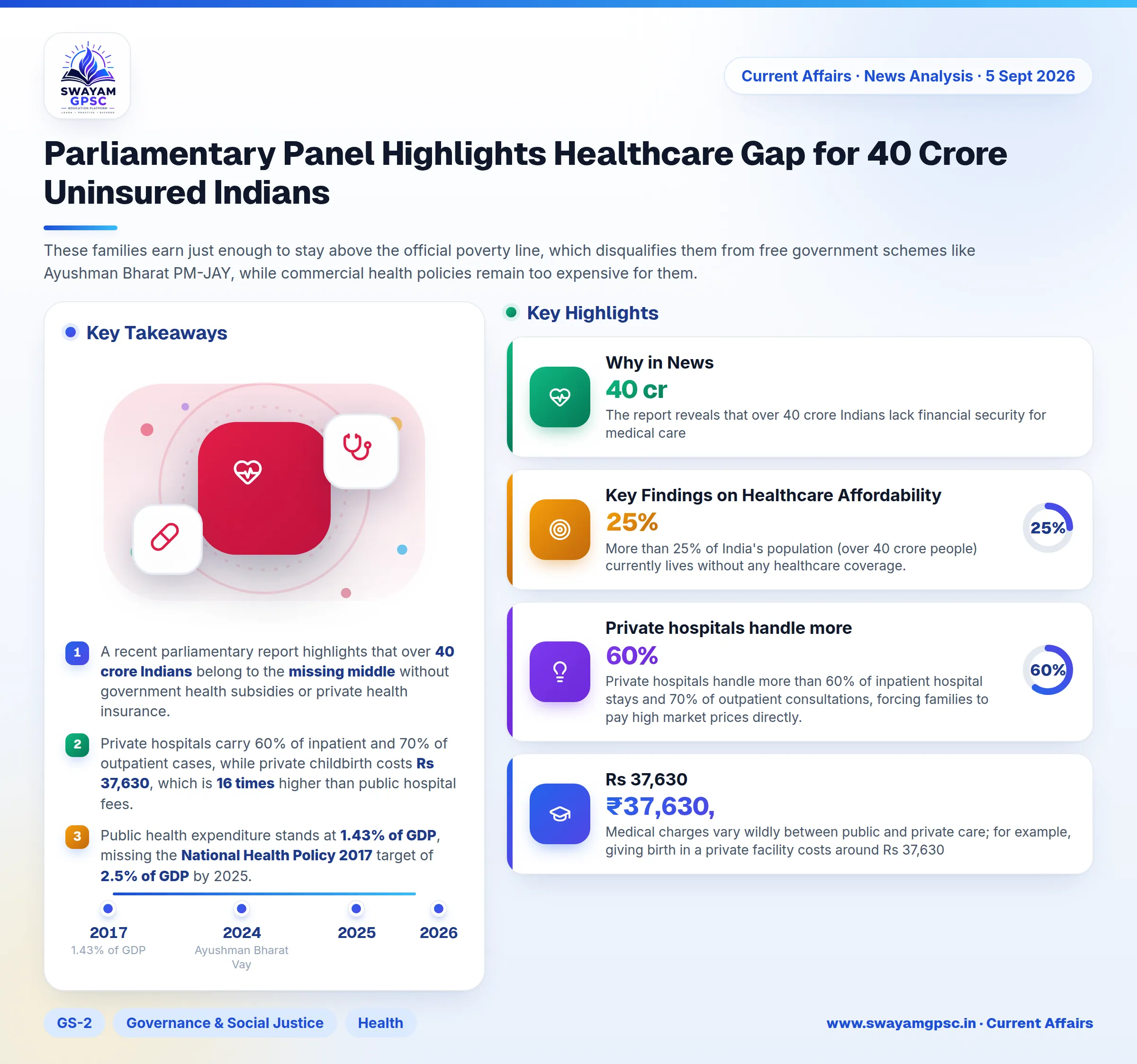
Parliamentary Panel Highlights Healthcare Gap for 40 Crore Uninsured Indians
#GS-2 #Governance & Social Justice #Health #Poverty #Current Events #National #Government Policies & Interventions
Key takeaways
- A recent parliamentary report highlights that over 40 crore Indians belong to the missing middle without government health subsidies or private health insurance.
- Private hospitals carry 60% of inpatient and 70% of outpatient cases, while private childbirth costs Rs 37,630, which is 16 times higher than public hospital fees.
- Public health expenditure stands at 1.43% of GDP, missing the National Health Policy 2017 target of 2.5% of GDP by 2025.
- The panel urges enforcement of the Clinical Establishments Act 2010 and full support for generic medicines to curb high health spending.
Why in News
- The Parliamentary Standing Committee on Health and Family Welfare recently submitted its report titled Affordability and Accessibility of Healthcare Facilities in Public and Private Sector to Parliament.
- The report reveals that over 40 crore Indians lack financial security for medical care, forming a vulnerable group known as the missing middle that gets no help from government subsidies or private health insurance.
Key Findings on Healthcare Affordability
- More than 25% of India's population (over 40 crore people) currently lives without any healthcare coverage.
- These families earn just enough to stay above the official poverty line, which disqualifies them from free government schemes like Ayushman Bharat PM-JAY, while commercial health policies remain too expensive for them.
- Private hospitals handle more than 60% of inpatient hospital stays and 70% of outpatient consultations, forcing families to pay high market prices directly.
- The central risk for these households stems from daily outpatient expenses like medicines and diagnostic tests that gradually drain their earnings, rather than just one rare hospital stay.
- Long term health issues such as diabetes, high blood pressure, and heart disease are rising fast, making regular doctor visits and lifelong medicines a constant expense.
- Medical charges vary wildly between public and private care; for example, giving birth in a private facility costs around Rs 37,630, which is 16 times higher than the Rs 2,299 charged in public hospitals.
- Buying medicines accounts for nearly 30% of all medical spending in India, aggravated by high retail markup fees and pharmacies selling antibiotics without doctor prescriptions.
- Public spending on healthcare remains low at 1.43% of GDP, missing the goal set in the National Health Policy 2017 to reach 2.5% of GDP by 2025.
- Health funding dropped from 6.12% of total government spending in 2021-22 to 4.89% in 2022-23, falling below pre-pandemic levels of 5.02% recorded in 2019-20.
- Private health insurance policies rarely solve this problem because they require high yearly payments, impose long waiting periods, exclude common diseases, and focus only on hospital admissions rather than daily clinic visits.
Universal Health Coverage
- The core objective of Universal Health Coverage (UHC) is to provide every citizen with quality healthcare services without subjecting them to heavy financial strain.
- The government uses Ayushman Bharat PM-JAY to provide free hospital treatment for the poorest 40% of the population.
- Under the Ayushman Bharat Vay Vandana expansion of 2024, all senior citizens aged 70 and above get free coverage regardless of family income, driving total Ayushman Cards past 45.5 crore by August 2026.
- India supports public health through core initiatives including Ayushman Vaya Vandana, Employees State Insurance Scheme (ESIS), Central Government Health Scheme (CGHS), National Health Mission, and PM-Bharatiya Janaushadhi Pariyojana.
Key Recommendations
- The parliamentary panel recommended expanding government hospital capacity directly instead of spending public funds on private insurance plans, while also setting price limits for private hospital treatments.
- Doctors should write prescriptions using generic drug names, and public clinics must stock all items on the essential drug list to give patients low cost choices.
- The report called for strict inspections to stop excessive profit margins on drug sales and halt non-prescription sales of antibiotics.
- State governments should set up a separate public health management cadre so that expert doctors can treat patients instead of spending time on office paperwork.
- Authorities must enforce the Clinical Establishments Act 2010 across all states to guarantee clear treatment rules, proper care standards, and mandatory price displays in private hospitals.
- Government schemes must expand financial relief to cover daily outpatient consultations, blood tests, and routine medicines so that everyday health costs do not push families into debt.
Way Forward
- True health protection requires far more than basic hospital insurance for major surgeries.
- Fixing standard rates through the Clinical Establishments Act 2010 and expanding local primary health centers are essential steps to keep middle class families from falling into poverty due to medical bills.
Frequently Asked Questions
- The missing middle refers to middle income citizens who earn too much to receive government welfare health benefits, but cannot afford expensive private medical insurance.
- Insurance models fail to protect most families because they cover only major hospital stays, leaving daily doctor fees, blood tests, and routine pharmacy bills unpaid.
- The Clinical Establishments Act 2010 regulates private and public health centers by setting standard care guidelines, quality rules, and mandatory price disclosure.
- Promoting generic medicines reduces overall patient spending on prescription drugs and improves access to essential medicines for everyone.
- India can achieve strong health coverage by building government hospitals, funding daily outpatient treatment, capping drug prices, and regulating private clinic charges.