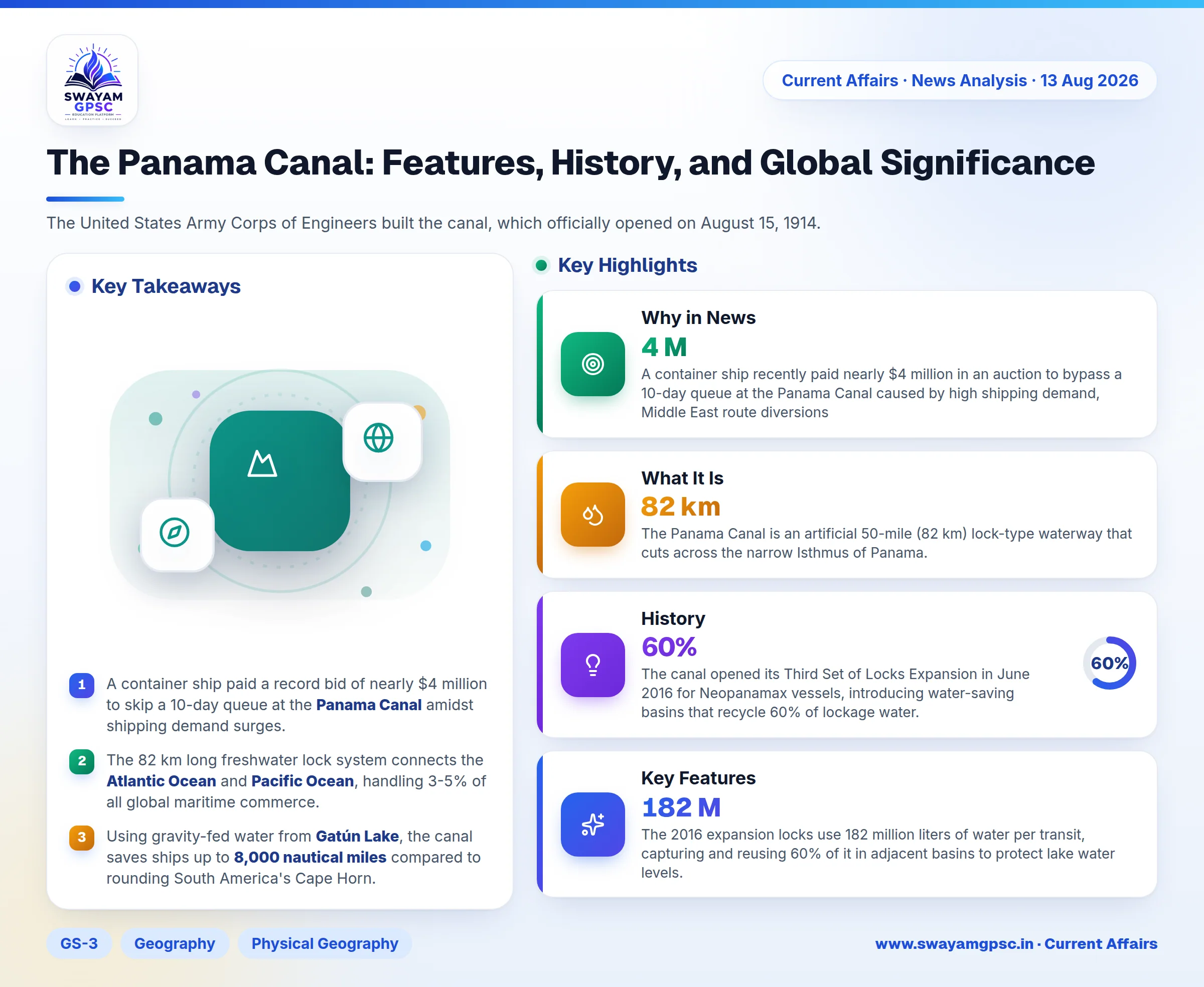
The Panama Canal: Features, History, and Global Significance
#GS-3 #Geography #Physical Geography #Resources #Industries #GS-2 #Current Events #International #Trade #Maritime Infrastructure
Key takeaways
- A container ship paid a record bid of nearly $4 million to skip a 10-day queue at the Panama Canal amidst shipping demand surges.
- The 82 km long freshwater lock system connects the Atlantic Ocean and Pacific Ocean, handling 3-5% of all global maritime commerce.
- Using gravity-fed water from Gatún Lake, the canal saves ships up to 8,000 nautical miles compared to rounding South America's Cape Horn.
- Administered solely by the Panama Canal Authority (ACP), its 2016 Neopanamax expansion recycles 60% of lockage water to reduce drought impact.
Why in News
- A container ship recently paid nearly $4 million in an auction to bypass a 10-day queue at the Panama Canal caused by high shipping demand, Middle East route diversions, and drought-related restrictions.
What It Is
- The Panama Canal is an artificial 50-mile (82 km) lock-type waterway that cuts across the narrow Isthmus of Panama. It connects the Atlantic Ocean through the Caribbean Sea with the Pacific Ocean, serving as a vital global maritime choke point.
- Ships use this canal to move goods directly between the two major oceans without sailing all the way around South America.
Location and Governance
- The canal is located at 9° N latitude in Central America across the Isthmus of Panama, connecting Colón on the Atlantic side to Balboa and Panama City on the Pacific side.
- The Panama Canal Authority (ACP), an autonomous agency of the Government of Panama, solely owns, operates, and administers the canal.
History
- The United States Army Corps of Engineers built the canal, which officially opened on August 15, 1914.
- The Panama Canal Commission jointly administered the waterway from 1979 until Panama gained full control on December 31, 1999.
- The canal opened its Third Set of Locks Expansion in June 2016 for Neopanamax vessels, introducing water-saving basins that recycle 60% of lockage water.
Key Features
- The canal uses a gravity-fed freshwater lock system that operates without pumps, relying on natural water flow from artificial lakes like Gatún Lake and Alajuela Lake fed by the Chagres River.
- It uses step-locks including Gatún, Pedro Miguel, and Miraflores to lift vessels 85 feet (26 meters) above sea level across the Continental Divide through the Gaillard Cut.
- Electric towing locomotives called Mules run on tracks along the lock walls to guide ships safely and keep them centered in the original chambers.
- The 2016 expansion locks use 182 million liters of water per transit, capturing and reusing 60% of it in adjacent basins to protect lake water levels.
- While standard transits use pre-booked slots, the ACP conducts daily auctions where unreserved ships can bid high premiums to skip long waiting lines.
Global Significance
- Sailing through the canal avoids the long route around Cape Horn, saving ships up to 8,000 nautical miles and several weeks of travel time.
- The canal handles around 3-5% of global maritime trade, including energy products, agricultural goods, and manufactured items.