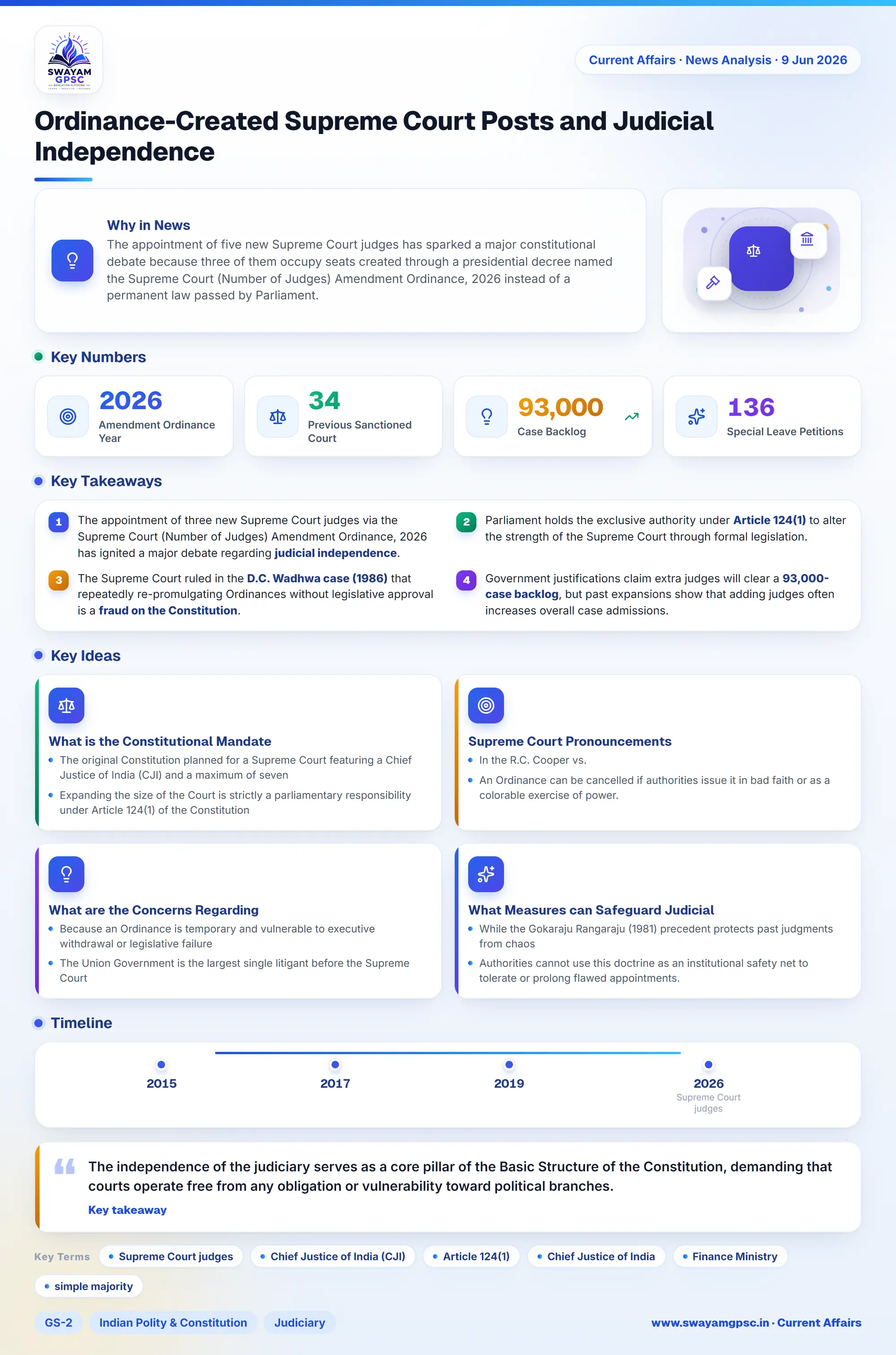
Ordinance-Created Supreme Court Posts and Judicial Independence
#GS-2 #Indian Polity & Constitution #Judiciary #Indian Constitution
Key takeaways
- The appointment of three new Supreme Court judges via the Supreme Court (Number of Judges) Amendment Ordinance, 2026 has ignited a major debate regarding judicial independence.
- Parliament holds the exclusive authority under Article 124(1) to alter the strength of the Supreme Court through formal legislation.
- The Supreme Court ruled in the D.C. Wadhwa case (1986) that repeatedly re-promulgating Ordinances without legislative approval is a fraud on the Constitution.
- Government justifications claim extra judges will clear a 93,000-case backlog, but past expansions show that adding judges often increases overall case admissions.
Why in News
- The appointment of five new Supreme Court judges has sparked a major constitutional debate because three of them occupy seats created through a presidential decree named the Supreme Court (Number of Judges) Amendment Ordinance, 2026 instead of a permanent law passed by Parliament.
- This situation has created worries about how using an Ordinance to create judicial positions affects judicial independence, security of tenure, and the separation of powers.
What is the Constitutional Mandate for Altering the Strength of the Supreme Court
- The original Constitution planned for a Supreme Court featuring a Chief Justice of India (CJI) and a maximum of seven judges until Parliament by law prescribes a larger number.
- Expanding the size of the Court is strictly a parliamentary responsibility under Article 124(1) of the Constitution, which reserves the power to change judge numbers for Parliament by law.
- Parliament regularly amends the Supreme Court (Number of Judges) Act, 1956 to raise judge strength, such as lifting the limit to 31 in 2009 and 34 in 2019.
- Typically, the Chief Justice of India informs the Union Ministry of Law and Justice about the need for more judges by pointing out rising case backlogs.
- Following discussions with other bodies including the Finance Ministry, the Union Cabinet approves a draft amendment bill.
- The government then presents the Supreme Court (Number of Judges) Amendment Bill in Parliament, requiring approval from both Houses by a simple majority.
- Once it receives Presidential assent, the bill becomes law and officially raises the sanctioned strength, allowing new judges to be appointed through the established collegium-based appointment process.
- Article 123 of the Constitution gives the President the power to issue an Ordinance as an emergency measure when Parliament is not sitting and urgent action cannot wait.
- An Ordinance carries the same legal weight as a parliamentary law, but it remains temporary and expires six weeks after Parliament reassembles unless approved by both Houses, rejected by a resolution, or withdrawn by the President.
Supreme Court Pronouncements on Ordinances
- In the *R.C. Cooper vs. Union of India (1970)* case, the Supreme Court decided that the President's satisfaction regarding the need for immediate action under Article 123 is not immune from judicial review.
- An Ordinance can be cancelled if authorities issue it in bad faith or as a colorable exercise of power.
- In *D.C. Wadhwa v. State of Bihar (1986)*, the Supreme Court ruled firmly that reissuing Ordinances repeatedly without presenting them to the legislature amounts to a fraud on the Constitution and damages the democratic lawmaking process.
- In *Gokaraju Rangaraju vs. State of Andhra Pradesh (1981)* concerning the De Facto Doctrine, the Supreme Court confirmed that judicial decisions delivered by a judge remain legally protected and valid for public policy reasons even if the underlying appointment or position later turns out to be legally defective.
- In *Krishna Kumar Singh v. State of Bihar (2017)*, a seven-judge Constitution Bench stated that the Ordinance-making power cannot function as a separate, parallel source of legislation.
- This authority is an exceptional power designed solely for urgent situations, meaning executive convenience can never replace proper legislative debate.
What are the Concerns Regarding the Judicial Posts Through an Ordinance
- The independence of the judiciary serves as a core pillar of the Basic Structure of the Constitution, demanding that courts operate free from any obligation or vulnerability toward political branches.
- Because an Ordinance is temporary and vulnerable to executive withdrawal or legislative failure, judges occupying these newly created seats effectively hold their roles at the sufferance of the executive, undermining the necessary detachment of the judicial office.
- The Union Government is the largest single litigant before the Supreme Court, meaning that a system where a judge depends on the ruling party's legislative majority to regularize their seat creates an institutional vulnerability and hurts the appearance of total neutrality.
- During the landmark 2015 ruling that invalidated the National Judicial Appointments Commission (NJAC), the Supreme Court stated that granting the executive any veto power over appointments would destroy the judiciary's primacy and independence.
- Critics argue that by accepting Ordinance-based seats, the Supreme Court Collegium has paradoxically tied its structural safety to executive goodwill, which contradicts its previous stance on staying completely independent from the government.
- An Ordinance automatically expires six weeks after Parliament meets again unless both Houses approve it.
- If Parliament fails to pass the replacement bill or votes it down, the total sanctioned strength of the apex court will automatically fall back to 34.
- The legal status of active Supreme Court judges sitting in expired or nonexistent posts presents a highly contentious and untested anomaly in Indian constitutional history.
- The Collegium seems to follow a transition plan where judges placed in Ordinance seats can eventually move into permanent vacancies created when senior judges retire.
- However, people worry that if the Ordinance expires before a regular vacancy opens up, junior judges could face legal uncertainty and find their jobs temporarily dependent on parliamentary approval of the replacement legislation.
- The government argues that extra judges will clear the 93,000-case backlog, but history demonstrates that previous expansions in 2008 and 2019 actually increased pendency.
- The core problem involves the vast admission of Special Leave Petitions under Article 136, meaning that adding more judges historically leads to more admitted cases rather than faster resolution times.
What Measures can Safeguard Judicial Independence
- While the *Gokaraju Rangaraju (1981)* precedent protects past judgments from chaos, the Supreme Court ought to clarify that the de facto doctrine acts as a temporary shield for past actions rather than a permanent fix for structural illegalities.
- Authorities cannot use this doctrine as an institutional safety net to tolerate or prolong flawed appointments.
- To protect the appearance of neutrality and uphold the separation of powers, the Supreme Court Collegium could establish an institutional convention to withhold the swearing-in of judges to newly created posts until an Ordinance becomes an Act through parliamentary approval.
- To maintain public trust, judges sitting in temporary, Ordinance-dependent seats could voluntarily recuse themselves from high-profile constitutional cases involving the Union Executive until their positions receive full legal security.
Conclusion
- Dr. B.R. Ambedkar stressed that the judiciary must remain independent of the executive and must also be competent in itself.
- Upholding this constitutional morality demands that the strength of the apex court gets decided through democratic legislative channels instead of emergency executive orders, completely protecting judicial tenure from shifting political timelines.