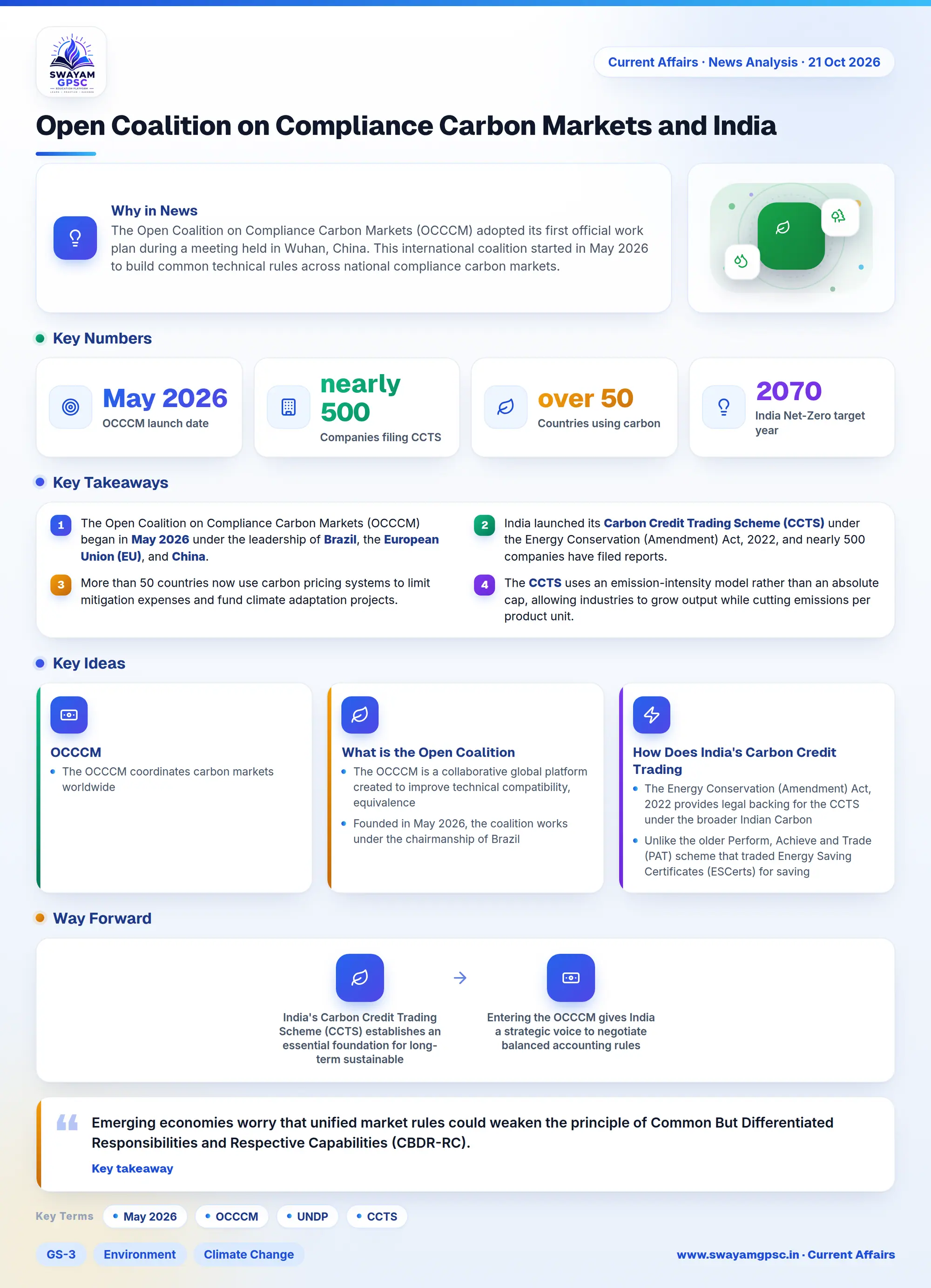
Open Coalition on Compliance Carbon Markets and India
#GS-3 #Environment #Climate Change #Sustainable Development #Economy #Taxation #Infrastructure #GS-2 #Current Events #International #Regulatory Bodies #Government Policies & Interventions #Carbon Markets #CCTS #OCCCM #CBAM
Key takeaways
- The Open Coalition on Compliance Carbon Markets (OCCCM) began in May 2026 under the leadership of Brazil, the European Union (EU), and China.
- India launched its Carbon Credit Trading Scheme (CCTS) under the Energy Conservation (Amendment) Act, 2022, and nearly 500 companies have filed reports.
- More than 50 countries now use carbon pricing systems to limit mitigation expenses and fund climate adaptation projects.
- The CCTS uses an emission-intensity model rather than an absolute cap, allowing industries to grow output while cutting emissions per product unit.
- Aligning with global verification frameworks helps Indian exporters in sectors like steel and aluminium prepare for the European Union's Carbon Border Adjustment Mechanism (CBAM).
Why in News
- The Open Coalition on Compliance Carbon Markets (OCCCM) adopted its first official work plan during a meeting held in Wuhan, China.
- This international coalition started in May 2026 to build common technical rules across national compliance carbon markets.
- At the same time, India rolled out its domestic Carbon Credit Trading Scheme (CCTS), and nearly 500 companies submitted their first compliance filings.
- These developments have triggered a key policy debate on whether India should enter the OCCCM to shape global carbon standards.
Summary
- The OCCCM coordinates carbon markets worldwide, offering India a direct chance to guide international accounting rules and protect exporters from border taxes.
- India drives industrial decarbonisation through its Carbon Credit Trading Scheme (CCTS) using tradable certificates, but it must strengthen verification, protect small businesses, and uphold climate justice.
What is the Open Coalition on Compliance Carbon Markets
- The OCCCM is a collaborative global platform created to improve technical compatibility, equivalence, and shared standards across national compliance carbon markets.
- Founded in May 2026, the coalition works under the chairmanship of Brazil, with the European Union (EU) and China acting as Co-Chairs.
- Its membership includes countries like Germany, New Zealand, Canada, France, Norway, Singapore, Türkiye, and the United Kingdom.
- Key international observers include the UNDP, the UNEP, and the World Bank’s Partnership for Market Implementation.
- The coalition provides a forum where governments share practical knowledge to help different carbon pricing systems connect smoothly.
- It concentrates on emissions trading systems and carbon tax policies to spread best practices among members.
- It focuses on creating uniform Monitoring, Reporting, and Verification standards across all participating carbon markets.
- It works to design unified rules for measuring and accounting for greenhouse gas emissions.
- It develops credible guidelines for using carbon offset credits across international borders.
- Importantly, the OCCCM does not dictate emission cuts or enforce domestic laws, focusing only on technical alignment.
How Does India's Carbon Credit Trading Scheme Operate
- The Energy Conservation (Amendment) Act, 2022 provides legal backing for the CCTS under the broader Indian Carbon Market (ICM) to support India's 2070 Net-Zero target.
- Unlike the older Perform, Achieve and Trade (PAT) scheme that traded Energy Saving Certificates (ESCerts) for saving energy, the CCTS directly curbs emissions.
- The scheme covers energy-intensive sectors like aluminium, cement, chlor-alkali, pulp and paper, iron and steel, fertilizer, refineries, petrochemicals, and textiles.
- Even though thermal power plants generate a large portion of national emissions, the government has not yet added them to the compliance mechanism.
- Instead of setting an absolute cap like the European Union does, India adopts an emission-intensity system that permits economic expansion while reducing pollution per unit.
- Under the compliance route, designated industries receive mandatory intensity targets, earning sellable Carbon Credit Certificates (CCCs) for overachieving or buying them to avoid fines.
- Under the offset route, non-obligated entities like clean energy producers can voluntarily run green projects to generate and trade Carbon Credit Certificates (CCCs).
What is the Need for India to Join OCCCM
- Taking part in coalition meetings allows India to design international carbon rules directly rather than accepting standards created by rich nations later.
- Because more than 50 countries apply carbon pricing to reduce mitigation costs and raise public funds, joining early keeps India ahead of global shifts.
- Connecting India's trading system to overseas markets would enable domestic green developers to sell credits at higher prices in strictly regulated jurisdictions.
- As multilateral climate talks stall, independent climate coalitions are reshaping global trade through measures like the Carbon Border Adjustment Mechanism (CBAM).
- Participating in this coalition helps Indian exporters align their reporting and accounting systems with foreign standards before carbon border tariffs hurt them.
Challenges
- Emerging economies worry that unified market rules could weaken the principle of Common But Differentiated Responsibilities and Respective Capabilities (CBDR-RC).
- Advanced economies might use international carbon alignment platforms to justify border taxes, creating covert trade barriers against developing countries.
- Connecting India's young carbon market with mature systems too quickly could limit sovereign policy choices and overburden Micro, Small, and Medium Enterprises (MSMEs) with compliance costs.
- Weak emission baselines could create problems like carbon leakage or useless credits that do not represent real climate benefits.
What Measures can India Take to Strengthen its ICM
- The Bureau of Energy Efficiency must ensure that domestic Accredited Carbon Verification Agencies (ACVAs) follow high global benchmarks to keep Indian certificates trustworthy.
- The government should roll out financial aid and targeted policies to protect workers and small firms in heavy sectors from sudden regulatory shocks.
- As industrial efficiency improves over time, India should gradually shift its market from emission-intensity metrics to an absolute cap-and-trade system.
- The Ministry of Commerce and the Ministry of Environment, Forest and Climate Change must collaborate to subsidize decarbonisation in export sectors like steel and aluminium.
- Authorities must offer technical training and digital tools like Carbon-OS to help smaller enterprises manage their carbon accounting affordably.
Way Forward
- India's Carbon Credit Trading Scheme (CCTS) establishes an essential foundation for long-term sustainable industrial transformation.
- Entering the OCCCM gives India a strategic voice to negotiate balanced accounting rules, shield domestic exporters from punitive border measures, and sustain economic growth.