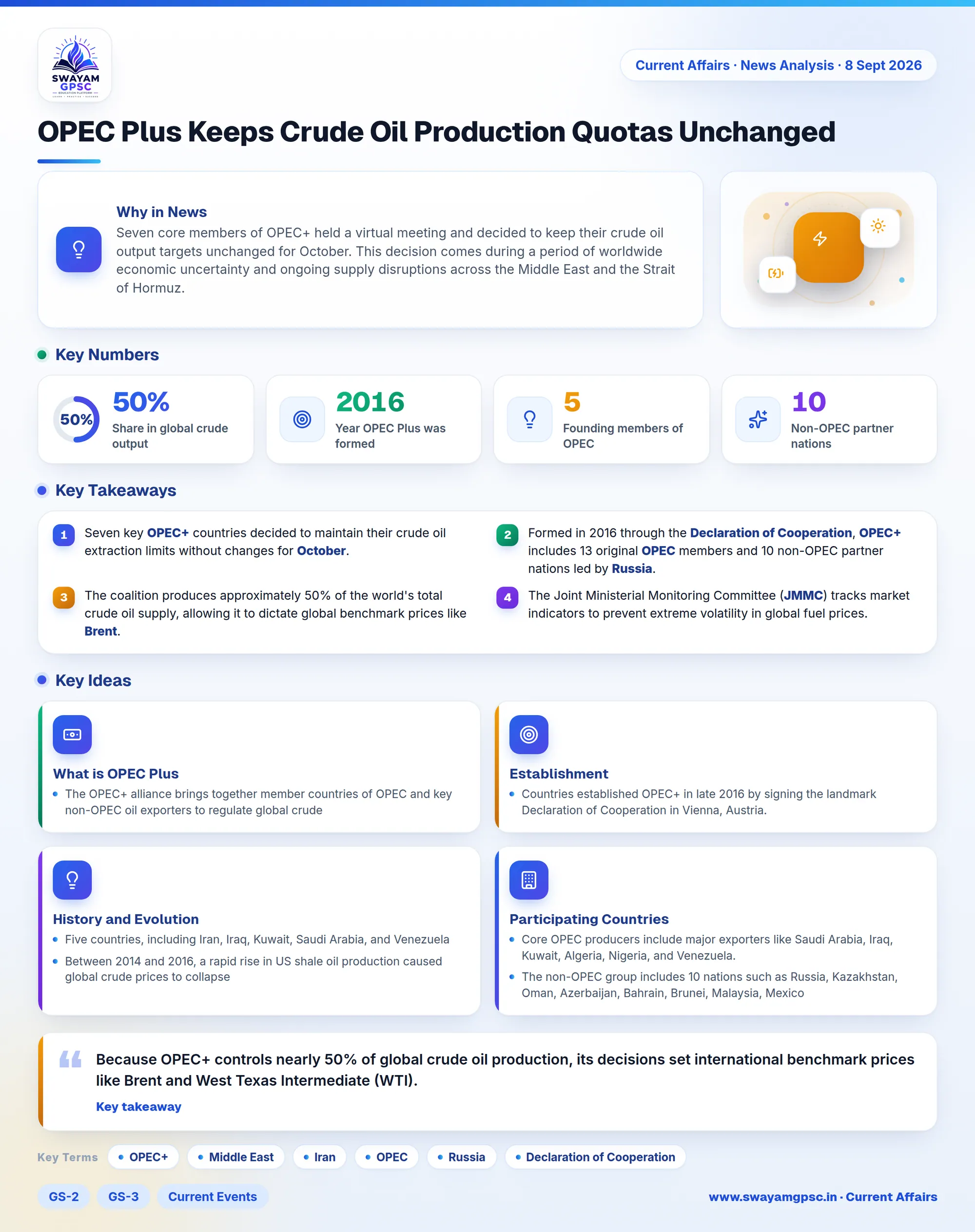
OPEC Plus Keeps Crude Oil Production Quotas Unchanged
#GS-2 #GS-3 #Current Events #International #Economy #Infrastructure #Energy #OPEC Plus #Crude Oil
Key takeaways
- Seven key OPEC+ countries decided to maintain their crude oil extraction limits without changes for October.
- Formed in 2016 through the Declaration of Cooperation, OPEC+ includes 13 original OPEC members and 10 non-OPEC partner nations led by Russia.
- The coalition produces approximately 50% of the world's total crude oil supply, allowing it to dictate global benchmark prices like Brent.
- The Joint Ministerial Monitoring Committee (JMMC) tracks market indicators to prevent extreme volatility in global fuel prices.
Why in News
- Seven core members of OPEC+ held a virtual meeting and decided to keep their crude oil output targets unchanged for October.
- This decision comes during a period of worldwide economic uncertainty and ongoing supply disruptions across the Middle East and the Strait of Hormuz.
What is OPEC Plus
- The OPEC+ alliance brings together member countries of OPEC and key non-OPEC oil exporters to regulate global crude oil supply and stabilize energy markets.
Establishment
- Countries established OPEC+ in late 2016 by signing the landmark Declaration of Cooperation in Vienna, Austria.
History and Evolution
- Five countries, including Iran, Iraq, Kuwait, Saudi Arabia, and Venezuela, founded OPEC at the Baghdad Conference in 1960 to challenge multinational oil corporations known as the Seven Sisters.
- Between 2014 and 2016, a rapid rise in US shale oil production caused global crude prices to collapse, prompting OPEC to ally with 10 non-OPEC oil producers led by Russia.
Participating Countries
- Core OPEC producers include major exporters like Saudi Arabia, Iraq, Kuwait, Algeria, Nigeria, and Venezuela.
- The non-OPEC group includes 10 nations such as Russia, Kazakhstan, Oman, Azerbaijan, Bahrain, Brunei, Malaysia, Mexico, South Sudan, and Sudan.
Key Functions
- The group sets and adjusts production limits for individual nations to match global oil supply with changing demand.
- It balances energy markets during sudden crises through voluntary production cuts or increases to prevent rapid price swings.
- The coalition aligns export policies between OPEC and non-OPEC partners to ensure reliable revenues for oil-producing nations.
- It monitors global oil stock levels to guarantee continuous and affordable fuel supplies for buying nations.
- Bodies like the Joint Ministerial Monitoring Committee (JMMC) conduct economic forecasts and market research to guide global policy.
Significance
- Because OPEC+ controls nearly 50% of global crude oil production, its decisions set international benchmark prices like Brent and West Texas Intermediate (WTI).
- Changes in OPEC+ production directly influence global transport costs, fuel prices, overall inflation, and central bank interest rate decisions.