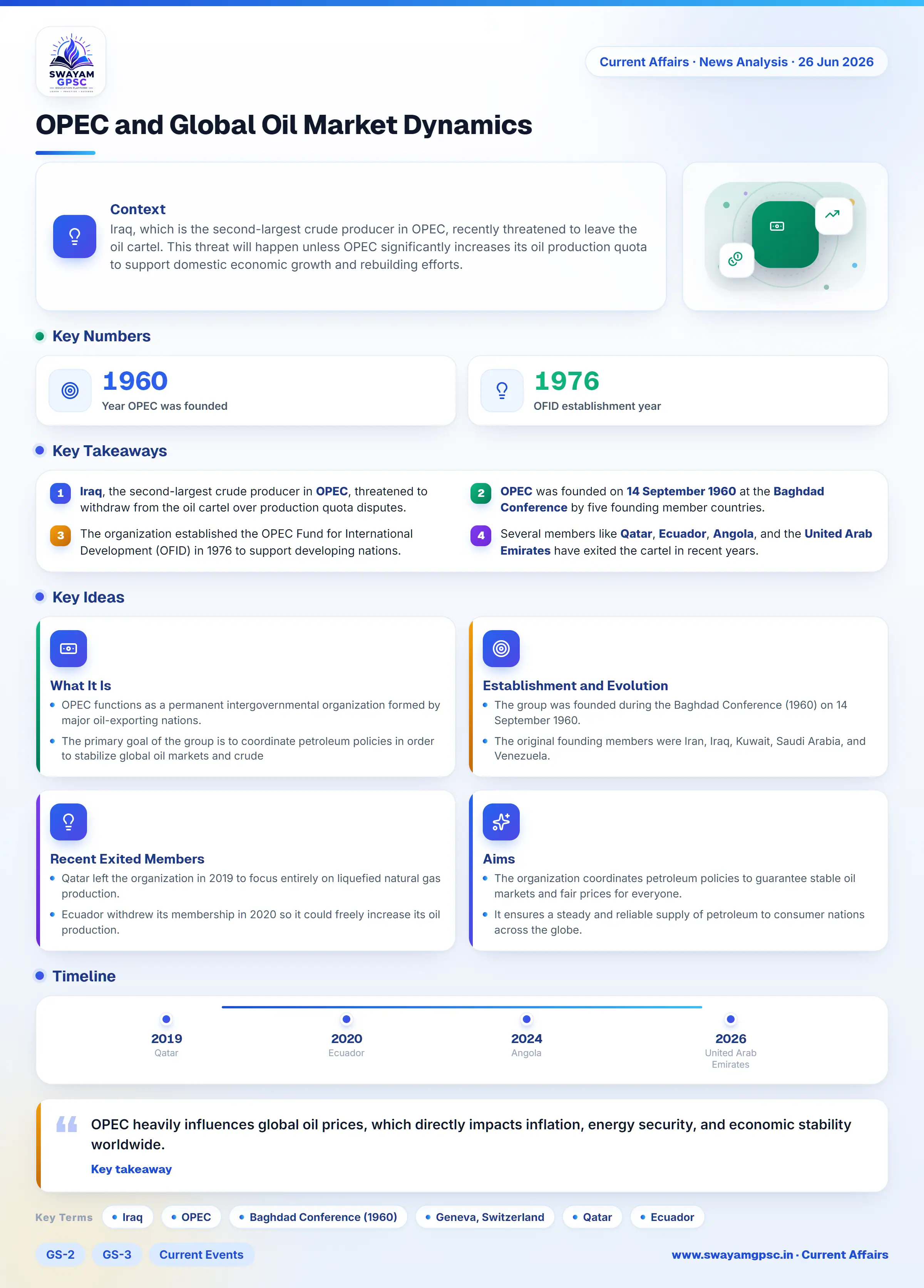
OPEC and Global Oil Market Dynamics
#GS-2 #GS-3 #Current Events #Economy #International
Key takeaways
- Iraq, the second-largest crude producer in OPEC, threatened to withdraw from the oil cartel over production quota disputes.
- OPEC was founded on 14 September 1960 at the Baghdad Conference by five founding member countries.
- The organization established the OPEC Fund for International Development (OFID) in 1976 to support developing nations.
- Several members like Qatar, Ecuador, Angola, and the United Arab Emirates have exited the cartel in recent years.
Context
- Iraq, which is the second-largest crude producer in OPEC, recently threatened to leave the oil cartel.
- This threat will happen unless OPEC significantly increases its oil production quota to support domestic economic growth and rebuilding efforts.
What It Is
- OPEC functions as a permanent intergovernmental organization formed by major oil-exporting nations.
- The primary goal of the group is to coordinate petroleum policies in order to stabilize global oil markets and crude prices.
Establishment and Evolution
- The group was founded during the Baghdad Conference (1960) on 14 September 1960.
- The original founding members were Iran, Iraq, Kuwait, Saudi Arabia, and Venezuela.
- The headquarters of the organization moved from Geneva, Switzerland, to Vienna, Austria, in 1965.
- Member states adopted a historic declaration in 1968 to assert their permanent sovereignty over natural resources.
- The organization established the OPEC Fund for International Development (OFID) in 1976 to help developing countries.
- OPEC partnered with major non-OPEC producers like Russia under the Declaration of Cooperation (DoC) in 2016 to form OPEC+.
Recent Exited Members
- Qatar left the organization in 2019 to focus entirely on liquefied natural gas production.
- Ecuador withdrew its membership in 2020 so it could freely increase its oil production.
- Angola exited the group in 2024 due to disagreements over production quotas.
- The United Arab Emirates left in 2026 to pursue an independent national oil production strategy.
Aims
- The organization coordinates petroleum policies to guarantee stable oil markets and fair prices for everyone.
- It ensures a steady and reliable supply of petroleum to consumer nations across the globe.
- It protects fair financial returns for investors who put money into the oil sector.
Key Functions of the Cartel
- The organization monitors global oil demand and assigns mandatory production caps to prevent oversupply or shortages.
- It introduces and manages an official reference basket for crude pricing to reduce global price volatility.
- It coordinates large-scale production cuts during global economic slumps to clear oil gluts and protect capital.
- It tracks international environmental talks, joins UNFCCC climate conferences, and plans long-term energy strategies.
Significance
- OPEC heavily influences global oil prices, which directly impacts inflation, energy security, and economic stability worldwide.
- The rapid growth of non-OPEC oil production, particularly U.S. shale oil, has reduced the overall market influence of the cartel.