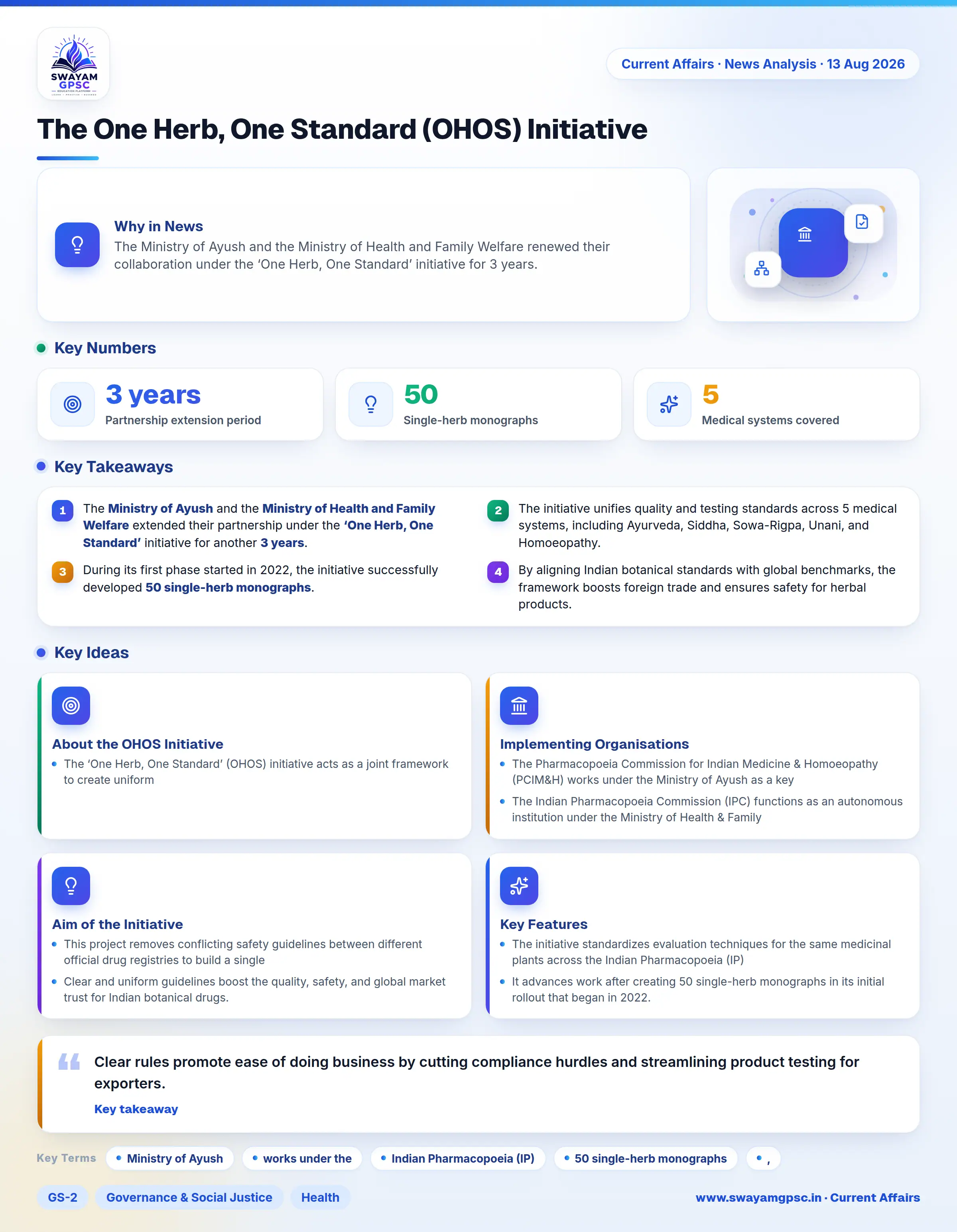
The One Herb, One Standard (OHOS) Initiative
#GS-2 #Governance & Social Justice #Health #Regulatory Bodies #Current Events #National #Ministry of Ayush #Botanical Products
Key takeaways
- The Ministry of Ayush and the Ministry of Health and Family Welfare extended their partnership under the ‘One Herb, One Standard’ initiative for another 3 years.
- The initiative unifies quality and testing standards across 5 medical systems, including Ayurveda, Siddha, Sowa-Rigpa, Unani, and Homoeopathy.
- During its first phase started in 2022, the initiative successfully developed 50 single-herb monographs.
- By aligning Indian botanical standards with global benchmarks, the framework boosts foreign trade and ensures safety for herbal products.
Why in News
- The Ministry of Ayush and the Ministry of Health and Family Welfare renewed their collaboration under the ‘One Herb, One Standard’ initiative for 3 years.
About the OHOS Initiative
- The ‘One Herb, One Standard’ (OHOS) initiative acts as a joint framework to create uniform, scientifically verified testing standards for medicinal plants across India.
Implementing Organisations
- The Pharmacopoeia Commission for Indian Medicine & Homoeopathy (PCIM&H) works under the Ministry of Ayush as a key implementing agency.
- The Indian Pharmacopoeia Commission (IPC) functions as an autonomous institution under the Ministry of Health & Family Welfare.
Aim of the Initiative
- This project removes conflicting safety guidelines between different official drug registries to build a single trusted standard for medicinal herbs.
- Clear and uniform guidelines boost the quality, safety, and global market trust for Indian botanical drugs.
Key Features
- The initiative standardizes evaluation techniques for the same medicinal plants across the Indian Pharmacopoeia (IP) and traditional ASU&H Pharmacopoeias.
- It advances work after creating 50 single-herb monographs in its initial rollout that began in 2022.
- The uniform guidelines apply across 5 recognized traditional systems, including Ayurveda, Siddha, Sowa-Rigpa, Unani, and Homoeopathy.
- It merges global quality benchmarks into domestic specifications so that Indian botanical products easily fulfill international trade rules.
- Testing labs, regulatory authorities, and drug makers receive a single clear manual, removing confusing and conflicting laboratory requirements.
Significance
- Clear rules promote ease of doing business by cutting compliance hurdles and streamlining product testing for exporters.
- World-class compliance enhances product safety, builds foreign buyer trust, and expands the export reach of traditional Indian remedies.