Oldest Dated Evidence of Ancient Microbial Life Found in Indian Rock
#GS-3 #Science & Technology #GS-2 #Current Events #National #Physical Geography #Singhbhum Craton #Biosignatures
Key takeaways
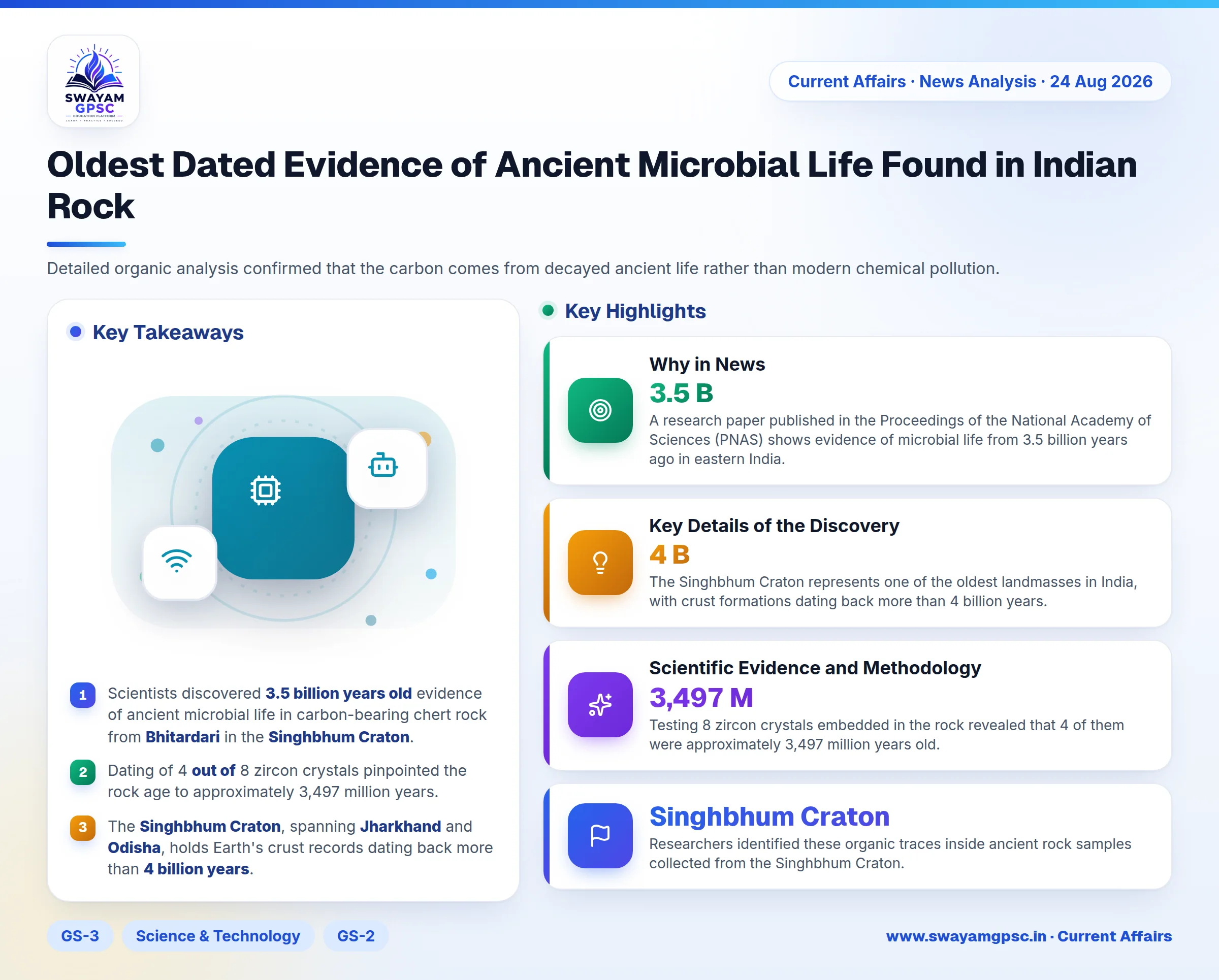
- Scientists discovered 3.5 billion years old evidence of ancient microbial life in carbon-bearing chert rock from Bhitardari in the Singhbhum Craton.
- Dating of 4 out of 8 zircon crystals pinpointed the rock age to approximately 3,497 million years.
- The Singhbhum Craton, spanning Jharkhand and Odisha, holds Earth's crust records dating back more than 4 billion years.
- Published in PNAS, this discovery offers one of the world's oldest directly dated biosignature records to study early life and space habitability.
Why in News
- A research paper published in the Proceedings of the National Academy of Sciences (PNAS) shows evidence of microbial life from 3.5 billion years ago in eastern India.
- Researchers identified these organic traces inside ancient rock samples collected from the Singhbhum Craton.
Key Details of the Discovery
- Scientists collected the carbon-rich chert rock sample from Bhitardari, a site inside the Singhbhum Craton that extends across Jharkhand and Odisha.
- Chert is a dense, silica-heavy rock that can protect organic matter from breaking down over billions of years.
- The Singhbhum Craton represents one of the oldest landmasses in India, with crust formations dating back more than 4 billion years.
Scientific Evidence and Methodology
- Testing 8 zircon crystals embedded in the rock revealed that 4 of them were approximately 3,497 million years old.
- Chemical testing revealed carbon isotope ratios that match the exact signatures produced when living organisms fix carbon.
- Detailed organic analysis confirmed that the carbon comes from decayed ancient life rather than modern chemical pollution.
Significance of the Finding
- This discovery stands among the world's oldest directly dated biosignatures of microbial life established through chemical and geological tests.
- The findings help scientists understand early biological growth on Earth and aid in searching for life on other habitable planets.