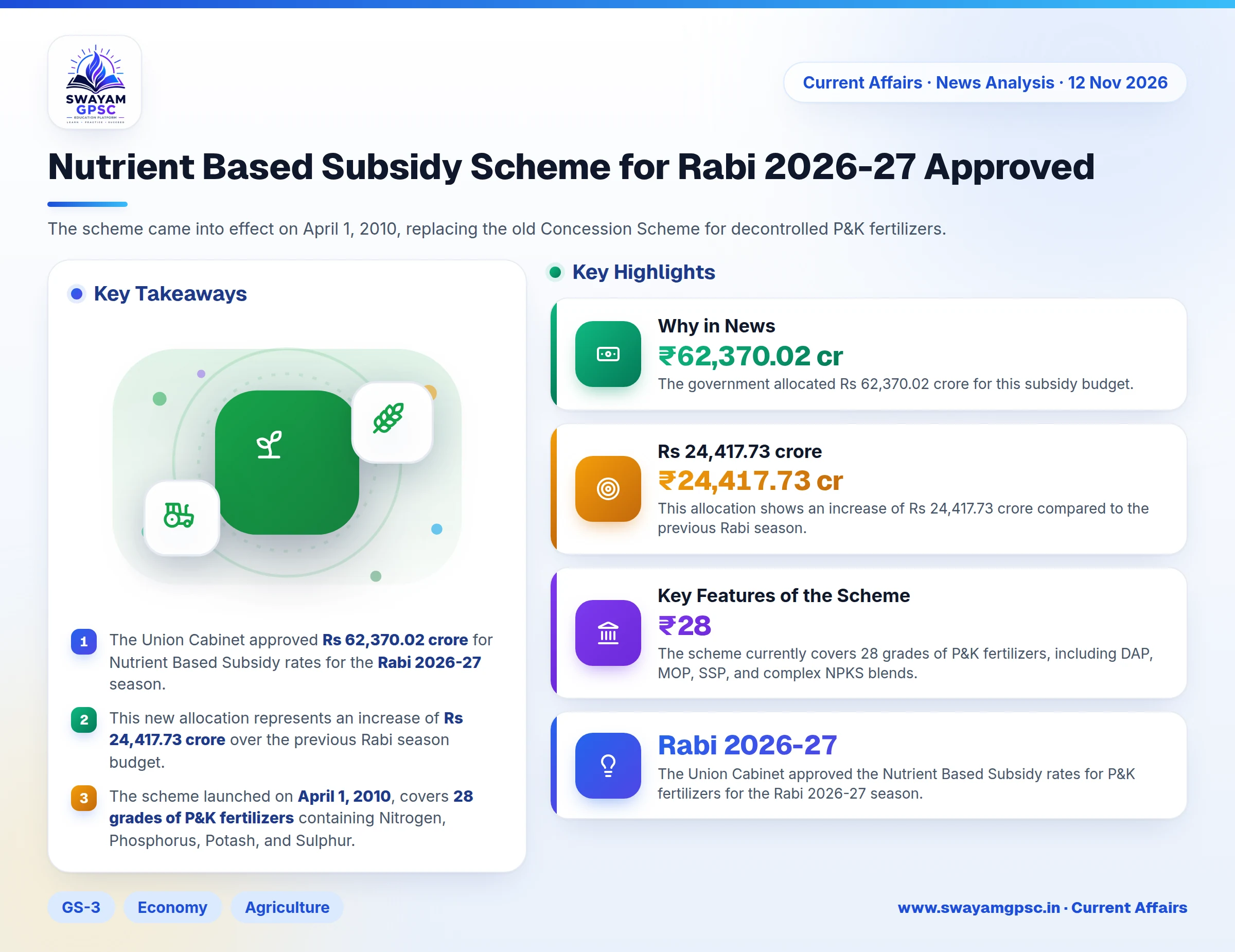
Nutrient Based Subsidy Scheme for Rabi 2026-27 Approved
#GS-3 #Economy #Agriculture #Food Security #Nutrient Based Subsidy #P&K Fertilizers #Government Schemes
Key takeaways
- The Union Cabinet approved Rs 62,370.02 crore for Nutrient Based Subsidy rates for the Rabi 2026-27 season.
- This new allocation represents an increase of Rs 24,417.73 crore over the previous Rabi season budget.
- The scheme launched on April 1, 2010, covers 28 grades of P&K fertilizers containing Nitrogen, Phosphorus, Potash, and Sulphur.
- Urea remains excluded from the Nutrient Based Subsidy framework and continues under statutory price controls.
Why in News
- The Union Cabinet approved the Nutrient Based Subsidy rates for P&K fertilizers for the Rabi 2026-27 season.
- The government allocated Rs 62,370.02 crore for this subsidy budget.
- This allocation shows an increase of Rs 24,417.73 crore compared to the previous Rabi season.
About the Nutrient Based Subsidy Scheme
- The Department of Fertilizers under the Ministry of Chemicals and Fertilizers runs this central sector scheme.
- The government provides a fixed subsidy amount on each grade of subsidized Phosphatic and Potassic fertilizers based on their nutrient content.
- Authorities decide these subsidy rates on an annual or biannual basis.
Background
- The scheme came into effect on April 1, 2010, replacing the old Concession Scheme for decontrolled P&K fertilizers.
- Farmers previously overused heavily subsidized urea compared to phosphatic and potassic fertilizers.
- This imbalance damaged soil health across the country, prompting the government to launch the new regime.
Aim of the Scheme
- The main objective is to promote balanced fertilizer use across farms in India.
- It aims to improve soil health and boost overall crop productivity.
- The scheme also encourages innovation in fertilizers and ensures efficient government spending.
Nutrients Covered
- The scheme covers four main nutrients: Nitrogen, Phosphorus, Potash, and Sulphur.
- It provides extra per-tonne subsidies for fertilizers enriched with micronutrients like Boron and Zinc.
- Urea remains outside this scheme because the government controls its prices under a separate law.
Key Features of the Scheme
- The government sets a fixed per-kilogram subsidy rate for each nutrient element.
- Official calculations determine the total subsidy on a fertilizer bag based on its exact chemical percentage.
- The scheme currently covers 28 grades of P&K fertilizers, including DAP, MOP, SSP, and complex NPKS blends.
- Manufacturers set retail prices at reasonable levels while receiving fixed subsidies directly after verified sales.
- Companies receive subsidy payments only after point-of-sale devices verify physical sales to farmers through Aadhaar.
- The government offers financial incentives for micronutrient fortification to meet specific regional soil needs.
Significance
- The policy protects farmers from global price surges and import supply disruptions.
- Encouraging balanced nutrient use reduces urea overuse and stops long-term soil degradation.