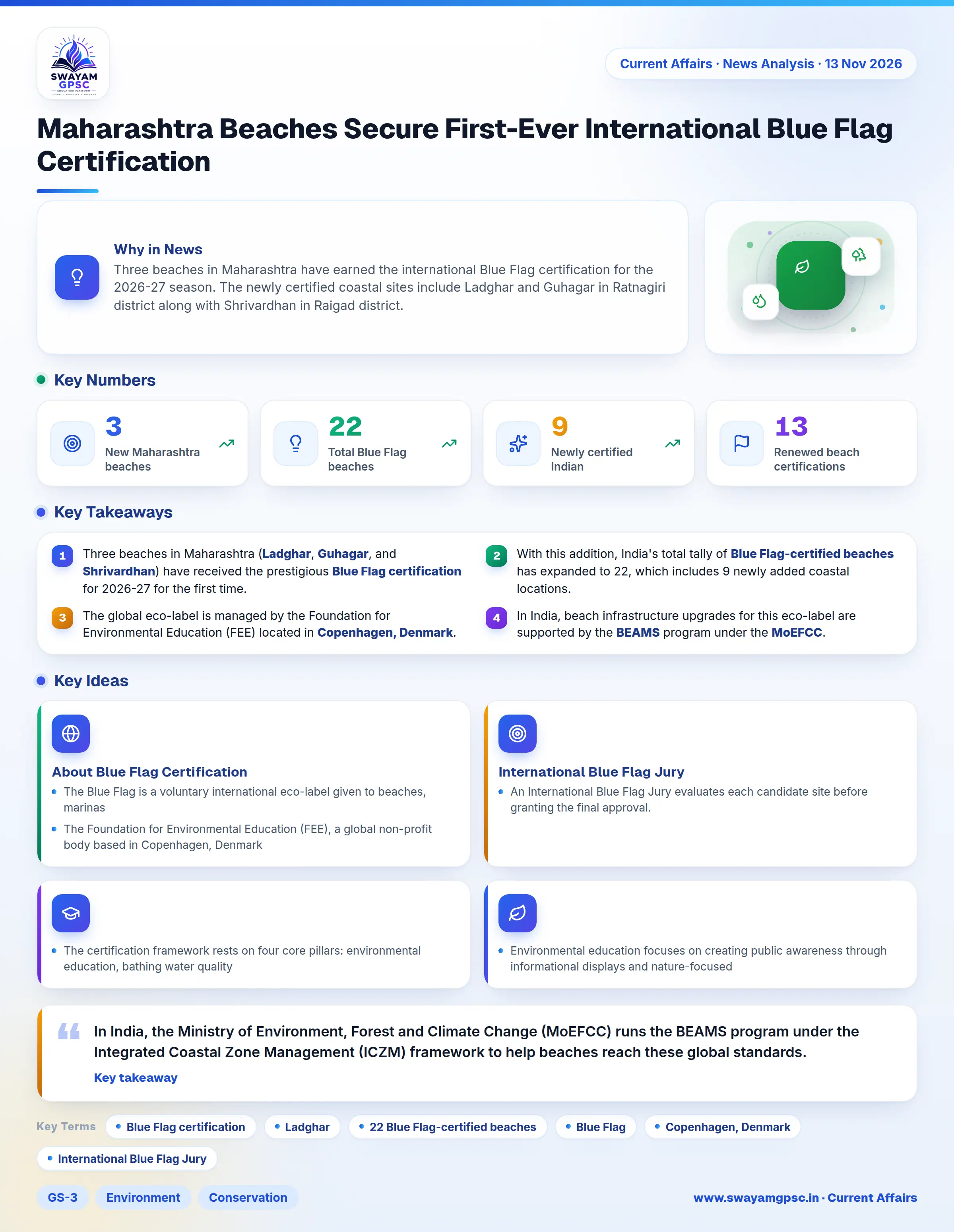
Maharashtra Beaches Secure First-Ever International Blue Flag Certification
#GS-3 #Environment #Conservation #Sustainable Development #Biodiversity #Current Events #National
Key takeaways
- Three beaches in Maharashtra (Ladghar, Guhagar, and Shrivardhan) have received the prestigious Blue Flag certification for 2026-27 for the first time.
- With this addition, India's total tally of Blue Flag-certified beaches has expanded to 22, which includes 9 newly added coastal locations.
- The global eco-label is managed by the Foundation for Environmental Education (FEE) located in Copenhagen, Denmark.
- In India, beach infrastructure upgrades for this eco-label are supported by the BEAMS program under the MoEFCC.
Why in News
- Three beaches in Maharashtra have earned the international Blue Flag certification for the 2026-27 season.
- The newly certified coastal sites include Ladghar and Guhagar in Ratnagiri district along with Shrivardhan in Raigad district.
- This achievement marks the first time any beach in Maharashtra has entered this globally recognized eco-label program.
- India now has a total of 22 Blue Flag-certified beaches for 2026-27, comprising 13 renewed certifications and 9 new certifications.
- To earn this tag, these beaches fulfilled strict international standards covering bathing water quality, safety, clean surroundings, and environmental conservation.
About Blue Flag Certification
- The Blue Flag is a voluntary international eco-label given to beaches, marinas, and sustainable boat tourism operators.
- The Foundation for Environmental Education (FEE), a global non-profit body based in Copenhagen, Denmark, manages this certification.
- An International Blue Flag Jury evaluates each candidate site before granting the final approval.
- The certification framework rests on four core pillars: environmental education, bathing water quality, environmental management, and safety services.
- Environmental education focuses on creating public awareness through informational displays and nature-focused activities.
- Water quality requires strict compliance with international testing standards for safe swimming.
- Environmental management covers proper waste treatment, clean toilets, and protection of fragile coastal ecosystems.
- Safety and services demand trained lifeguards, emergency action plans, clear access paths, and reliable tourist amenities.
- The certification remains valid for a specific season only, and sites must continuously meet all criteria to retain it.
- In India, the Ministry of Environment, Forest and Climate Change (MoEFCC) runs the BEAMS program under the Integrated Coastal Zone Management (ICZM) framework to help beaches reach these global standards.