Nutrient Based Subsidy Rates Approved for Rabi Season 2026-27
#GS-2 #GS-3 #Government Policies & Interventions #Agricultural Resources #Mobilization of Resources #Direct & Indirect Farm Subsidies #Economy #Agriculture #Current Events #National
Key takeaways
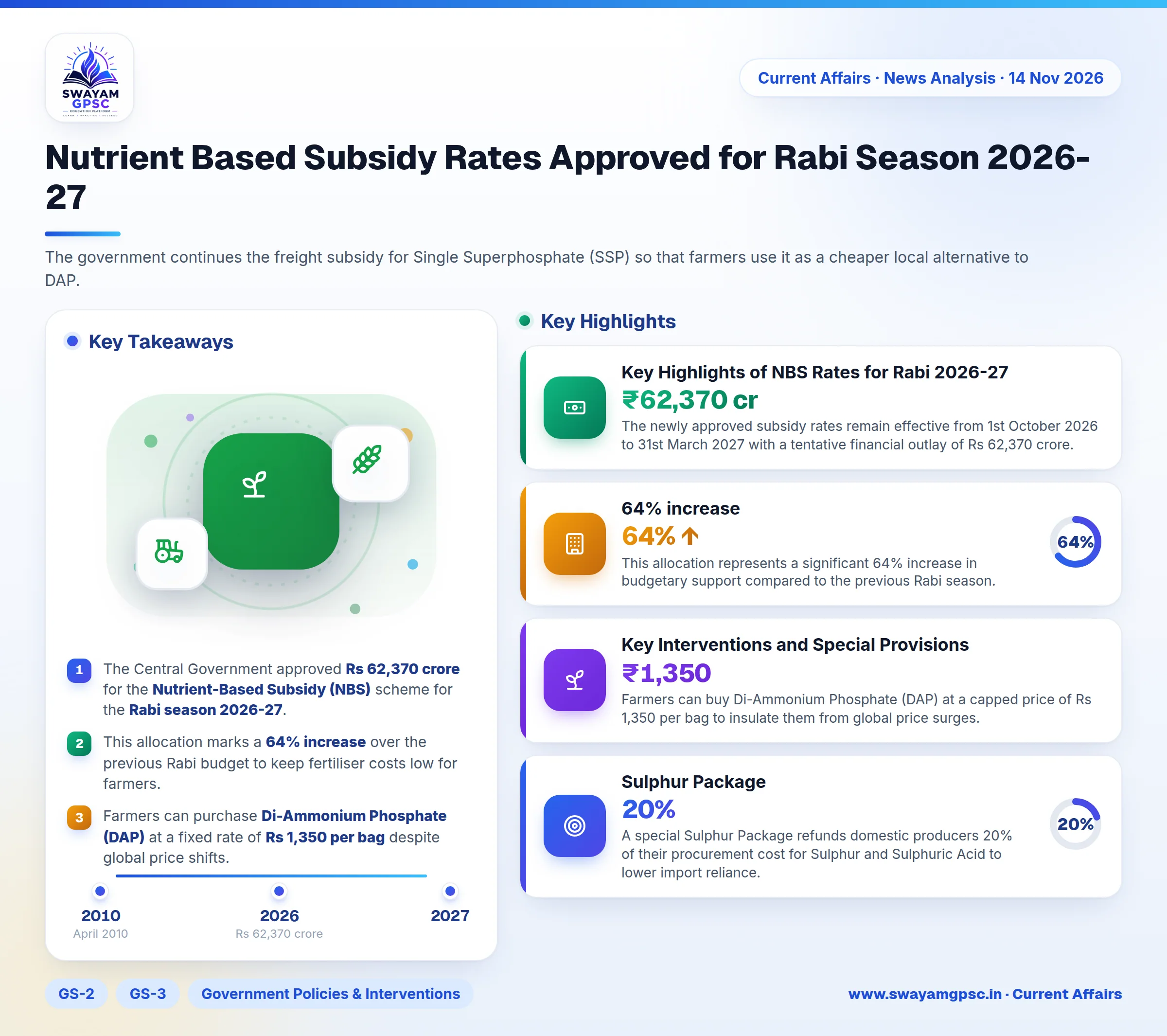
- The Central Government approved Rs 62,370 crore for the Nutrient-Based Subsidy (NBS) scheme for the Rabi season 2026-27.
- This allocation marks a 64% increase over the previous Rabi budget to keep fertiliser costs low for farmers.
- Farmers can purchase Di-Ammonium Phosphate (DAP) at a fixed rate of Rs 1,350 per bag despite global price shifts.
- The policy covers 28 grades of Phosphatic and Potassic fertilisers but excludes Urea, which remains under strict government price controls.
- A special Sulphur Package provides a 20% reimbursement on procurement costs to boost domestic production and curb import dependency.
Why in News
- The Union Government approved the Nutrient-Based Subsidy (NBS) rates for Phosphatic and Potassic (P&K) fertilisers for the Rabi season 2026-27.
- This decision aims to ensure affordable key fertilisers for farmers and encourage balanced nutrient application across agricultural fields.
Key Highlights of NBS Rates for Rabi 2026-27
- The newly approved subsidy rates remain effective from 1st October 2026 to 31st March 2027 with a tentative financial outlay of Rs 62,370 crore.
- This allocation represents a significant 64% increase in budgetary support compared to the previous Rabi season.
- The government adjusted subsidies for fundamental nutrients including Nitrogen (N), Phosphorus (P), Potassium (K), and Sulphur (S) to match international market trends and preserve soil health.
Key Interventions and Special Provisions
- Farmers can buy Di-Ammonium Phosphate (DAP) at a capped price of Rs 1,350 per bag to insulate them from global price surges.
- Similar price-capping protections apply to both imported and domestic Triple Superphosphate (TSP) and Monoammonium Phosphate (MAP).
- The government continues the freight subsidy for Single Superphosphate (SSP) so that farmers use it as a cheaper local alternative to DAP.
- Financial support through subsidies continues for Ammonium Sulphate as an alternative to Urea.
- A special Sulphur Package refunds domestic producers 20% of their procurement cost for Sulphur and Sulphuric Acid to lower import reliance.
About the Nutrient Based Subsidy Scheme
- The NBS Scheme operates as a central sector policy managed by the Department of Fertilizers under the Ministry of Chemicals and Fertilizers.
- Launched in April 2010, the policy makes essential agricultural inputs accessible to farmers while improving overall soil nutrition.
Key Features of the NBS Scheme
- Instead of subsidizing complete fertiliser bags, the policy pays a set subsidy per kilogram for Nitrogen (N), Phosphorus (P), Potassium (K), and Sulphur (S).
- Authorities review and fix these nutrient rates every year or twice a year for the Kharif and Rabi cropping periods.
- The framework currently covers 28 grades of Phosphatic and Potassic fertilisers, including DAP, Muriate of Potash (MOP), and SSP.
- P&K fertiliser companies operate in a decontrolled environment where they set reasonable retail prices based on raw material costs.
- The government keeps watch over these retail prices to protect farmers from excessive price hikes.
- Under the Direct Benefit Transfer system, companies receive their subsidy payouts only after selling products through Point-of-Sale (PoS) biometric devices.
- Urea stays outside the NBS framework, as the government directly fixes its retail price under a separate statutory control scheme.
- The scheme provides extra financial bonuses for customised fertilisers enriched with secondary nutrients and micro-nutrients.