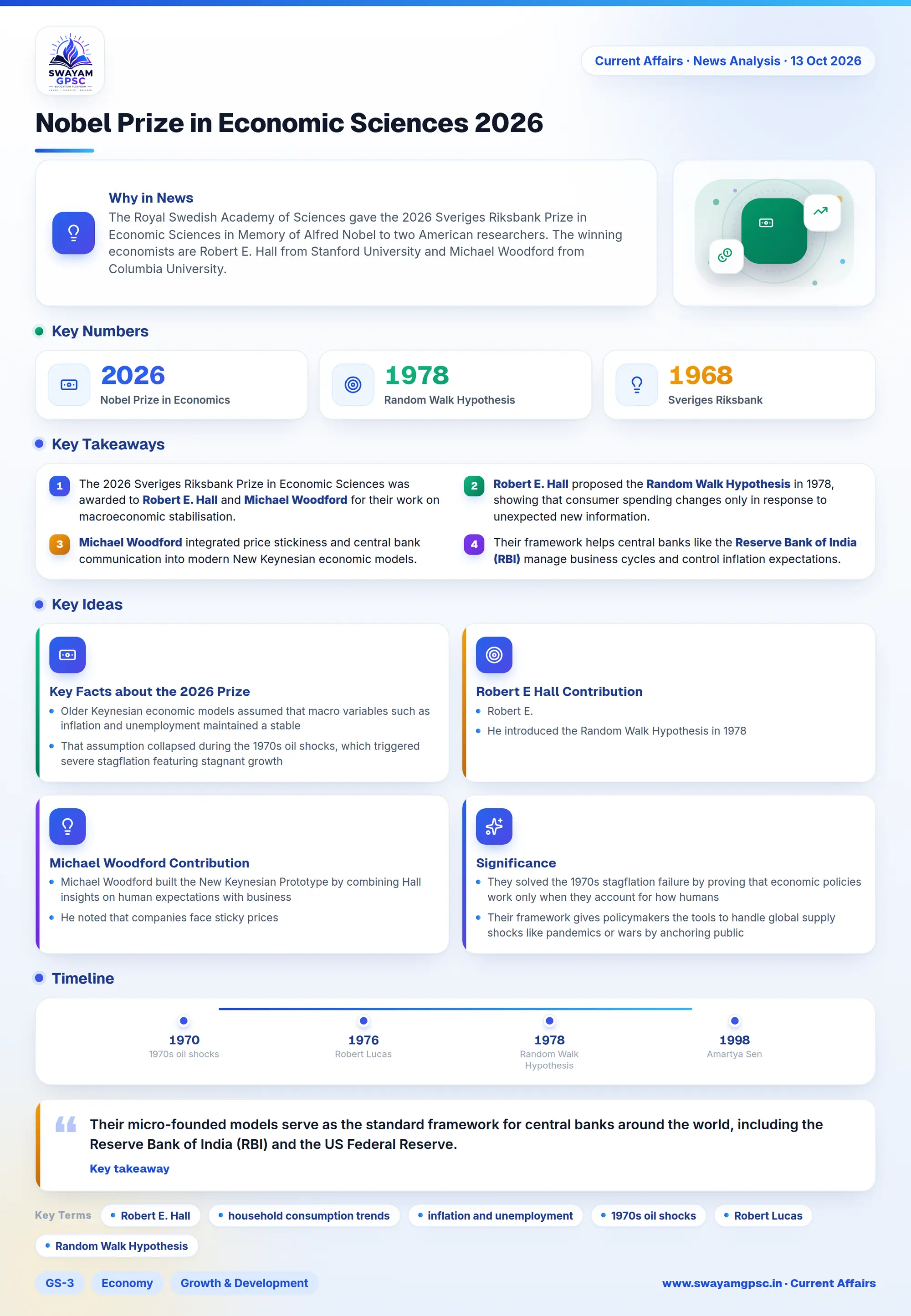
Nobel Prize in Economic Sciences 2026
#GS-3 #Economy #Growth & Development #Monetary Policy #Quick Facts For Prelims
Key takeaways
- The 2026 Sveriges Riksbank Prize in Economic Sciences was awarded to Robert E. Hall and Michael Woodford for their work on macroeconomic stabilisation.
- Robert E. Hall proposed the Random Walk Hypothesis in 1978, showing that consumer spending changes only in response to unexpected new information.
- Michael Woodford integrated price stickiness and central bank communication into modern New Keynesian economic models.
- Their framework helps central banks like the Reserve Bank of India (RBI) manage business cycles and control inflation expectations.
Why in News
- The Royal Swedish Academy of Sciences gave the 2026 Sveriges Riksbank Prize in Economic Sciences in Memory of Alfred Nobel to two American researchers.
- The winning economists are Robert E. Hall from Stanford University and Michael Woodford from Columbia University.
- They received the award for explaining the microeconomic foundations of macroeconomic stabilisation.
- Their research shows how individual household consumption trends and business pricing expectations drive broader macroeconomic policies like monetary and fiscal decisions.
Key Facts about the 2026 Prize
- Older Keynesian economic models assumed that macro variables such as inflation and unemployment maintained a stable relationship.
- That assumption collapsed during the 1970s oil shocks, which triggered severe stagflation featuring stagnant growth, high unemployment, and persistent inflation.
- Economist Robert Lucas pointed out in 1976 that human behaviour is not fixed.
- When central banks apply policies based on old data, consumers and businesses change their behaviour to match the new rules, which weakens the intended policy outcomes.
Robert E Hall Contribution
- Robert E. Hall proved that family spending depends on people and their expectations about future lifetime wealth rather than just current income.
- He introduced the Random Walk Hypothesis in 1978, showing that consumption changes only when people receive unexpected new information like a sudden job loss or a surprise bonus.
- Because families already account for known future events, future consumption follows a random walk and cannot be predicted using past economic data.
- He also explained labour market search frictions, which are the time and effort required to match workers with vacant jobs, clarifying why high unemployment often persists long after an economic recovery starts.
Michael Woodford Contribution
- Michael Woodford built the New Keynesian Prototype by combining Hall insights on human expectations with business operations.
- He noted that companies face sticky prices, meaning they cannot change prices instantly because of operational expenses known as menu costs.
- Firms therefore set prices today based on their expectations of future inflation and central bank policies.
- He demonstrated that transparent central bank communication regarding future monetary policy can influence current consumption, investment, and inflation expectations.
Significance
- Their micro-founded models serve as the standard framework for central banks around the world, including the Reserve Bank of India (RBI) and the US Federal Reserve.
- They solved the 1970s stagflation failure by proving that economic policies work only when they account for how humans adapt their future expectations.
- Their framework gives policymakers the tools to handle global supply shocks like pandemics or wars by anchoring public inflation expectations and stopping price spikes from spiraling out of control.
Macroeconomic Stabilisation Policy
- Stabilisation policy refers to the strategy used by governments and central banks to maintain steady economic growth, minimize unemployment shifts, and control inflation.
- The concept grew during the Great Depression (1929-1939) through the work of John Maynard Keynes, who argued that free markets need state intervention during deep downturns.
- The two primary pillars are monetary policy managed by central banks and fiscal policy managed by governments.
- The main goals include smoothing business cycles, ensuring price stability, promoting full employment, and anchoring public expectations.
Background and Context
- The economics prize differs from older Nobel prizes because Sveriges Riksbank, Sweden central bank, established it in 1968 on its 300th anniversary.
- The Royal Swedish Academy of Sciences selects and announces the winner every year.
- Indian laureates include Amartya Sen in 1998 for welfare economics and poverty, and Abhijit Banerjee in 2019 for experimental approaches to alleviating global poverty using randomized controlled trials (RCTs).
Prelims in Focus
- The 2026 Sveriges Riksbank Prize in Economic Sciences was jointly awarded to Robert E. Hall and Michael Woodford.
- Robert E. Hall formulated the Random Walk Hypothesis in 1978 regarding consumer spending patterns.
- Michael Woodford developed modern Neo-Wicksellian Monetary Frameworks integrating price stickiness and forward guidance into central banking.
- The economics prize was created in 1968 by Sveriges Riksbank, unlike the original 1895 Nobel prizes.