NITI Aayog Report on India's Regulatory Regime in Professional Services
#GS-3 #Economy #Infrastructure #Employment #NITI Aayog #Inclusive Growth #Current Events #National
Key takeaways
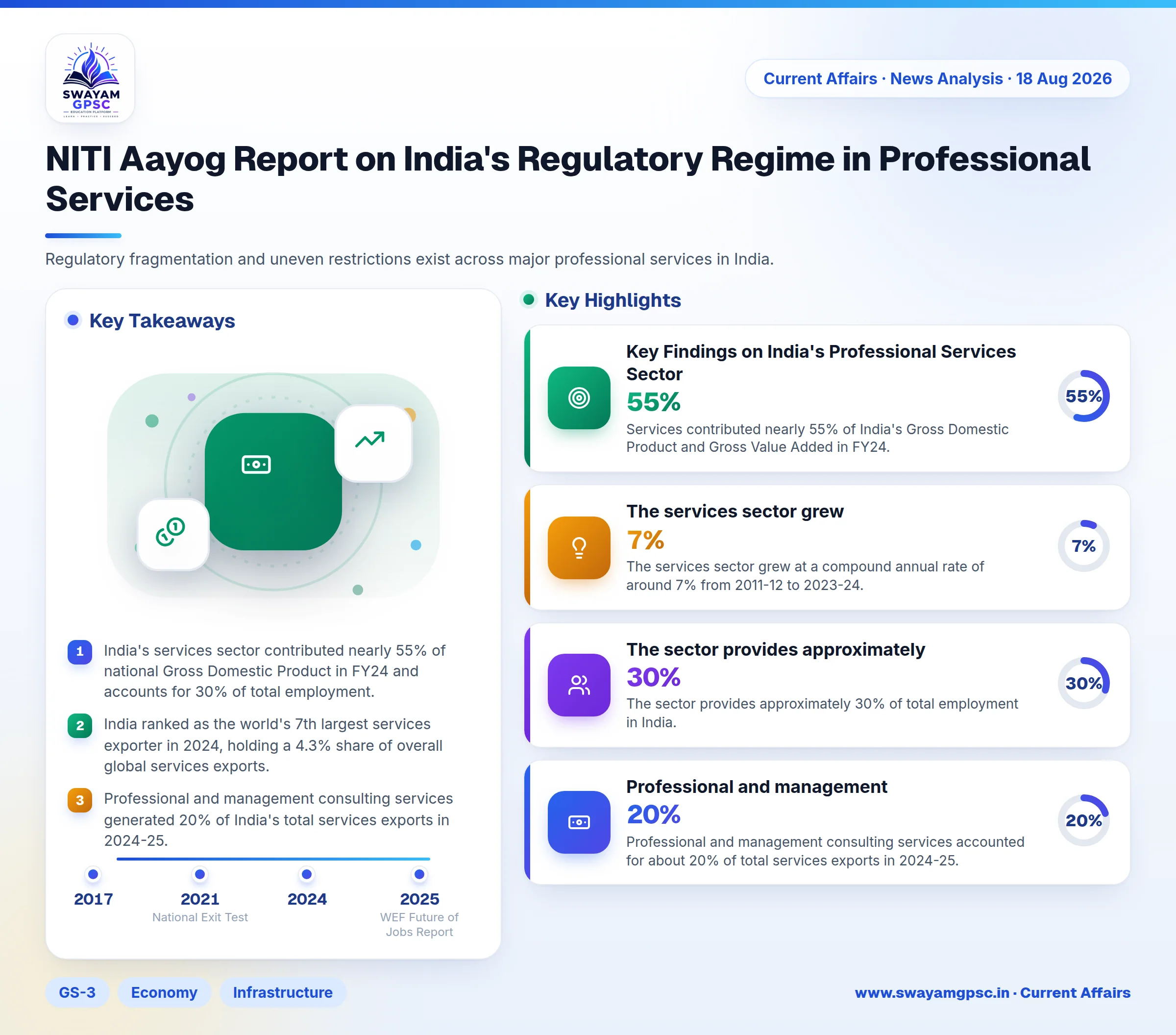
- India's services sector contributed nearly 55% of national Gross Domestic Product in FY24 and accounts for 30% of total employment.
- India ranked as the world's 7th largest services exporter in 2024, holding a 4.3% share of overall global services exports.
- Professional and management consulting services generated 20% of India's total services exports in 2024-25.
- India's Revealed Comparative Advantage in professional consulting services rose significantly from 0.95 in 2005 to 3.0 in 2024.
- NITI Aayog recommends regulatory harmonisation, wider Mutual Recognition Agreements, and Continuous Professional Development to strengthen services exports.
Why in News
- NITI Aayog released a detailed report titled India's Services Sector: Insights on Regulatory Regime in Professional Services.
- The report analyzes the regulatory framework governing knowledge-intensive professional services in India.
- It aims to identify structural bottlenecks and enhance India's global competitiveness in the services sector.
Executive Summary
- Regulatory fragmentation and uneven restrictions exist across major professional services in India.
- These restrictions affect legal, accounting, architectural, engineering, and healthcare services.
- Current regulations limit professional mobility and reduce India's overall global competitiveness.
- The report recommends harmonizing regulations, negotiating wider Mutual Recognition Agreements, and allowing modern business structures.
- Enforcing Continuous Professional Development and adopting emerging technologies will expand high-skilled jobs and services exports.
Key Findings on India's Professional Services Sector
- Services contributed nearly 55% of India's Gross Domestic Product and Gross Value Added in FY24.
- The services sector grew at a compound annual rate of around 7% from 2011-12 to 2023-24.
- The sector provides approximately 30% of total employment in India.
- Services remain the top recipient sector for foreign direct investment inflows into India.
- Professional and management consulting services accounted for about 20% of total services exports in 2024-25.
- Consulting export revenue expanded at an 18% compound annual growth rate between FY15 and FY25.
- India's Revealed Comparative Advantage score in professional consulting rose from 0.95 in 2005 to 3.0 in 2024.
- A Revealed Comparative Advantage score above 1 indicates a strong international competitive edge.
- India is the 7th largest services exporter globally, accounting for 4.3% of world services exports in 2024.
- This global market share represents a significant increase from 2% recorded in 2005.
- General cross-sectoral statutes such as the Companies Act, 2013 and LLP Act, 2008 govern all domestic businesses.
OECD Services Trade Restrictiveness Index Rankings
- The OECD Services Trade Restrictiveness Index evaluates regulatory trade barriers across 22 sectors in 51 countries.
- Annual updates to the index allow nations to benchmark regulations, identify bottlenecks, and measure reform progress.
- India's architectural services rank as the 2nd most restrictive regime globally.
- Legal services in India rank as the 3rd most restrictive among evaluated countries.
- Accounting services in India rank as the 4th most restrictive globally.
- Engineering services rank 38th in restrictiveness, operating under a relatively liberal regulatory framework.
Global Trade Rules and International Commitments
- The General Agreement on Trade in Services categorizes international services trade into four distinct modes.
- Mode 1 covers cross-border supply, Mode 2 covers consumption abroad, Mode 3 covers commercial presence, and Mode 4 covers the presence of natural persons.
- India has made zero commitments under the General Agreement on Trade in Services for legal and architectural services.
- In engineering services, India limits Mode 3 foreign equity participation to 51%.
- India is not a signatory to the WTO 2017 Joint Initiative on Services Domestic Regulation.
- India still benefits from these discipline standards because participating nations apply them on a Most-Favoured-Nation basis.
Legal and Accounting Sector Challenges
- The Advocates Act, 1961 recognizes advocates but leaves in-house corporate legal teams and outsourcing workers outside a clear framework.
- India lacks Mutual Recognition Agreements with overseas legal bodies to enable foreign practice.
- The memorandum between the Bar Council of India and the Bar Council of England and Wales does not permit mutual practitioner mobility.
- The Advocates Act, 1961 stops advocates from creating corporate structures or Multi-Disciplinary Practices with non-law professionals.
- Dual oversight by the Institute of Chartered Accountants of India and the National Financial Reporting Authority creates jurisdictional issues.
- Foreign accountants cannot practise independently without registering with the ICAI or associating with an Indian firm.
- Bookkeeping services lack a dedicated regulatory framework governing entry qualifications, professional ethics, and record keeping.
Architectural, Engineering, and Healthcare Challenges
- The Architects Act, 1972 regulates architecture, while civil engineering practice lacks a overarching national statutory framework.
- The proposed Engineers Bill remains pending in Parliament, leaving AICTE focused mainly on education rather than professional practice.
- The absence of a clear engineering framework creates functional overlaps with architects and lowers overall professional accountability.
- Registered architects can only operate as sole proprietors or partnerships, which restricts their business growth.
- Architects face duplicate registration hurdles at the state level alongside their mandatory Council of Architecture registration.
- In healthcare, jurisdiction is split across the Ministry of AYUSH, the National Commission for Indian System of Medicine, and state bodies.
- Medical professionals must obtain No Objection Certificates to transfer registrations across State Medical Councils, restricting interstate mobility.
- Delayed implementation of the National Exit Test and partial operationalization of the NCAHP Act, 2021 slow competency standardization.
Way Forward and Recommendations
- Establish an enforceable Continuous Professional Development hour system across all professions to update skills regularly.
- Improve regulatory transparency by publishing clear licensing rules, setting fixed processing timelines, and offering simple appeal options.
- Adopt best practices like Malaysia's Unified Public Consultation portal for single-window stakeholder engagement.
- Replicate Australia's DFAT Professional Services and Mutual Recognition Unit model to help domestic bodies negotiate global recognition agreements.
- Shift professional services toward high-value, knowledge-intensive fields such as strategic technology advisory and complex engineering design.
- Leverage India's 1,700 Global Capability Centres employing over 1.9 million workers to drive high-value services exports.
- Build institutional readiness for artificial intelligence, green finance, and supply chain reorganization as highlighted in the WEF Future of Jobs Report 2025.
Historical Evolution of Professional Services
- Ancient texts like the Dharmaśāstra and Arthashastra set ethical standards for skilled professions.
- Early medical practices followed principles detailed in the Caraka Saṃhitā and Suśruta Saṃhitā.
- Ancient legal conduct was governed by the Manusmriti and Yajnavalkya Smriti, while Shilpa Shastra guided architecture.
- Merchant guilds known as Śreṇīs served as early regulatory bodies during the Mauryan and Gupta periods.
- British rule introduced common-law courts and Western licensing through the Mayor's Court in 1726 and the Supreme Court of Judicature in 1773.
- Post-independence framework was shaped by statutes like the Advocates Act, 1961 and recommendations of the Bhore Committee.
Conclusion
- NITI Aayog's report serves as an analytical diagnostic highlighting structural issues in professional service regulations.
- Harmonizing regulations, expanding mutual recognition agreements, and adopting modern corporate structures will expand services trade.
- Reforming the professional sector will drive high-skilled employment and support the Viksit Bharat @2047 vision.