NITI Aayog Plan to Make India a Global Manufacturing Hub
#GS-3 #Economy #Manufacturing #Infrastructure #Current Events #National
Key takeaways
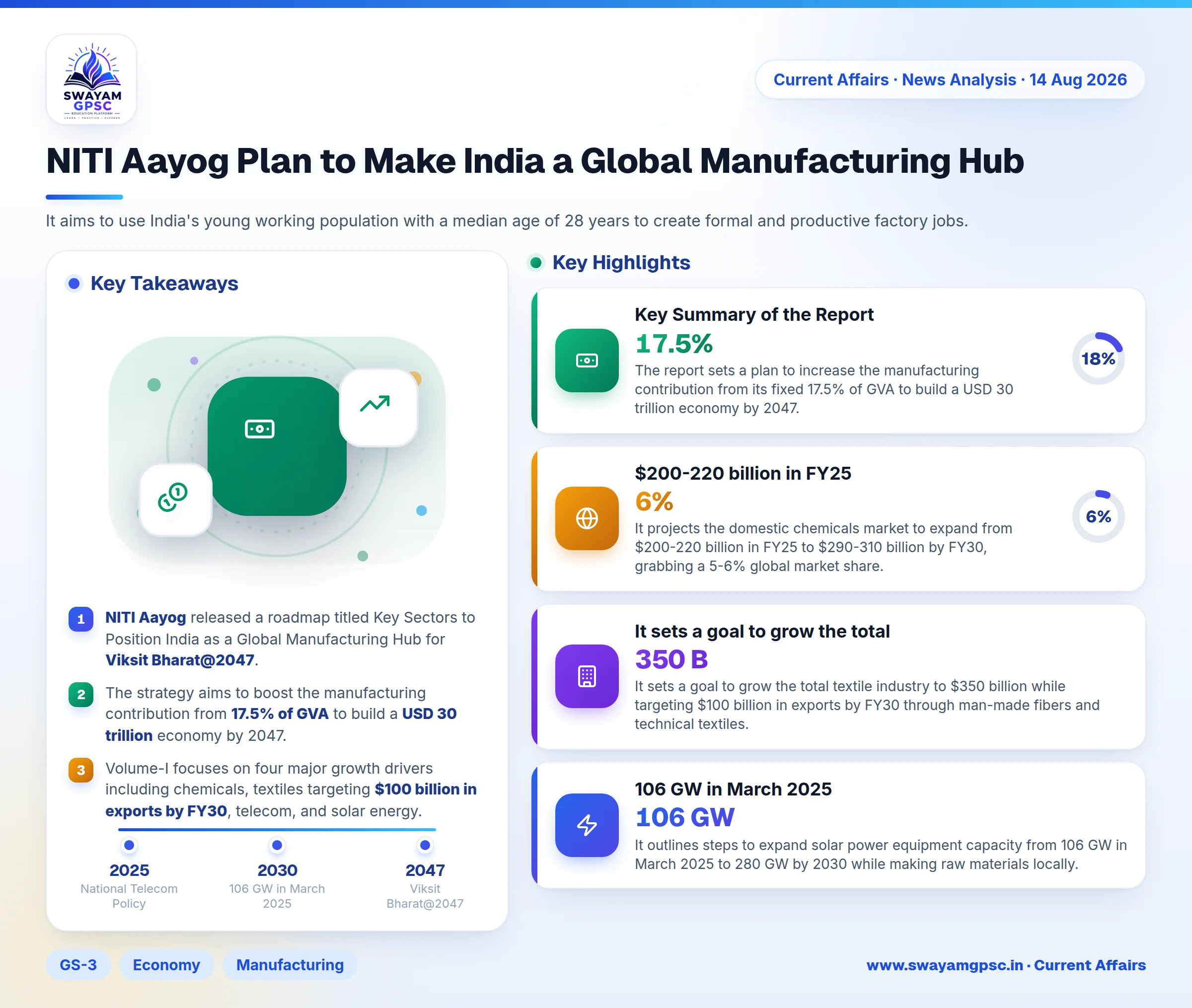
- NITI Aayog released a roadmap titled Key Sectors to Position India as a Global Manufacturing Hub for Viksit Bharat@2047.
- The strategy aims to boost the manufacturing contribution from 17.5% of GVA to build a USD 30 trillion economy by 2047.
- Volume-I focuses on four major growth drivers including chemicals, textiles targeting $100 billion in exports by FY30, telecom, and solar energy.
- Major manufacturing roadblocks include raw material import dependence of 85-90% for key chemicals and high logistics costs at 8% of GDP.
- Key fixes include adjusting inverted tariff structures, creating integrated clusters, and linking ports through PM Gati Shakti corridors.
Why in News
- NITI Aayog and CRISIL Intelligence jointly published a landmark report named Key Sectors to Position India as a Global Manufacturing Hub.
About the NITI Aayog Report
- The report creates a data-based guide to transform India from a country driven by domestic buying into a world-class manufacturing center by Viksit Bharat@2047.
- Researchers first mapped 62 industrial sectors and then selected 12 high-potential sectors using a detailed four-stage testing framework.
Key Summary of the Report
- The report sets a plan to increase the manufacturing contribution from its fixed 17.5% of GVA to build a USD 30 trillion economy by 2047.
- It aims to use India's young working population with a median age of 28 years to create formal and productive factory jobs.
- The study compares Indian factory capabilities directly with major global industrial leaders like China, Vietnam, Singapore, Germany, and South Korea.
- It projects the domestic chemicals market to expand from $200-220 billion in FY25 to $290-310 billion by FY30, grabbing a 5-6% global market share.
- It sets a goal to grow the total textile industry to $350 billion while targeting $100 billion in exports by FY30 through man-made fibers and technical textiles.
- It plans to double telecom exports and increase local parts creation under the National Telecom Policy 2025 instead of relying on basic assembly.
- It outlines steps to expand solar power equipment capacity from 106 GW in March 2025 to 280 GW by 2030 while making raw materials locally.
- It recommends linking specific manufacturing zones with major national infrastructure projects like PM Gati Shakti and PM MITRA Parks.
- It urges Indian factories to stop making low-value final products and move toward making complex high-value components and advanced machinery.
Key Sectors Identified in Volume-I
- The chemicals industry focus stays on making high-margin specialty chemicals like agrochemicals and dyes while solving basic feedstock deficits.
- The textile sector focuses on scaling up synthetic fibers like polyester, upgrading small weaving units, and improving cotton farm production.
- The telecom equipment sector focuses on making key parts locally for 5G and 6G networks, routers, and fiber optic systems to cut imports.
- The solar panel sector aims to build full domestic production lines from raw silicon and ingots down to final solar cells.
- The report reserves eight remaining sectors including electronics, automobiles, pharmaceuticals, steel, and food processing for future volumes.
Challenges Associated with Indian Manufacturing
- Indian factories face high import dependence for essential industrial inputs, such as importing 85-90% of needed methanol and acetic acid.
- Tax structures often charge higher taxes on raw materials than finished goods, which blocks company capital, such as taxing raw chemical inputs at 18% GST while finished fibers face 5% GST.
- Over 80% of textile businesses operate as small fragmented units that lack modern technology and easy loans.
- High transport costs at 8% of GDP and slow port delays hurt trade due to a lack of special chemical ports and fast connections.
- Worker output in sectors like textiles remains 50% lower than general standards, while private companies spend very little on research.
Recommendations Given by NITI Aayog
- The government should offer financial support through Production Linked Incentive (PLI) schemes and Viability Gap Funding (VGF) for critical raw materials.
- Authorities need to balance import duties and GST rates across full product chains so raw inputs do not cost more than final goods.
- States should speed up ready-to-use industrial parks equipped with shared water treatment facilities and single-window clearance systems.
- Port authorities should construct specialized berths for chemicals and dangerous liquids while linking ports directly to PM Gati Shakti transit corridors.
- The government should give tax deductions for research spending, encourage technology transfer deals, and sign balanced trade agreements with export partners.
Conclusion
- NITI Aayog provides a practical path to transform India into a strong global manufacturing power. Fixing raw material shortages, correcting tax errors, and building modern industrial clusters will make Indian products competitive worldwide and create quality jobs for Viksit Bharat@2047.