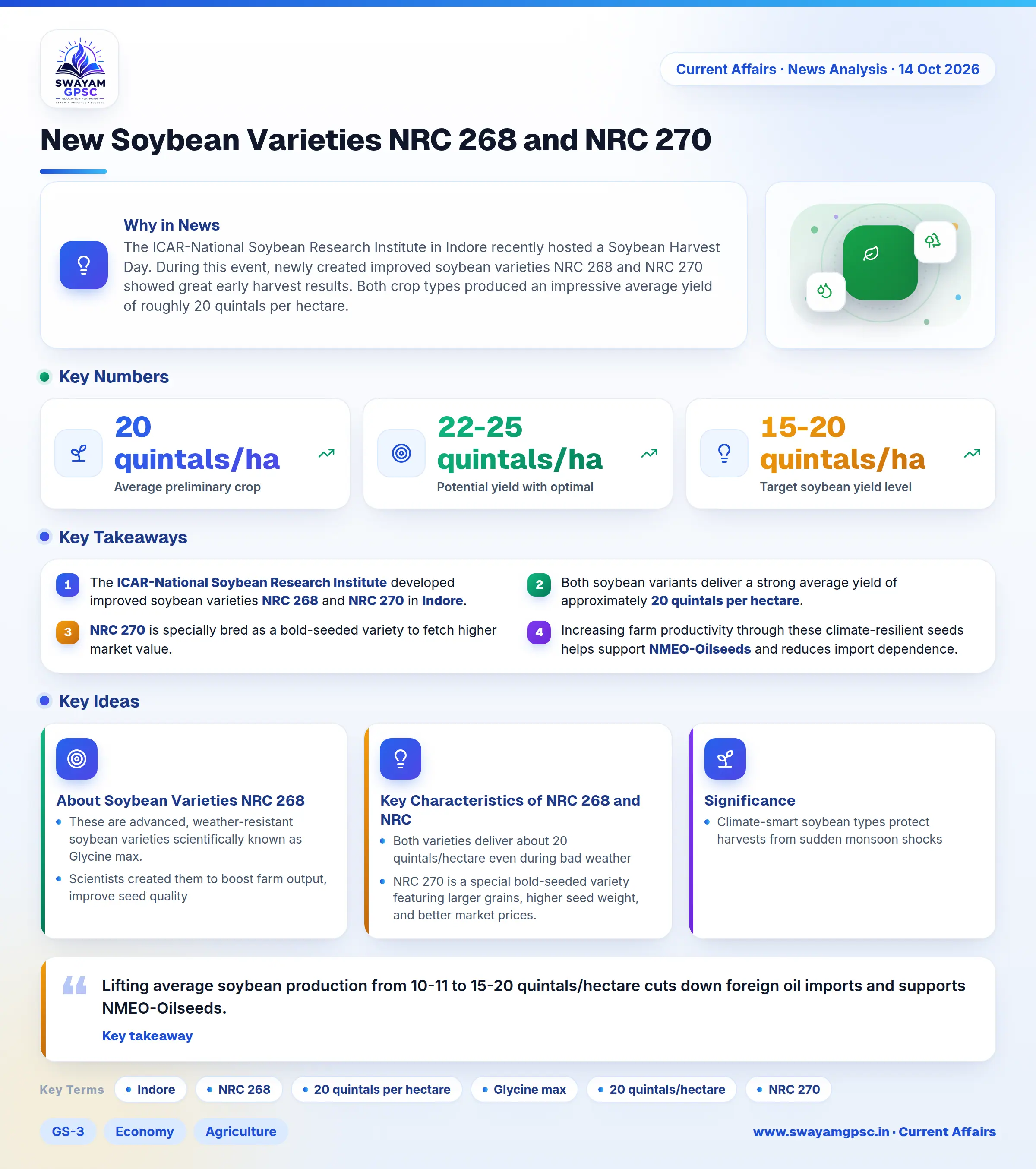
New Soybean Varieties NRC 268 and NRC 270
#GS-3 #Economy #Agriculture #Science & Technology #Biotechnology #Environment #Climate Change
Key takeaways
- The ICAR-National Soybean Research Institute developed improved soybean varieties NRC 268 and NRC 270 in Indore.
- Both soybean variants deliver a strong average yield of approximately 20 quintals per hectare.
- NRC 270 is specially bred as a bold-seeded variety to fetch higher market value.
- Increasing farm productivity through these climate-resilient seeds helps support NMEO-Oilseeds and reduces import dependence.
Why in News
- The ICAR-National Soybean Research Institute in Indore recently hosted a Soybean Harvest Day.
- During this event, newly created improved soybean varieties NRC 268 and NRC 270 showed great early harvest results.
- Both crop types produced an impressive average yield of roughly 20 quintals per hectare.
About Soybean Varieties NRC 268 and NRC 270
- These are advanced, weather-resistant soybean varieties scientifically known as Glycine max.
- Scientists created them to boost farm output, improve seed quality, and increase profits for oilseed farmers across Indian farming zones.
- The ICAR-National Soybean Research Institute (ICAR-NSRI) located in Indore, Madhya Pradesh, developed these seeds.
- The main goal is to close the production gap in domestic oilseed farming, fight unpredictable weather, and replace old low-yield seeds.
Key Characteristics of NRC 268 and NRC 270
- Both varieties deliver about 20 quintals/hectare even during bad weather, and can reach 22-25 quintals/hectare with best farming care.
- NRC 270 is a special bold-seeded variety featuring larger grains, higher seed weight, and better market prices.
- They offer strong resistance against irregular rainfall, dry spells, pests, and crop diseases to keep harvests safe during tough times.
- These seeds fit well in top soybean states like Madhya Pradesh, Maharashtra, and Rajasthan, especially during the kharif season.
- They contain high oil and protein levels, which helps both the edible oil industry and livestock feed producers.
Significance
- Lifting average soybean production from 10-11 to 15-20 quintals/hectare cuts down foreign oil imports and supports NMEO-Oilseeds.
- Climate-smart soybean types protect harvests from sudden monsoon shocks, guaranteeing steady farm yields and reliable incomes.