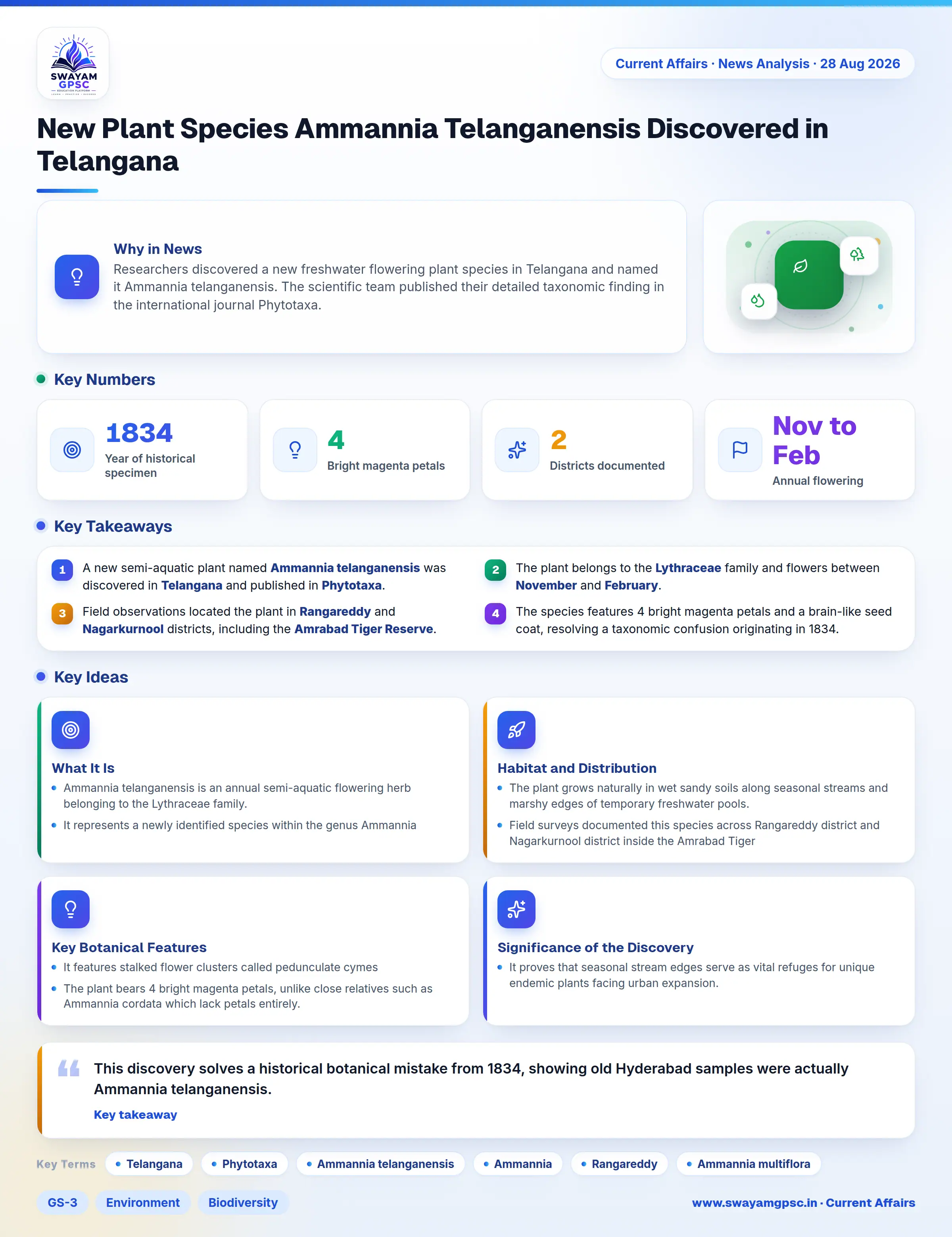
New Plant Species Ammannia Telanganensis Discovered in Telangana
#GS-3 #Environment #Biodiversity #Botany #Telangana #Prelims
Key takeaways
- A new semi-aquatic plant named Ammannia telanganensis was discovered in Telangana and published in Phytotaxa.
- The plant belongs to the Lythraceae family and flowers between November and February.
- Field observations located the plant in Rangareddy and Nagarkurnool districts, including the Amrabad Tiger Reserve.
- The species features 4 bright magenta petals and a brain-like seed coat, resolving a taxonomic confusion originating in 1834.
- The IUCN classifies its conservation status as Data Deficient (DD) until broader surveys are conducted.
Why in News
- Researchers discovered a new freshwater flowering plant species in Telangana and named it Ammannia telanganensis.
- The scientific team published their detailed taxonomic finding in the international journal Phytotaxa.
What It Is
- Ammannia telanganensis is an annual semi-aquatic flowering herb belonging to the Lythraceae family.
- It represents a newly identified species within the genus Ammannia, which includes herbs adapted to tropical and subtropical freshwater environments.
Habitat and Distribution
- The plant grows naturally in wet sandy soils along seasonal streams and marshy edges of temporary freshwater pools.
- Field surveys documented this species across Rangareddy district and Nagarkurnool district inside the Amrabad Tiger Reserve.
- It co-exists with other aquatic plant species such as Ammannia multiflora and various Rotala species.
- The plant enters its flowering and fruiting stage post-monsoon from November through February.
Key Botanical Features
- It features stalked flower clusters called pedunculate cymes, distinguishing it from related species with unstalked flowers.
- The plant bears 4 bright magenta petals, unlike close relatives such as Ammannia cordata which lack petals entirely.
- Microscopic analysis shows a brain-like cerebriform pattern on the surface of its seed coat.
- Its leaf and bract structures are specially adapted to handle fluctuating water levels in shallow stream habitats.
- Though meeting local standards for Endangered status, the IUCN currently lists it as Data Deficient (DD) until full surveys complete.
Significance of the Discovery
- This discovery solves a historical botanical mistake from 1834, showing old Hyderabad samples were actually Ammannia telanganensis.
- It proves that seasonal stream edges serve as vital refuges for unique endemic plants facing urban expansion.