New Corporate Average Fuel Economy (CAFE) Norms
#GS-3 #Environment #Pollution #Sustainable Development #Energy #Automobile Sector #CAFE Norms #Fuel Efficiency
Key takeaways
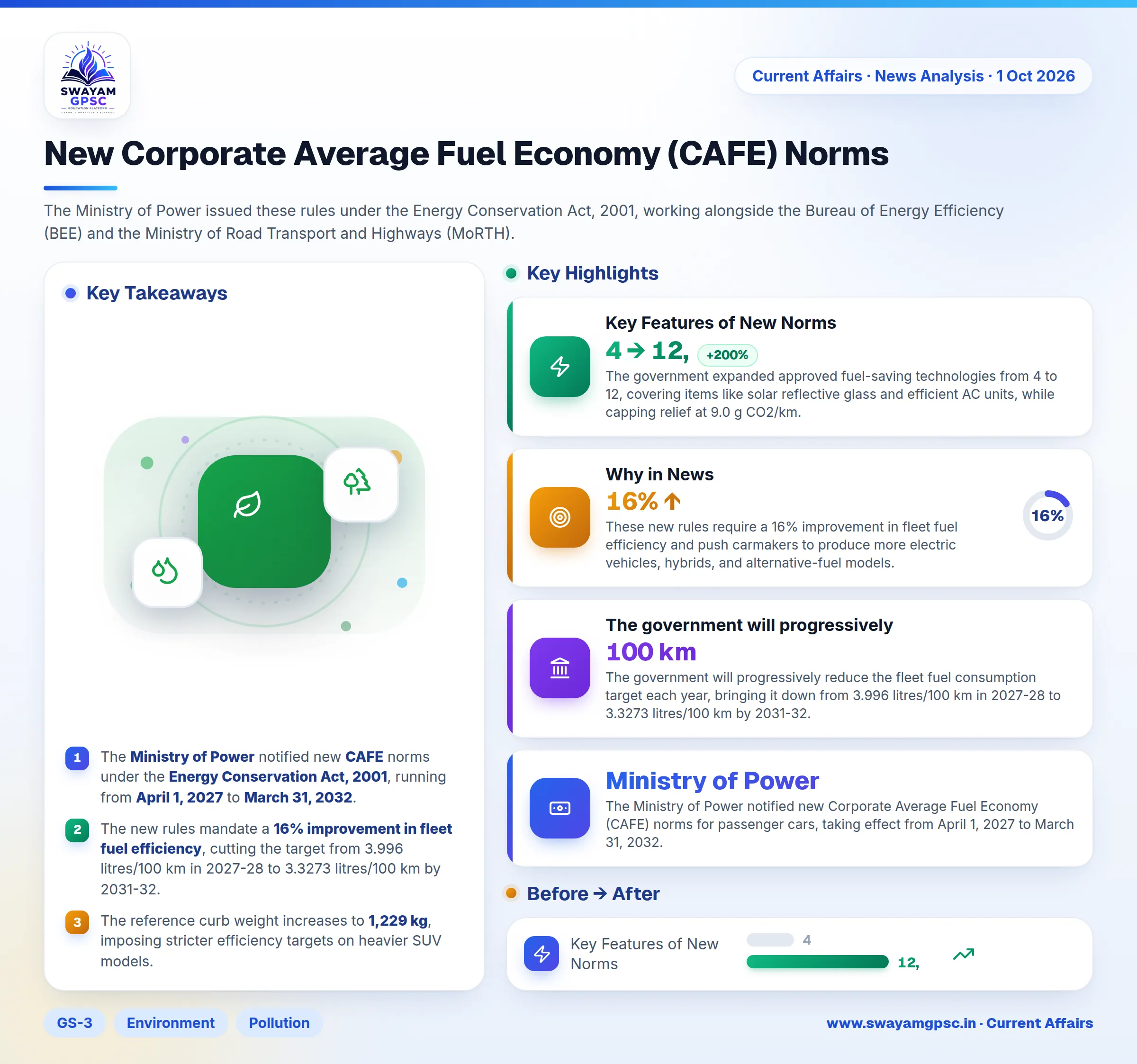
- The Ministry of Power notified new CAFE norms under the Energy Conservation Act, 2001, running from April 1, 2027 to March 31, 2032.
- The new rules mandate a 16% improvement in fleet fuel efficiency, cutting the target from 3.996 litres/100 km in 2027-28 to 3.3273 litres/100 km by 2031-32.
- The reference curb weight increases to 1,229 kg, imposing stricter efficiency targets on heavier SUV models.
- Automakers producing fewer than 1,000 units each year are entirely exempt from these standards.
Why in News
- The Ministry of Power notified new Corporate Average Fuel Economy (CAFE) norms for passenger cars, taking effect from April 1, 2027 to March 31, 2032.
- These new rules require a 16% improvement in fleet fuel efficiency and push carmakers to produce more electric vehicles, hybrids, and alternative-fuel models.
About CAFE Norms
- CAFE norms serve as a legal standard that limits the average fuel use and carbon dioxide emissions across all passenger cars sold by an automaker in India.
- The Ministry of Power issued these rules under the Energy Conservation Act, 2001, working alongside the Bureau of Energy Efficiency (BEE) and the Ministry of Road Transport and Highways (MoRTH).
- The primary goal is to lower India's crude oil import bills, cut vehicular emissions, and speed up the adoption of clean vehicles without limiting customer choice.
Key Features of New Norms
- The government will progressively reduce the fleet fuel consumption target each year, bringing it down from 3.996 litres/100 km in 2027-28 to 3.3273 litres/100 km by 2031-32.
- The rules raise the reference vehicle weight from 1,082 kg to 1,229 kg, which eases requirements for lightweight cars but imposes stricter standards on heavy SUVs.
- A new Carbon Neutrality Factor (CNF) gives compliance credits to carmakers using green domestic fuels like ethanol blends, biofuels, and compressed bio-gas (CBG).
- The framework gives super credits to electric vehicles, plug-in hybrids, strong hybrids, flex-fuel vehicles, and range-extended EVs during overall fleet calculations.
- The government expanded approved fuel-saving technologies from 4 to 12, covering items like solar reflective glass and efficient AC units, while capping relief at 9.0 g CO2/km.
- Automakers gain flexibility through multi-year compliance cycles, inter-company credit trading, and a direct buyout mechanism managed by the Bureau of Energy Efficiency (BEE).
- Testing will use both the Modified Indian Driving Cycle (MIDC) and WLTP standards, while small carmakers selling fewer than 1,000 units annually receive full exemption.