New Additions to India's UNESCO Tentative List
#GS-1 #History #Modern India #Culture #Art & Architecture #Heritage #Indian Society #Current Events #National
Key takeaways
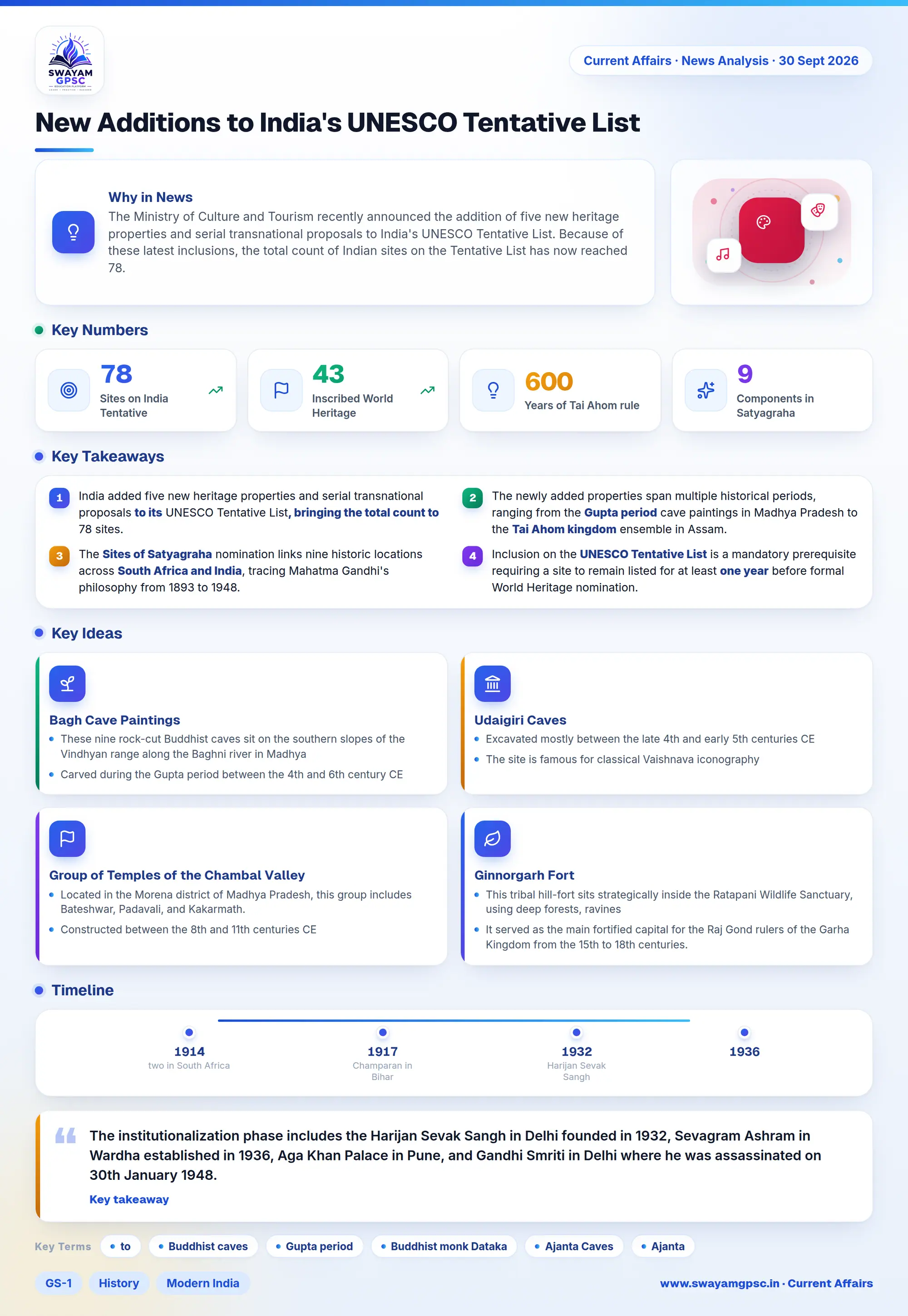
- India added five new heritage properties and serial transnational proposals to its UNESCO Tentative List, bringing the total count to 78 sites.
- The newly added properties span multiple historical periods, ranging from the Gupta period cave paintings in Madhya Pradesh to the Tai Ahom kingdom ensemble in Assam.
- The Sites of Satyagraha nomination links nine historic locations across South Africa and India, tracing Mahatma Gandhi's philosophy from 1893 to 1948.
- Inclusion on the UNESCO Tentative List is a mandatory prerequisite requiring a site to remain listed for at least one year before formal World Heritage nomination.
Why in News
- The Ministry of Culture and Tourism recently announced the addition of five new heritage properties and serial transnational proposals to India's UNESCO Tentative List.
- Because of these latest inclusions, the total count of Indian sites on the Tentative List has now reached 78.
Bagh Cave Paintings
- These nine rock-cut Buddhist caves sit on the southern slopes of the Vindhyan range along the Baghni river in Madhya Pradesh, forming the only sandstone outcrop in an otherwise basaltic region.
- Carved during the Gupta period between the 4th and 6th century CE, ancient inscriptions from 358 to 487 AD use administrative terms like Valkha and Vikha-adishthana, proving the site was a major political hub rather than a simple isolated retreat.
- The complex served as a major Buddhist monastic center under the Buddhist monk Dataka, featuring assembly halls, residential cells, pillared verandas, and stupas.
- The mural paintings show clear technical ties with the Ajanta Caves while keeping a distinct regional style, using earth and lime plasters along with mineral pigments like lapis lazuli, terre verte, red and yellow ochre, and carbon.
- These murals stand alongside famous traditions found in Ajanta, Sigiriya in Sri Lanka, and Mogao in China.
Udaigiri Caves
- Excavated mostly between the late 4th and early 5th centuries CE, this Madhya Pradesh site contains twenty rock-cut caves commissioned under Gupta rulers Chandragupta II and Kumaragupta I.
- The site is famous for classical Vaishnava iconography, especially the massive Varaha panel showing the divine rescue of Prithvi and the reclining Anantasayana Vishnu.
- Alongside monuments dedicated to Vaishnava and Shaivism, the complex includes Jain excavations, showing the strong religious pluralism of the Gupta era.
- The architecture acts as a vital bridge connecting early monolithic rock-cut traditions with later freestanding stone temples featuring carved sanctums and axial entry plans.
- Artistically, the caves blend Mathura and Malwa regional styles with standard Gupta classical aesthetics, setting a design standard for northern and central Indian temples.
Group of Temples of the Chambal Valley
- Located in the Morena district of Madhya Pradesh, this group includes Bateshwar, Padavali, and Kakarmath.
- Constructed between the 8th and 11th centuries CE, these monuments show how regional architecture evolved under the Gurjara-Pratihara and Kachchhapaghata dynasties.
- The temples represent outstanding examples of Nagara-style temple architecture, featuring axial layouts, prominent shikharas, detailed sandstone carvings, and advanced dry masonry construction built entirely without mortar.
Ginnorgarh Fort
- This tribal hill-fort sits strategically inside the Ratapani Wildlife Sanctuary, using deep forests, ravines, and steep slopes as natural defenses.
- It served as the main fortified capital for the Raj Gond rulers of the Garha Kingdom from the 15th to 18th centuries.
- After legendary Gond queen Rani Durgavati fell in 1564 CE, the region came under Mughal control while keeping strong local Gond traditions.
- The fort layout follows a strict tribal social hierarchy, divided into the outer Morcha zone, the middle Amghera administrative zone, and an inner royal core.
- Builders used local stone, lime, and surkhi, bound together with organic binders like natural jaggery and Bael pulp to construct structures like the Rani Mahal.
- The architecture combines native Gond planning with Mughal and Indo-Islamic elements such as engrailed arches and multi-faceted pillars.
Rangpur-Sivasagar Historical Ensemble
- This Assam ensemble forms the political and architectural heartland of the Tai Ahom kingdom.
- Led by Siu-ka-pha, the Tai Ahom people entered Assam from modern-day Myanmar in 1228 CE and ruled the Brahmaputra Valley for 600 years.
- They successfully fought off Mughal expansion during the Battle of Saraighat in 1671 before falling due to Burmese invasions and British annexation under the Treaty of Yandaboo in 1826.
- The ensemble centers around Rangpur and Sivasagar, showcasing an architectural shift from wood and bamboo to permanent brick and stone structures.
- Ahom temples feature octagonal plinths reflecting Ahom cosmology, topped by distinctive hybrid shikhara spires.
- The rulers built massive reservoirs using the Paik system of labor and applied advanced indigenous techniques like the Nagastambha wooden pillar to locate water sources safely.
- Key monuments include Rang Ghar, recognized as one of Asia's oldest amphitheatres with an Ahom boat-shaped roof, and Talatal Ghar, a multi-level royal palace and military citadel.
- Other notable sites include Ghanashyam House, Pohugarh, and the Namdang Stone Bridge built in 1703 from a single stone monolith using traditional organic mortar.
Sites of Satyagraha
- This proposed serial transnational property connects nine components, with two in South Africa covering Gandhi's 21-year stay from 1893 to 1914 and seven in India tracing the growth of the Satyagraha movement.
- The South African phase includes Pietermaritzburg Station, where Gandhi experienced his 1893 train eviction, and the Phoenix Settlement founded in 1904 as his first ashram base.
- The Indian consolidation phase covers Champaran in Bihar for Gandhi's first Indian Satyagraha in 1917, Sabarmati Ashram in Gujarat established in 1917, and Mani Bhavan in Mumbai.
- The institutionalization phase includes the Harijan Sevak Sangh in Delhi founded in 1932, Sevagram Ashram in Wardha established in 1936, Aga Khan Palace in Pune, and Gandhi Smriti in Delhi where he was assassinated on 30th January 1948.
UNESCO Tentative List
- The Tentative List serves as an official inventory of cultural and natural heritage sites that a country considers to have outstanding universal value.
- Inclusion on this list is a mandatory prerequisite, as UNESCO rules state a site must remain on it for at least one year before formal nomination.
- India now has 78 sites on the Tentative List alongside 43 inscribed World Heritage Sites.