NBA Disburses Access and Benefit Sharing Funds
#Rapid Fire CA #Quick Facts For Prelims #Government Policies & Interventions #International Treaties & Agreements #Conservation #Biodiversity Hotspots #Economy #Environment #GS-2 #GS-3 #Governance & Social Justice #Current Events #Agriculture #Sustainable Development
Key takeaways
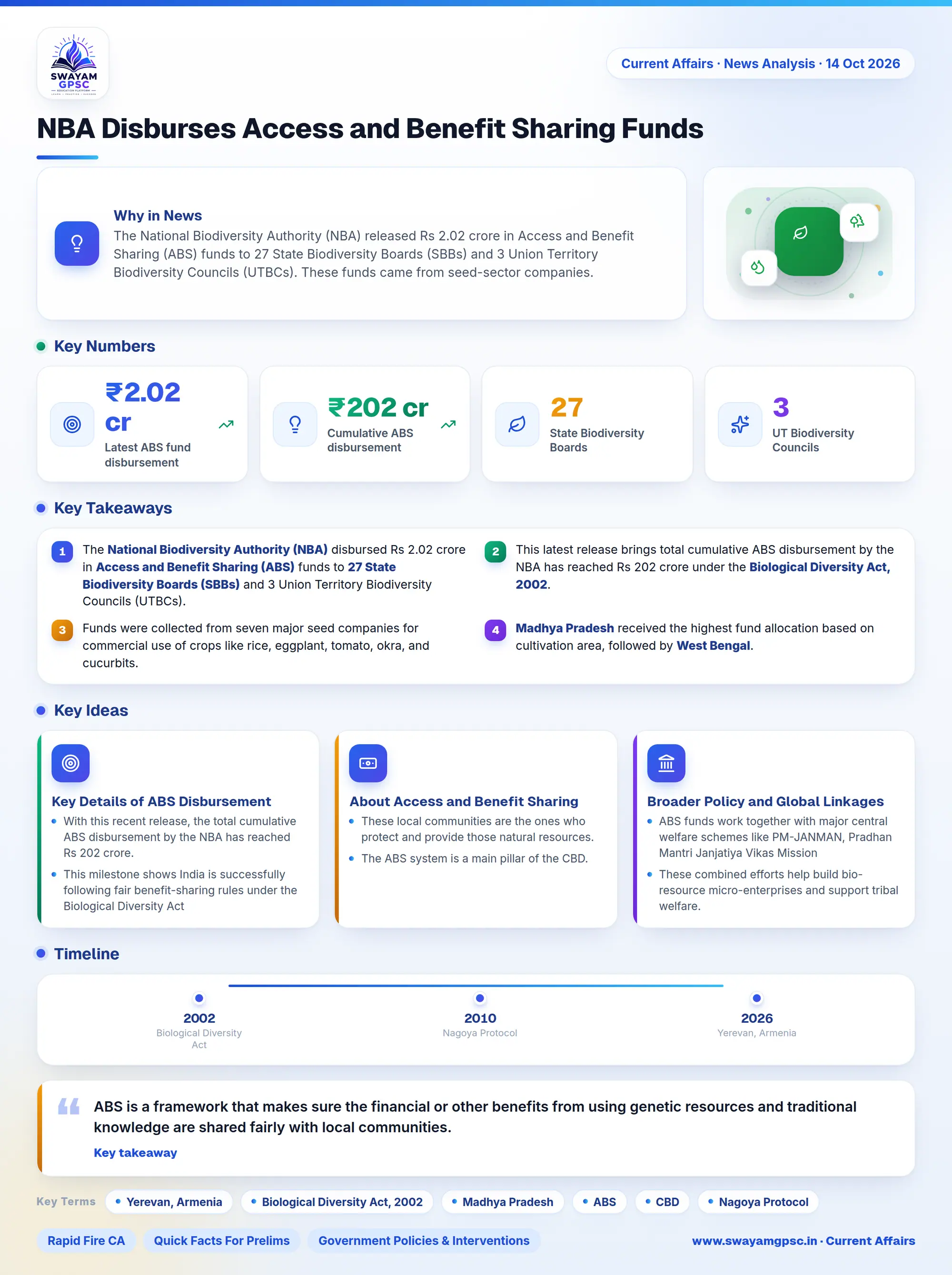
- The National Biodiversity Authority (NBA) disbursed Rs 2.02 crore in Access and Benefit Sharing (ABS) funds to 27 State Biodiversity Boards (SBBs) and 3 Union Territory Biodiversity Councils (UTBCs).
- This latest release brings total cumulative ABS disbursement by the NBA has reached Rs 202 crore under the Biological Diversity Act, 2002.
- Funds were collected from seven major seed companies for commercial use of crops like rice, eggplant, tomato, okra, and cucurbits.
- Madhya Pradesh received the highest fund allocation based on cultivation area, followed by West Bengal.
- The ABS mechanism aligns with Target 13 and Target 19 of the Kunming-Montreal Global Biodiversity Framework (KMGBF) and supports several Sustainable Development Goals (SDGs).
Why in News
- The National Biodiversity Authority (NBA) released Rs 2.02 crore in Access and Benefit Sharing (ABS) funds to 27 State Biodiversity Boards (SBBs) and 3 Union Territory Biodiversity Councils (UTBCs).
- These funds came from seed-sector companies.
- This financial release aims to strengthen biodiversity conservation and fair benefit-sharing before the 17th Conference of the Parties (COP 17) to the Convention on Biological Diversity (CBD).
- The event is scheduled to start in October 2026 in Yerevan, Armenia.
Key Details of ABS Disbursement
- With this recent release, the total cumulative ABS disbursement by the NBA has reached Rs 202 crore.
- This milestone shows India is successfully following fair benefit-sharing rules under the Biological Diversity Act, 2002.
- The money was collected from seven major seed firms.
- These firms used parental varieties and hybrids of staple and vegetable crops for commercial purposes, including rice, eggplant, tomato, okra, and cucurbits.
- Authorities could not trace individual grassroots benefit-claimers for these market-procured crops.
- As a result, funds were distributed based on the cultivation area of respective resources using figures from the Ministry of Agriculture and Farmers Welfare.
- Madhya Pradesh received the highest share of funds, followed by West Bengal.
- The distributed money will directly support the working of Biodiversity Management Committees (BMCs).
- It will also help update People’s Biodiversity Registers (PBRs).
- Other uses include protecting local landraces, medicinal plants, and restoring natural habitats.
About Access and Benefit Sharing
- ABS is a framework that makes sure the financial or other benefits from using genetic resources and traditional knowledge are shared fairly with local communities.
- These local communities are the ones who protect and provide those natural resources.
- The ABS system is a main pillar of the CBD.
- The Nagoya Protocol, adopted in 2010, further operationalized this system around the world.
- In India, the Biological Diversity Act, 2002 handles the legal side of ABS.
- This law routes benefit-sharing funds through the NBA to help local groups and protect nature.
Broader Policy and Global Linkages
- ABS funds work together with major central welfare schemes like PM-JANMAN, Pradhan Mantri Janjatiya Vikas Mission, and Pradhan Mantri Van Dhan Yojana.
- These combined efforts help build bio-resource micro-enterprises and support tribal welfare.
- Disbursing these funds shows India is making strong progress under the National Biodiversity Strategy and Action Plan (NBSAP) 2024-2030.
- It also fulfills Target 13 (Equitable ABS) and Target 19 (Resource Mobilisation) of the Kunming-Montreal Global Biodiversity Framework (KMGBF).
- ABS directly supports SDG 2 (Zero Hunger), SDG 8 (Decent Work), SDG 12 (Responsible Consumption and Production), SDG 15 (Life on Land), and SDG 17 (Partnerships for the Goals).