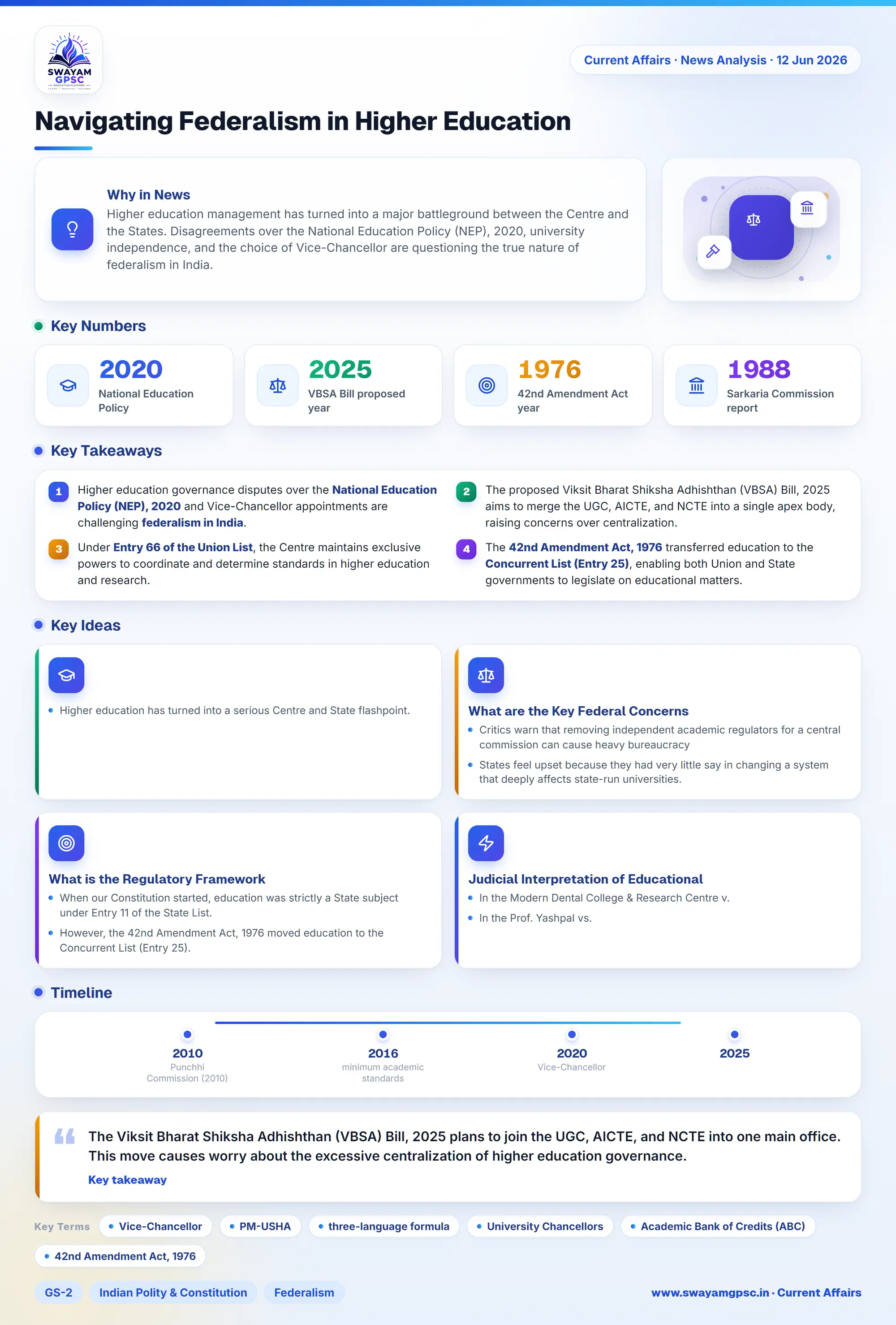
Navigating Federalism in Higher Education
#GS-2 #Indian Polity & Constitution #Federalism #Governance & Social Justice #Good Governance #Education #Government Policies & Interventions #Co-operative Federalism
Key takeaways
- Higher education governance disputes over the National Education Policy (NEP), 2020 and Vice-Chancellor appointments are challenging federalism in India.
- The proposed Viksit Bharat Shiksha Adhishthan (VBSA) Bill, 2025 aims to merge the UGC, AICTE, and NCTE into a single apex body, raising concerns over centralization.
- Under Entry 66 of the Union List, the Centre maintains exclusive powers to coordinate and determine standards in higher education and research.
- The 42nd Amendment Act, 1976 transferred education to the Concurrent List (Entry 25), enabling both Union and State governments to legislate on educational matters.
Why in News
- Higher education management has turned into a major battleground between the Centre and the States. Disagreements over the National Education Policy (NEP), 2020, university independence, and the choice of Vice-Chancellor are questioning the true nature of federalism in India.
Summary
- Higher education has turned into a serious Centre and State flashpoint. Issues like the National Education Policy (NEP), 2020, the VBSA Bill, unified entrance exams, Vice-Chancellor selections, and online rules create worries about too much central control and the loss of state independence.
- Fixing educational federalism needs cooperative governance. This means the Centre must talk more with States, share funding fairly, include state members in rule-making bodies, and allow freedom in applying national reforms while keeping standard academic levels.
What are the Key Federal Concerns in Higher Education?
- The Viksit Bharat Shiksha Adhishthan (VBSA) Bill, 2025 plans to join the UGC, AICTE, and NCTE into one main office. This move causes worry about the excessive centralization of higher education governance.
- Critics warn that removing independent academic regulators for a central commission can cause heavy bureaucracy and lower institutional freedom.
- States feel upset because they had very little say in changing a system that deeply affects state-run universities.
- Central funding through *PM-USHA* and the Anusandhan National Research Foundation comes with strict rules. States must follow Union reform plans to get money, and keeping grants in the Central Ministry takes away state power to fund local research needs.
- Pushing the Four-Year Undergraduate Programme (FYUP) ignores local problems with buildings, teachers, and student readiness.
- Promoting the three-language formula faces strong political pushback in states like Tamil Nadu. They see it as a forced rule that hurts local language identity and constitutional rights.
- Governors acting as University Chancellors in states like Kerala, West Bengal, and Tamil Nadu make unilateral Vice-Chancellor choices. This skips elected state leaders and acts as a tool for central meddling in local work.
- Mandatory central databases like the Academic Bank of Credits (ABC) act as tools for heavy central tracking and strict uniformity. In the end, this crushes local and creative teaching methods.
- Forcing centralized exams like NEET for medical courses ignores state school board syllabi.
- States, especially Tamil Nadu, say this harms rural and state-board students, breaks the state right to handle admissions, and ruins state reservation rules.
- Moving from traditional infrastructure grants given by the UGC to loan-based funding via the Higher Education Financing Agency (HEFA) creates big friction.
- State universities do not have the massive money funds of central institutes. They argue this pushes them into debt, which leads to higher fees and goes against state welfare goals.
What is the Regulatory Framework for Education in India?
- When our Constitution started, education was strictly a State subject under Entry 11 of the State List.
- However, the 42nd Amendment Act, 1976 moved education to the Concurrent List (Entry 25). This change gave both the Union and State governments the power to make laws on education and universities.
- If a fight happens between a Central law and a State law on this subject, the Central law wins according to Article 254.
- The Centre keeps special law-making powers over institutions of national importance. Most importantly, it controls the coordination and determination of standards in higher education and research under Entry 66 of the Union List.
- The Union government uses big influence over schools and colleges nationwide through the Ministry of Education, the University Grants Commission (UGC), and central checking and approval bodies.
Judicial Interpretation of Educational Federalism
- In the Modern Dental College & Research Centre v. State of Madhya Pradesh (2016) case, the Supreme Court ruled that the Centre has the only right to set *minimum academic standards* under Entry 66. Meanwhile, States keep the power to control local rules like admissions, fee limits, and stopping commercial use under Entry 25, as long as state rules do not break Central standards.
- In the Prof. Yashpal vs. State of Chhattisgarh (2005) case, the Supreme Court clearly stated that keeping high education standards is only a job for Parliament. States cannot pass laws that lower the study levels fixed by central bodies like the UGC.
- In the State of T.N. v. Adhiyaman Educational & Research Institute (1995) case, the Supreme Court ruled that when laws overlap, Central rules on standards like the UGC Act (1956) and the AICTE Act (1987) will win.
- States cannot lower or weaken study levels set by Central bodies. This judgment makes the power of Entry 66 stronger than Entry 25.
Key Commission Recommendations
- The Sarkaria Commission (1988) stressed the value of cooperative federalism. It advised that while the Union should focus on setting rules and standards through bodies like the UGC, the real work of running education policies should stay entirely with the States.
- The Punchhi Commission (2010) suggested removing politics from the job of Governors acting as University Chancellors to stop daily fights in higher education management.
What Measures are Needed to Strengthen Federalism in Higher Education?
- The Central Advisory Board of Education (CABE) and the Inter-State Council must meet regularly. This ensures major law changes like the VBSA use an agreement-based approach instead of orders from the top.
- The Centre should give States the freedom to change national policies to match their unique social and money conditions. The Centre should only focus on keeping minimum academic standards under Entry 66 without controlling daily college work.
- Standard rules like the three-language formula or central entrance tests like CUET must offer state-level choices. This respects local language identities and state school board syllabi.
- Money plans must focus on cooperative funding models that lift state universities without tough conditions. We must accept that India's Gross Enrolment Ratio (GER) targets depend heavily on state-level infrastructure.
- If big central bodies like the Viksit Bharat Shiksha Adhishthan (VBSA) are set up, their managing boards must include fair and rotating members from State Higher Education Councils.
- This step stops heavy bureaucracy and hyper-centralization in managing academic institutions.
Conclusion
- A strong higher education network cannot be built using orders from the top. True excellence and global success happen only when the Centre acts as a guide by setting minimum standards and funds, while states act as equal and independent partners in applying reforms that fit their local realities.