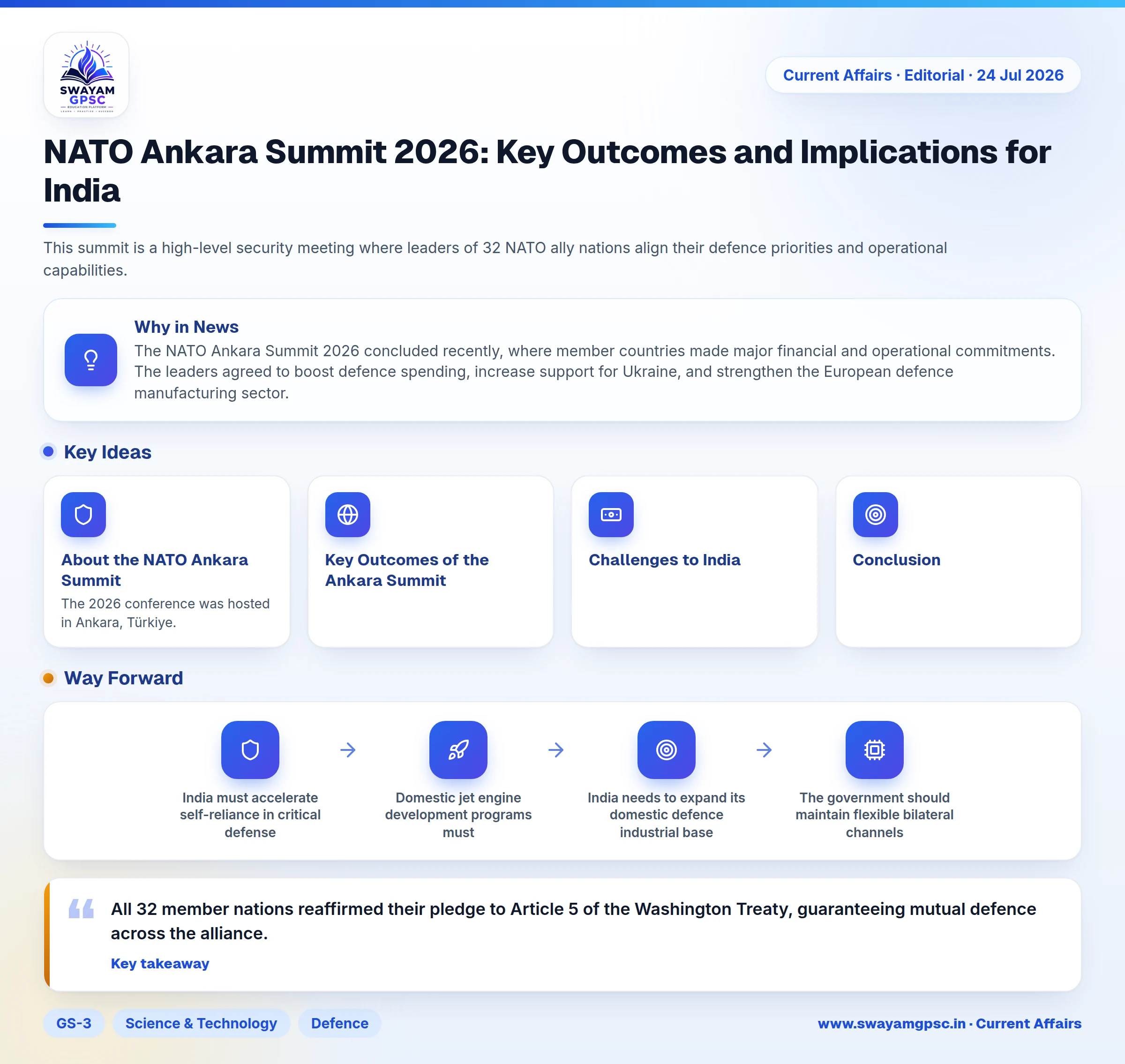
NATO Ankara Summit 2026: Key Outcomes and Implications for India
#GS-3 #Science & Technology #Defence #Current Events #International #NATO #Ankara Summit 2026
Why in News
- The NATO Ankara Summit 2026 concluded recently, where member countries made major financial and operational commitments.
- The leaders agreed to boost defence spending, increase support for Ukraine, and strengthen the European defence manufacturing sector.
About the NATO Ankara Summit
- This summit is a high-level security meeting where leaders of 32 NATO ally nations align their defence priorities and operational capabilities.
- The 2026 conference was hosted in Ankara, Türkiye.
- It serves as a follow-up to the 2025 Hague Summit to enforce long-term funding targets amid ongoing conflicts in Eastern Europe and West Asia.
Key Outcomes of the Ankara Summit
- All 32 member nations reaffirmed their pledge to Article 5 of the Washington Treaty, guaranteeing mutual defence across the alliance.
- The alliance endorsed The Hague defence commitment, which requires every member to spend a minimum of 5% of GDP on defence by 2035.
- Member states pledged long-term financial, strategic, and military assistance to protect the sovereignty of Ukraine.
- Allies agreed to create a high-tech network of research labs and factories across Europe to build a resilient Defence Industrial Base (DIB).
- NATO shifted its core operational posture from short-term crisis management to long-term military innovation and rapid factory production.
Challenges to India
- Heavy purchasing by NATO countries is transforming the global arms trade into a tight sellers market where buyers have less leverage.
- Western defence manufacturers are overburdened with NATO orders, causing supply delays for India such as GE Aerospace delaying F-404 jet engines for the Tejas LCA program.
- High consumption in regional wars has created severe shortages in global inventories of precision missiles, artillery shells, and air defence interceptors.
- European countries are relying heavily on US defence suppliers, which crowds out non-NATO nations competing for the same factory assembly lines.
- India's dependence on foreign original equipment manufacturers threatens its modernization plans for AI tools, autonomous drones, and electronic warfare systems.
Way Forward
- India must accelerate self-reliance in critical defense sectors by boosting domestic research in artificial intelligence, unmanned drones, cyber defence, and electronic warfare.
- Domestic jet engine development programs must be fast-tracked to eliminate structural vulnerabilities in aerospace manufacturing.
- India needs to expand its domestic defence industrial base across both public and private sectors to manufacture heavy artillery, air defence systems, and precision weapons.
- The government should maintain flexible bilateral channels for weapon purchases while strictly demanding full technology transfers and local co-production.
- National inventory reserves of raw materials, microchips, and crucial components must be built to safeguard domestic defence production against global supply chain shocks.
Conclusion
- The NATO Ankara Summit signals a clear shift where Western nations are prioritizing their own military rearmament over external supply needs.
- Relying on overstretched foreign defence suppliers poses a direct risk to India's operational readiness and strategic autonomy.
- Achieving complete self-reliance in next-generation military technologies is the only way to safeguard national security in an uncertain global environment.