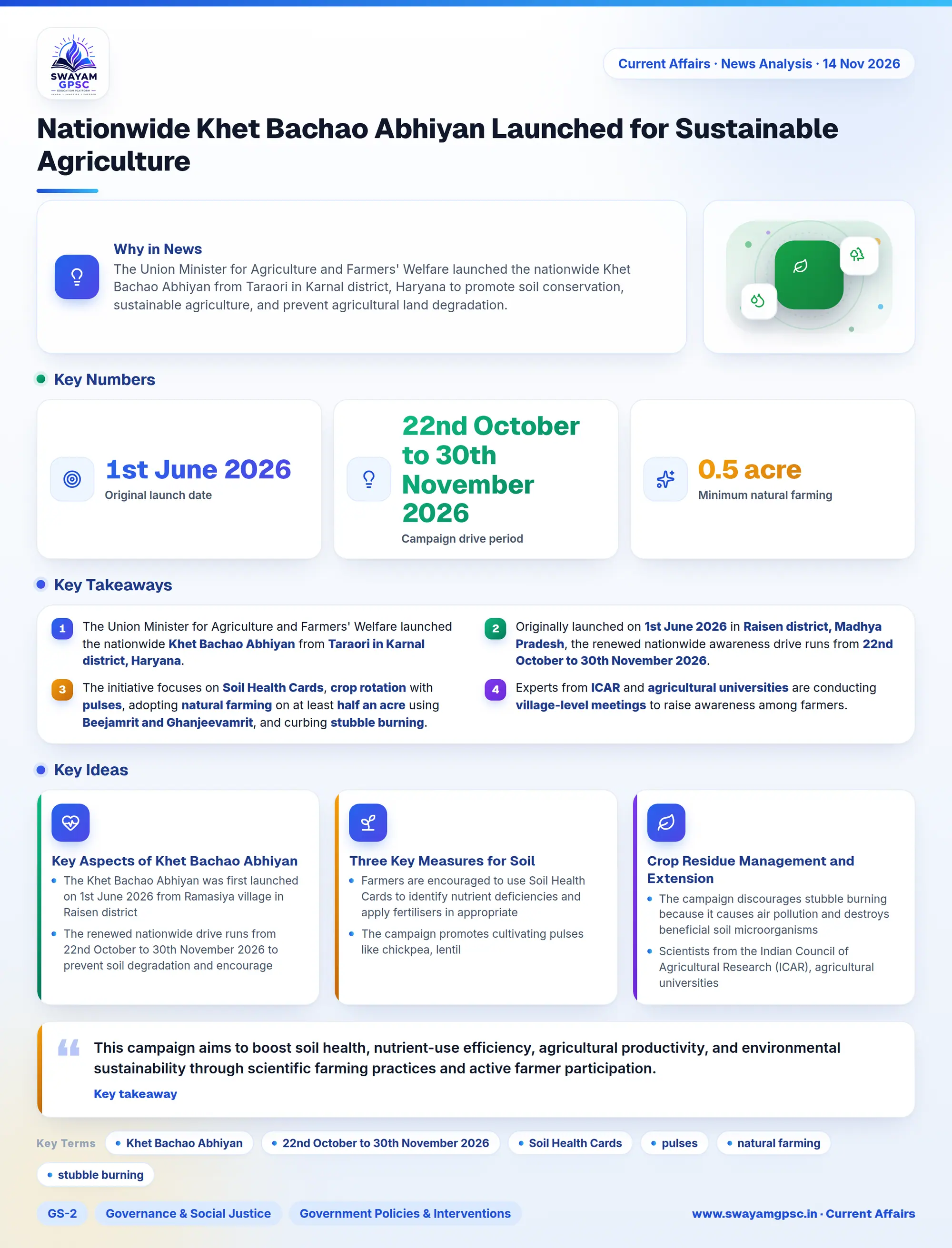
Nationwide Khet Bachao Abhiyan Launched for Sustainable Agriculture
#GS-2 #Governance & Social Justice #Government Policies & Interventions #GS-3 #Economy #Agriculture #Environment #Sustainable Development #Current Events #National
Key takeaways
- The Union Minister for Agriculture and Farmers' Welfare launched the nationwide Khet Bachao Abhiyan from Taraori in Karnal district, Haryana.
- Originally launched on 1st June 2026 in Raisen district, Madhya Pradesh, the renewed nationwide awareness drive runs from 22nd October to 30th November 2026.
- The initiative focuses on Soil Health Cards, crop rotation with pulses, adopting natural farming on at least half an acre using Beejamrit and Ghanjeevamrit, and curbing stubble burning.
- Experts from ICAR and agricultural universities are conducting village-level meetings to raise awareness among farmers.
Why in News
- The Union Minister for Agriculture and Farmers' Welfare launched the nationwide Khet Bachao Abhiyan from Taraori in Karnal district, Haryana to promote soil conservation, sustainable agriculture, and prevent agricultural land degradation.
Key Aspects of Khet Bachao Abhiyan
- The Khet Bachao Abhiyan was first launched on 1st June 2026 from Ramasiya village in Raisen district, Madhya Pradesh as a nationwide awareness campaign focusing on soil health, balanced fertiliser application, natural farming, water conservation, and scientific agricultural practices.
- The renewed nationwide drive runs from 22nd October to 30th November 2026 to prevent soil degradation and encourage sustainable farming practices.
Three Key Measures for Soil Conservation
- Farmers are encouraged to use Soil Health Cards to identify nutrient deficiencies and apply fertilisers in appropriate quantities to prevent soil degradation.
- The campaign promotes cultivating pulses like chickpea, lentil, and pigeon pea instead of the continuous paddy-wheat cycle because pulses improve soil fertility through biological nitrogen fixation.
- Farmers are advised to adopt natural farming on at least half an acre using Beejamrit and Ghanjeevamrit to reduce reliance on chemical inputs and lower cultivation costs.
Crop Residue Management and Extension Activities
- The campaign discourages stubble burning because it causes air pollution and destroys beneficial soil microorganisms, insects, and earthworms essential for soil fertility.
- Scientists from the Indian Council of Agricultural Research (ICAR), agricultural universities, and government departments will conduct village-level meetings and farmer awareness programmes to promote balanced nutrient management and crop rotation.
Significance
- This campaign aims to boost soil health, nutrient-use efficiency, agricultural productivity, and environmental sustainability through scientific farming practices and active farmer participation.