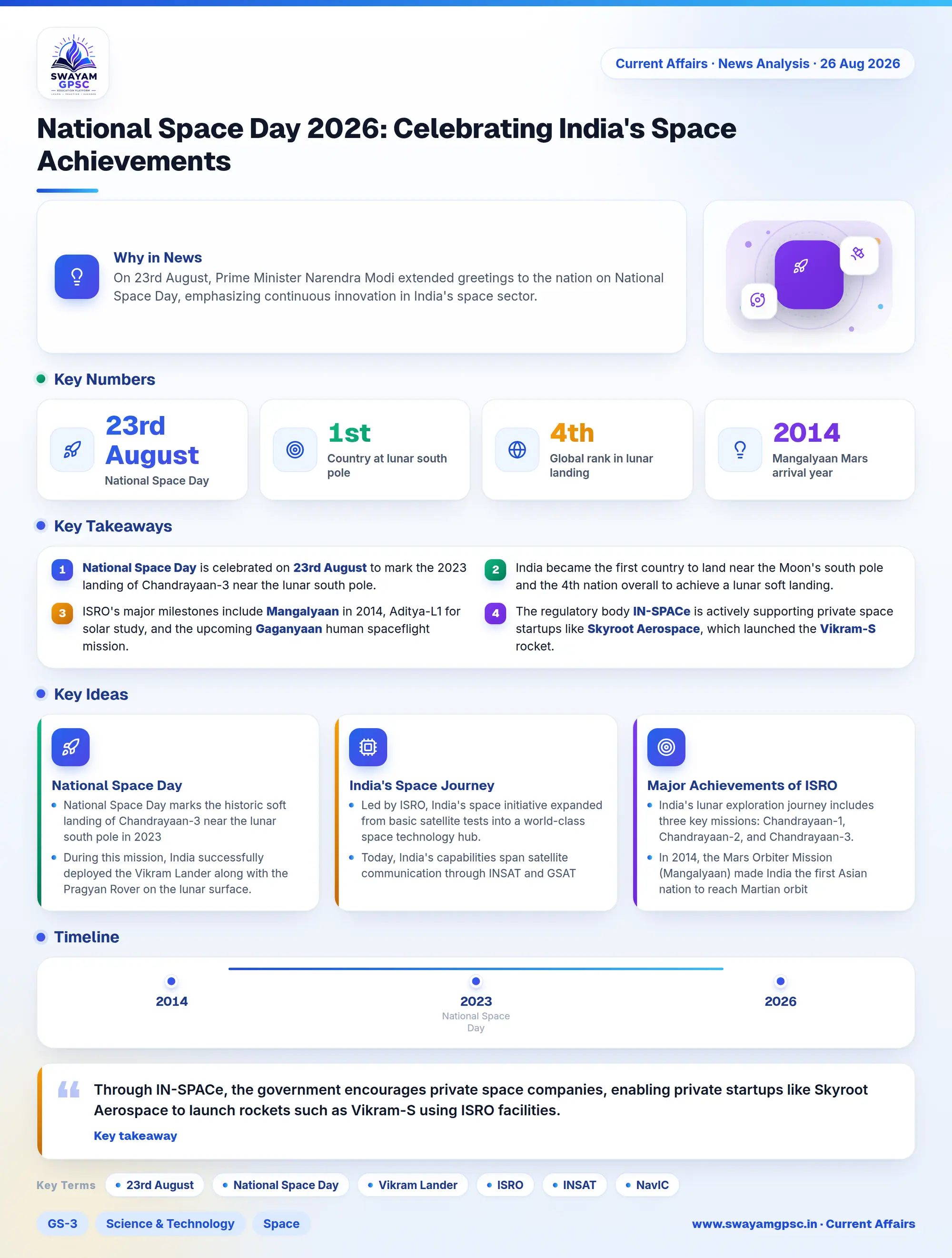
National Space Day 2026: Celebrating India's Space Achievements
#GS-3 #Science & Technology #Space #GS-2 #Current Events #National #ISRO #Chandrayaan-3
Key takeaways
- National Space Day is celebrated on 23rd August to mark the 2023 landing of Chandrayaan-3 near the lunar south pole.
- India became the first country to land near the Moon's south pole and the 4th nation overall to achieve a lunar soft landing.
- ISRO's major milestones include Mangalyaan in 2014, Aditya-L1 for solar study, and the upcoming Gaganyaan human spaceflight mission.
- The regulatory body IN-SPACe is actively supporting private space startups like Skyroot Aerospace, which launched the Vikram-S rocket.
Why in News
- On 23rd August, Prime Minister Narendra Modi extended greetings to the nation on National Space Day, emphasizing continuous innovation in India's space sector.
National Space Day
- National Space Day marks the historic soft landing of Chandrayaan-3 near the lunar south pole in 2023, making India the first country to reach this polar region and the fourth to land on the Moon.
- During this mission, India successfully deployed the Vikram Lander along with the Pragyan Rover on the lunar surface.
- The main purpose of this day is to celebrate space achievements, foster scientific curiosity, and inspire youth to choose careers in space technology and research.
- The official theme for 2026 is "Towards Viksit Bharat - Innovating, Collaborating and Aspiring Global Space Leadership".
India's Space Journey
- Led by ISRO, India's space initiative expanded from basic satellite tests into a world-class space technology hub.
- Today, India's capabilities span satellite communication through INSAT and GSAT, remote sensing via Cartosat and Resourcesat, regional navigation with NavIC, deep space exploration, and human spaceflight.
Major Achievements of ISRO
- India's lunar exploration journey includes three key missions: Chandrayaan-1, Chandrayaan-2, and Chandrayaan-3.
- In 2014, the Mars Orbiter Mission (Mangalyaan) made India the first Asian nation to reach Martian orbit, achieving this milestone on its very first attempt.
- The NavIC system functions as India's independent satellite navigation network, delivering accurate positioning across the region.
- The Aditya-L1 Mission operates as India's premier solar observatory, studying solar weather and the outer corona of the Sun.
- The Gaganyaan Mission aims to demonstrate human spaceflight by launching Indian astronauts into low Earth orbit using home-grown technology.
- Through IN-SPACe, the government encourages private space companies, enabling private startups like Skyroot Aerospace to launch rockets such as Vikram-S using ISRO facilities.