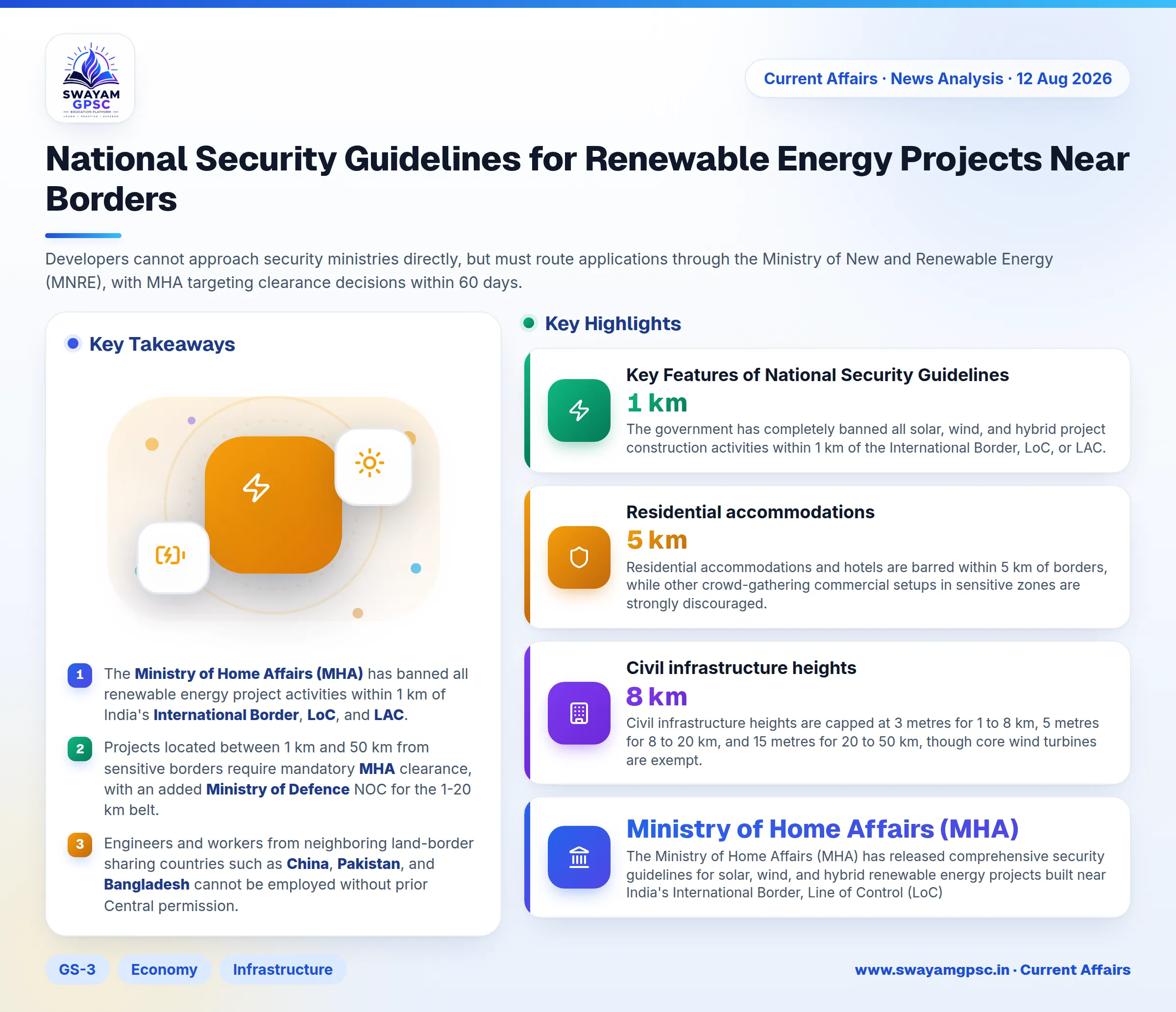
National Security Guidelines for Renewable Energy Projects Near Borders
#GS-3 #Economy #Infrastructure #Science & Technology #Energy #Current Events #National #Renewable Energy #Border Security
Key takeaways
- The Ministry of Home Affairs (MHA) has banned all renewable energy project activities within 1 km of India's International Border, LoC, and LAC.
- Projects located between 1 km and 50 km from sensitive borders require mandatory MHA clearance, with an added Ministry of Defence NOC for the 1-20 km belt.
- Engineers and workers from neighboring land-border sharing countries such as China, Pakistan, and Bangladesh cannot be employed without prior Central permission.
- Project developers must fund anti-drone equipment and security setup directly, which will be managed by the CISF or state police.
Why in News
- The Ministry of Home Affairs (MHA) has released comprehensive security guidelines for solar, wind, and hybrid renewable energy projects built near India's International Border, Line of Control (LoC), and Line of Actual Control (LAC).
Key Features of National Security Guidelines
- The policy framework aims to expand clean energy generation while safeguarding border surveillance, military troop movement, and vital installations from foreign risks.
- The government has completely banned all solar, wind, and hybrid project construction activities within 1 km of the International Border, LoC, or LAC.
- Any renewable project located between 1 km and 50 km from these border lines must secure explicit security clearance from the Ministry of Home Affairs (MHA).
- Projects planned within 1 km to 20 km from these sensitive borders will additionally require a mandatory No Objection Certificate (NOC) from the Ministry of Defence.
- Developers cannot approach security ministries directly, but must route applications through the Ministry of New and Renewable Energy (MNRE), with MHA targeting clearance decisions within 60 days.
- Project developers are forbidden from hiring engineers, technicians, or staff from land-border sharing nations like Pakistan, Bangladesh, and China without prior central permission.
- Project land cannot be transferred or allotted to a foreign firm without Central approval and MHA clearance, while adhering strictly to FDI and DPIIT regulations.
- Energy developers must deploy comprehensive security infrastructure including anti-drone technology at their own expense, to be operated by the Central Industrial Security Force (CISF) or local state police.
- Project design must avoid long continuous structures parallel to border lines, and internal roads must remain accessible to security forces during emergencies.
- Residential accommodations and hotels are barred within 5 km of borders, while other crowd-gathering commercial setups in sensitive zones are strongly discouraged.
- Civil infrastructure heights are capped at 3 metres for 1 to 8 km, 5 metres for 8 to 20 km, and 15 metres for 20 to 50 km, though core wind turbines are exempt.
- Projects that already hold valid MHA security approvals or Ministry of Defence NOCs before these rules take effect do not require fresh clearances.