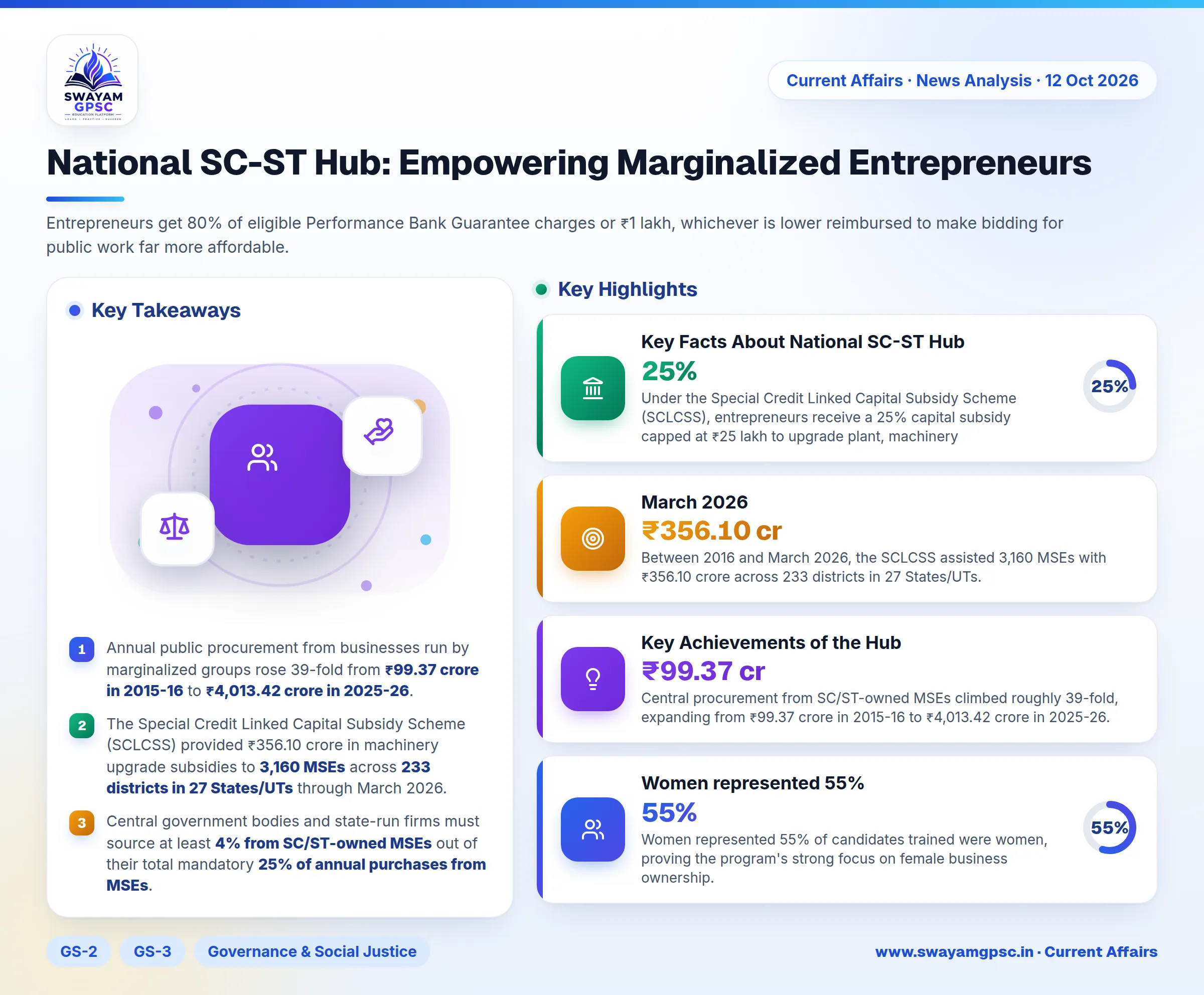
National SC-ST Hub: Empowering Marginalized Entrepreneurs
#GS-2 #GS-3 #Governance & Social Justice #Vulnerable Sections #Economy #Inclusive Growth #Infrastructure #National SC-ST Hub #MSME
Key takeaways
- Annual public procurement from businesses run by marginalized groups rose 39-fold from ₹99.37 crore in 2015-16 to ₹4,013.42 crore in 2025-26.
- The Special Credit Linked Capital Subsidy Scheme (SCLCSS) provided ₹356.10 crore in machinery upgrade subsidies to 3,160 MSEs across 233 districts in 27 States/UTs through March 2026.
- Central government bodies and state-run firms must source at least 4% from SC/ST-owned MSEs out of their total mandatory 25% of annual purchases from MSEs.
- Female entrepreneurs accounted for 55% of candidates trained were women across all capacity-building courses organized under the initiative.
Why in News
- The National SC-ST Hub (NSSH) helps SC/ST-owned Micro and Small Enterprises (MSEs) overcome hurdles in getting credit, adopting modern technology, building skills, receiving mentorship, and accessing wider markets.
Key Facts About National SC-ST Hub
- The government started the National SC-ST Hub (NSSH) on 18 October 2016 under the Ministry of Micro, Small and Medium Enterprises (MSME) to foster entrepreneurship among Scheduled Caste and Scheduled Tribe groups.
- The National Small Industries Corporation (NSIC) serves as the main nodal agency carrying out the hub's programs on the ground.
- The initiative aims to build competitive SC/ST-owned Micro and Small Enterprises (MSEs) by improving their reach into finance, technology, skills, mentorship, and public procurement systems.
- Under the Special Credit Linked Capital Subsidy Scheme (SCLCSS), entrepreneurs receive a 25% capital subsidy capped at ₹25 lakh to upgrade plant, machinery, and equipment across manufacturing and service sectors without sectoral restrictions.
- Between 2016 and March 2026, the SCLCSS assisted 3,160 MSEs with ₹356.10 crore across 233 districts in 27 States/UTs.
- Through the Single Point Registration Scheme (SPRS) run by NSIC, registered enterprises receive free tender forms and get complete exemptions from submitting earnest money deposits for government contracts.
- Under the national Public Procurement Policy, central ministries, departments, and public sector enterprises must buy 25% of annual purchases from MSEs, reserving a 4% from SC/ST-owned MSEs quota.
- The Special Marketing Assistance Scheme (SMAS) promotes enterprise competitiveness by funding stalls at exhibitions, vendor development sessions, trade fairs, and workshops, allowing firms to attend up to 4 domestic and 2 international events annually.
Key Achievements of the Hub
- Central procurement from SC/ST-owned MSEs climbed roughly 39-fold, expanding from ₹99.37 crore in 2015-16 to ₹4,013.42 crore in 2025-26.
- Five states led overall performance under the scheme: Uttar Pradesh, Maharashtra, Karnataka, Tamil Nadu and Assam.
- Women represented 55% of candidates trained were women, proving the program's strong focus on female business ownership.
- Skill programs directly matched public procurement and GeM demands, teaching practical trades like cafeteria management, food production, welding, CAD/CAM, laundry services, garment tailoring, and bamboo manufacturing.
Key Support Measures and Subsidies
- For global trade fairs, SMAS provides up to ₹3 lakh for micro, ₹2.5 lakh for small and ₹1.5 lakh for medium enterprises, requiring active listings on the Udyam Registration Portal and MSME Data Bank.
- During 2025-26, 141 SC/ST MSEs took part in 4 domestic exhibitions, and the hub coordinated 247 vendor development programmes, 197 e-tendering workshops and 230 awareness workshops.
- To cut the cost of borrowing, the scheme pays back 80% of loan processing fees or ₹1 lakh, whichever is lower on business loans from scheduled commercial banks, non-banking financial companies, and state financial corporations.
- Entrepreneurs get 80% of eligible Performance Bank Guarantee charges or ₹1 lakh, whichever is lower reimbursed to make bidding for public work far more affordable.
- To encourage product standards, the hub repays 80% of eligible testing fees or ₹1 lakh, whichever is lower for tests, certifications, and BIS marks done at government, PSU, or NABL/BIS-accredited labs.
- The scheme also covers 80% of eligible EPC membership charges or ₹20,000, whichever is lower for export councils, provided the applicant holds a valid IEC and RCMC.
- Through top-tier training support, students get 90% reimbursement of course fees, up to ₹1 lakh annually for short executive courses at the top 50 National Institutional Ranking Framework (NIRF) management schools, while the Business Accelerator Programme (BAP) provides direct advisory support.
- The hub finances digital selling by paying back 80% of membership fees or ₹25,000, whichever is lower for government portals such as GeM, e-Khadi, TRIFED, Tribes India and MSME Mart.
Conclusion
- The National SC-ST Hub drives inclusive business growth by assisting historically disadvantaged groups to participate actively in India's industrial sector.
- Continuous institutional funding and stronger market connections will spark new jobs, ensure fair economic opportunities, and sustain long-term micro-enterprise expansion.