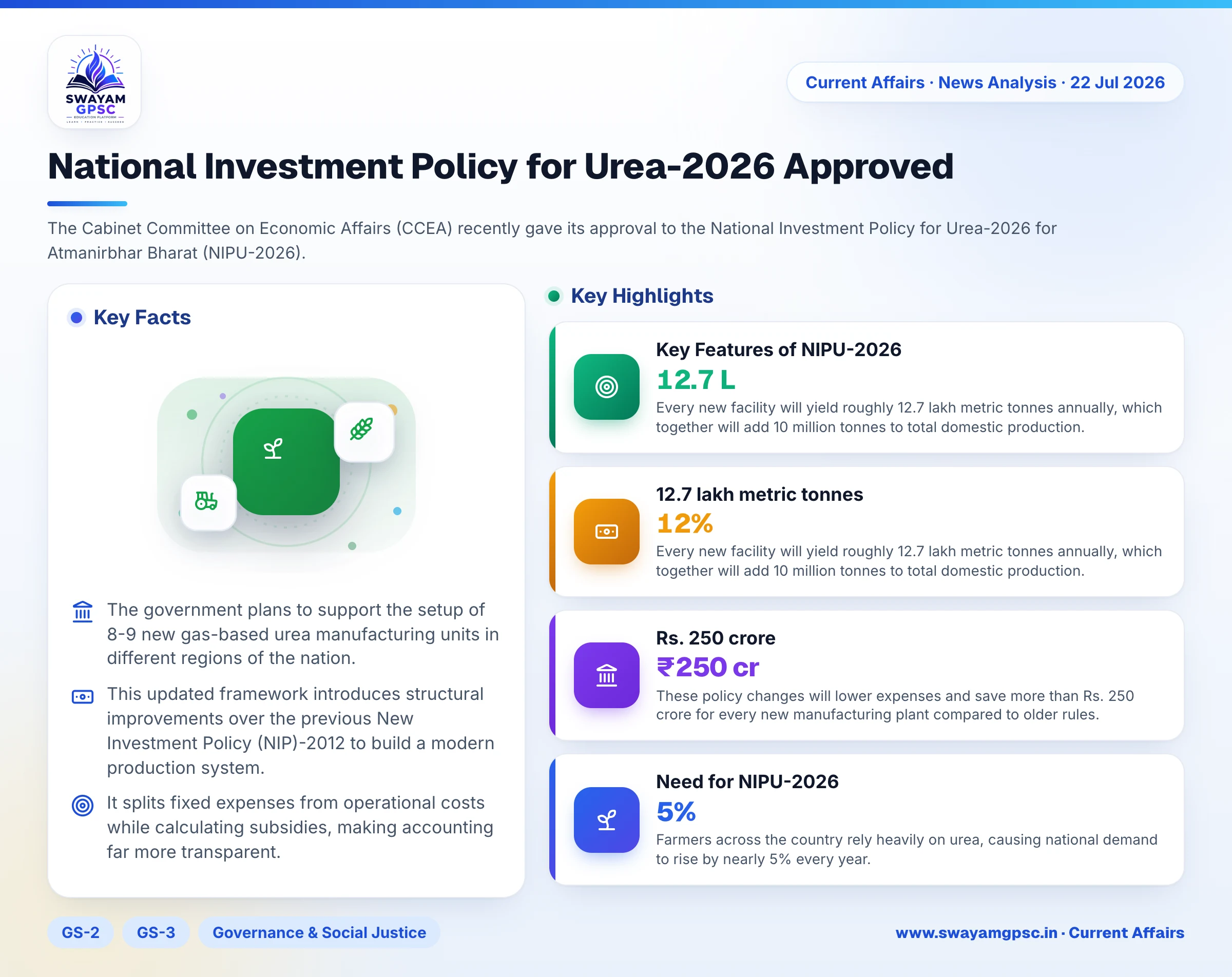
National Investment Policy for Urea-2026 Approved
#GS-2 #GS-3 #Governance & Social Justice #Economy #Agriculture #Infrastructure #National #Government Policies #Fertilizers
Why in News
- The Cabinet Committee on Economic Affairs (CCEA) recently gave its approval to the National Investment Policy for Urea-2026 for Atmanirbhar Bharat (NIPU-2026).
- This new policy focuses on setting up modern gas-based urea factories to boost local manufacturing, cut down foreign imports, and protect India's national fertilizer security.
Key Features of NIPU-2026
- The government plans to support the setup of 8-9 new gas-based urea manufacturing units in different regions of the nation.
- Every new facility will yield roughly 12.7 lakh metric tonnes annually, which together will add 10 million tonnes to total domestic production.
- This updated framework introduces structural improvements over the previous New Investment Policy (NIP)-2012 to build a modern production system.
- It splits fixed expenses from operational costs while calculating subsidies, making accounting far more transparent.
- Investors get guaranteed profit margins through a fixed Return on Equity (RoE) range, with a minimum of 12% and a maximum capped at 16%.
- The policy protects investors from currency rate fluctuations by converting fixed costs into Indian Rupees (INR) after 4 years using current currency rates.
- Unlike the older NIP-2012 scheme that funded plant upgrades and revivals, NIPU-2026 focuses specifically on constructing brand-new gas-based urea plants.
- These policy changes will lower expenses and save more than Rs. 250 crore for every new manufacturing plant compared to older rules.
- Private companies, state-run public sector units, and cooperative enterprises will all receive the exact same government support and financial incentives.
Need for NIPU-2026
- Farmers across the country rely heavily on urea, causing national demand to rise by nearly 5% every year.
- India consumes nearly 40 million tonnes of urea every year, but 33 domestic plants produce only about 30 million tonnes, leaving a gap of 10 million tonnes that must be imported.
- By adding 10 million tonnes of fresh local production, the new policy helps end import reliance and makes India self-reliant.
- The previous government policy, NIP-2012, which helped establish 6 new production units, came to an end in October 2019.
- The Department of Fertilizers received many new business proposals, creating a clear need for an updated guidelines framework.
- Depending heavily on imported urea and foreign Natural Gas (LNG) leaves Indian agriculture vulnerable to sudden international supply disruptions.
- Any conflict or blockages in vital sea routes like the Strait of Hormuz can surge raw material prices and put national food security at risk.
What is Urea and its Significance
- Urea, represented chemically as NH₂CONH₂, is a white crystalline organic compound that serves as the main source of nitrogen for crops.
- It contains around 46% nitrogen, which is the highest concentration among all solid fertilizers, making it essential for key crops like wheat, paddy, and sugarcane.
- The central government heavily subsidizes this fertilizer so that farmers can buy it at low, affordable rates.
- While non-urea fertilizers are managed under the Nutrient Based Subsidy (NBS) program, the Maximum Retail Price (MRP) of urea is strictly set by government law.
India's Other Initiatives Related to Fertilizers
- The government made 100% Neem Coated Urea (NCU) mandatory to make nitrogen absorption slower in soil and stop subsidized urea from being diverted to factories illegally.
- Authorities introduced Urea Gold, a sulfur-coated variant that cures sulfur deficiency in farmland and improves agricultural output.
- Created by IFFCO, Liquid Nano Urea is sprayed directly onto plant leaves, greatly cutting down the need for traditional heavy bags of fertilizer.
- The PM PRANAM scheme rewards states and union territories financially when they reduce chemical fertilizer consumption and adopt organic alternatives.
- Under the Pradhan Mantri Bhartiya Jan Urvarak Pariyojana, all subsidized products are sold under the brand name Bharat through the One Nation One Fertilizer initiative to lower transport costs.