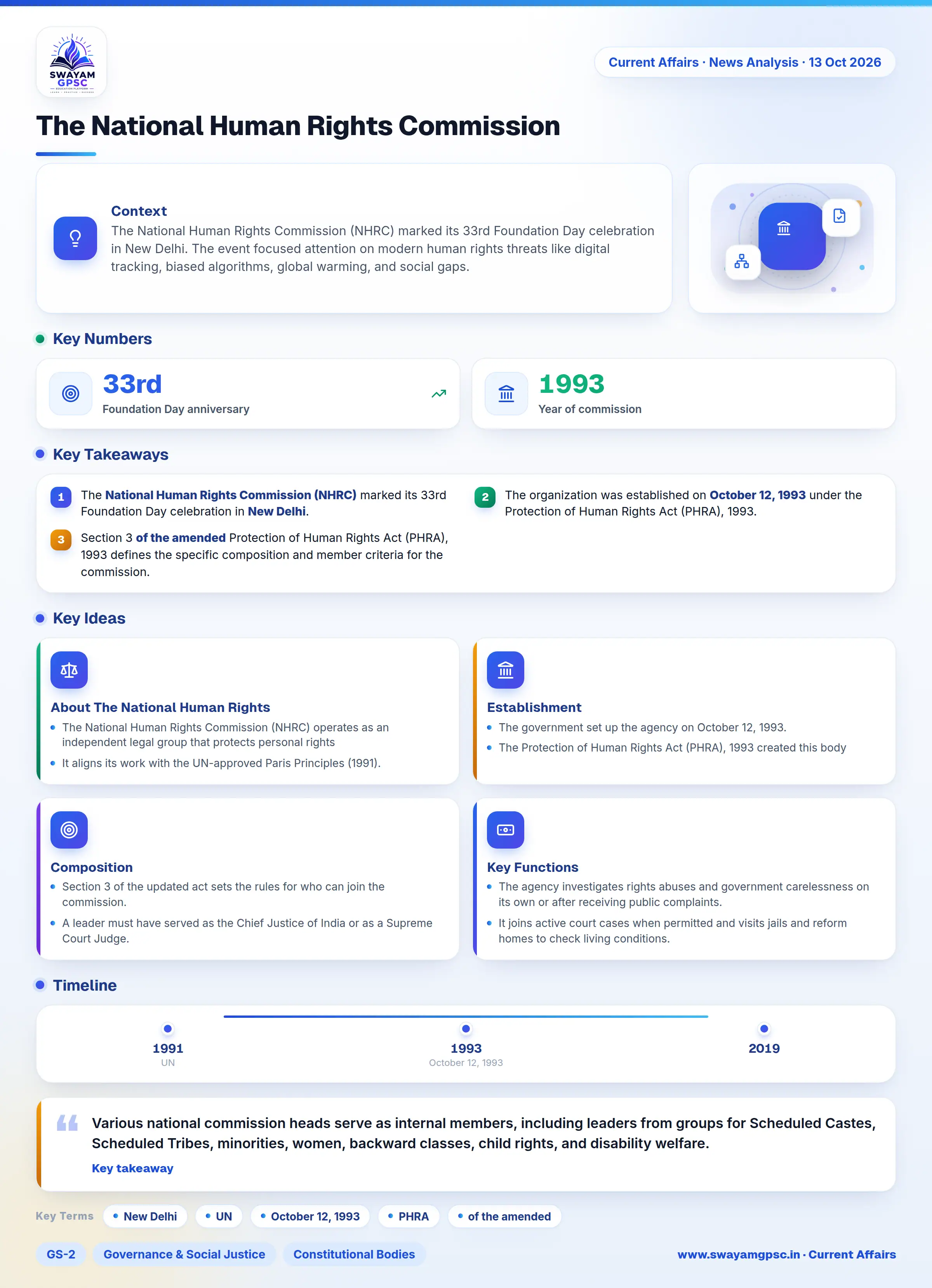
The National Human Rights Commission
#GS-2 #Governance & Social Justice #Constitutional Bodies #Good Governance #Vulnerable Sections #Current Events #National
Key takeaways
- The National Human Rights Commission (NHRC) marked its 33rd Foundation Day celebration in New Delhi.
- The organization was established on October 12, 1993 under the Protection of Human Rights Act (PHRA), 1993.
- Section 3 of the amended Protection of Human Rights Act (PHRA), 1993 defines the specific composition and member criteria for the commission.
Context
- The National Human Rights Commission (NHRC) marked its 33rd Foundation Day celebration in New Delhi.
- The event focused attention on modern human rights threats like digital tracking, biased algorithms, global warming, and social gaps.
About The National Human Rights Commission
- The National Human Rights Commission (NHRC) operates as an independent legal group that protects personal rights related to life, freedom, fairness, and self-respect.
- It aligns its work with the UN-approved Paris Principles (1991).
Establishment
- The government set up the agency on October 12, 1993.
- The Protection of Human Rights Act (PHRA), 1993 created this body, and lawmakers updated it later through the Protection of Human Rights (Amendment) Act, 2019.
Composition
- Section 3 of the updated act sets the rules for who can join the commission.
- A leader must have served as the Chief Justice of India or as a Supreme Court Judge.
- The team includes one judge from the Supreme Court and one former High Court Chief Justice.
- Three specialist members join the panel, and at least one of them must be a woman with hands-on human rights experience.
- Various national commission heads serve as internal members, including leaders from groups for Scheduled Castes, Scheduled Tribes, minorities, women, backward classes, child rights, and disability welfare.
Key Functions
- The agency investigates rights abuses and government carelessness on its own or after receiving public complaints.
- It joins active court cases when permitted and visits jails and reform homes to check living conditions.
- The panel checks current laws and security rules to suggest better ways to enforce them.
- It studies global treaties to match local laws with international standards while funding research and NGO projects.
- The group suggests money for victims, asks for action against careless officials, and goes to top courts for legal orders.