National Human Rights Commission: Structure, Challenges, and Reform Agenda
#GS-2 #Governance & Social Justice #Regulatory Bodies #Indian Polity & Constitution #Constitutional Bodies #Fundamental Rights #Statutory Bodies #Government Policies & Interventions
Key takeaways
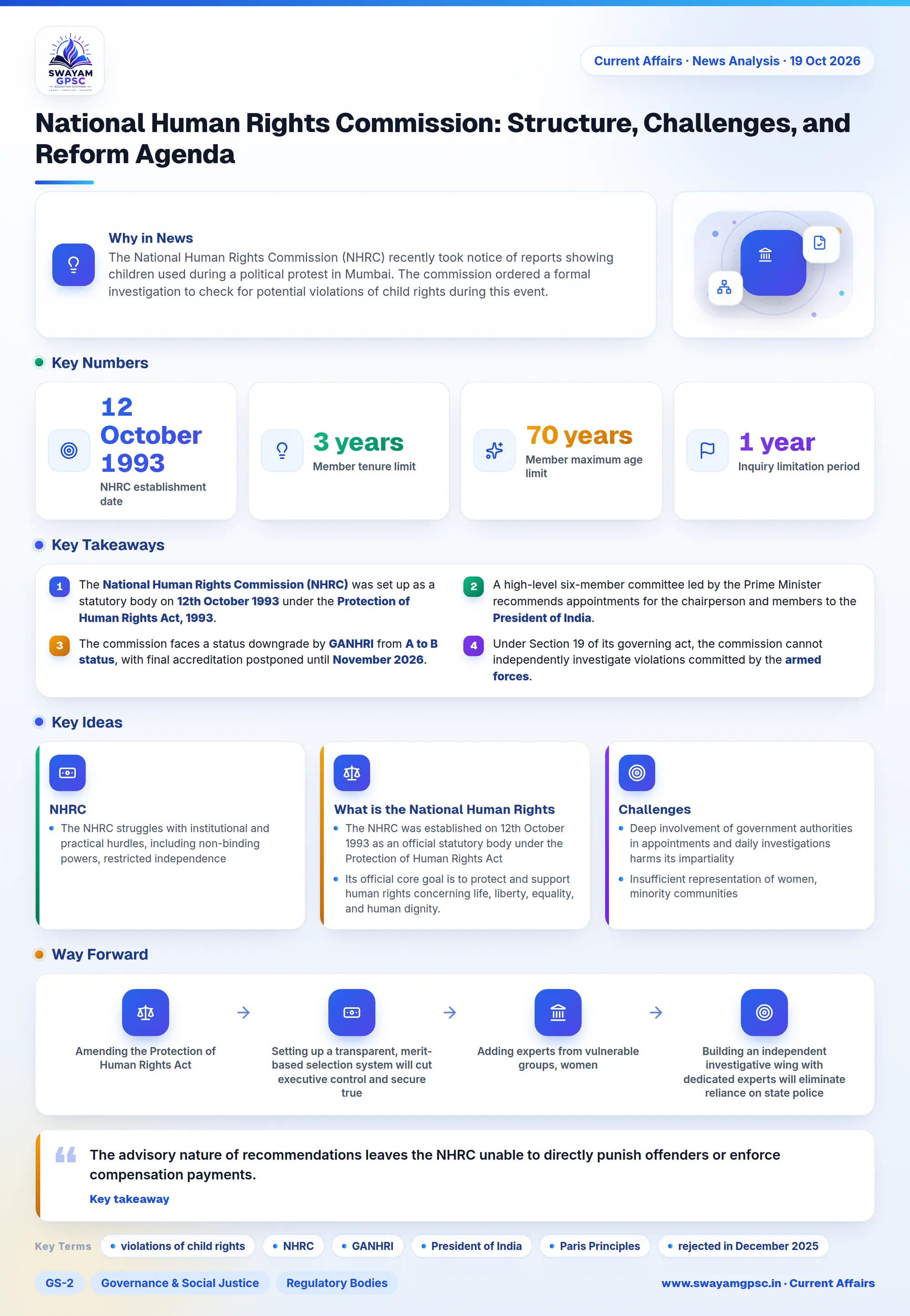
- The National Human Rights Commission (NHRC) was set up as a statutory body on 12th October 1993 under the Protection of Human Rights Act, 1993.
- A high-level six-member committee led by the Prime Minister recommends appointments for the chairperson and members to the President of India.
- The commission faces a status downgrade by GANHRI from A to B status, with final accreditation postponed until November 2026.
- Under Section 19 of its governing act, the commission cannot independently investigate violations committed by the armed forces.
- The NHRC cannot investigate any human rights abuse case if the incident occurred more than one year before the complaint was lodged.
Why in News
- The National Human Rights Commission (NHRC) recently took notice of reports showing children used during a political protest in Mumbai.
- The commission ordered a formal investigation to check for potential violations of child rights during this event.
- This decision brings public focus back to the role and responsibilities of the NHRC in guarding individual freedoms in India.
Summary
- The NHRC struggles with institutional and practical hurdles, including non-binding powers, restricted independence, reliance on police investigators, and limited jurisdiction.
- The proposed downgrade of its international status by GANHRI highlights failure to meet the Paris Principles, showing an urgent need for structural independence and reform.
What is the National Human Rights Commission?
- The NHRC was established on 12th October 1993 as an official statutory body under the Protection of Human Rights Act, 1993.
- Its official core goal is to protect and support human rights concerning life, liberty, equality, and human dignity.
- Under Section 3 of the legal act, the leadership consists of a Chairperson, five full-time Members, and seven ex-officio Members.
- The leader must be a former Chief Justice of India or Supreme Court Judge, and at least one human rights expert member must be a woman.
- The President of India appoints members based on recommendations from a six-member committee led by the Prime Minister.
- This selection committee includes the Lok Sabha Speaker, Union Home Minister, Rajya Sabha Deputy Chairman, and Opposition Leaders of both Houses.
- Appointed members hold office for three years or until reaching 70 years of age, whichever comes first, with eligibility for reappointment.
- Core functions include looking into human rights abuses, intervening in legal court proceedings, inspecting prisons, and running public awareness programs.
- During official inquiries, the NHRC exercises basic powers of a civil court, such as issuing summons and requesting official documents.
- The organization aligns with international Paris Principles, which require administrative independence, adequate operating funds, and broad representation.
Challenges
- The advisory nature of recommendations leaves the NHRC unable to directly punish offenders or enforce compensation payments.
- Deep involvement of government authorities in appointments and daily investigations harms its impartiality, transparency, and independence.
- Insufficient representation of women, minority communities, and independent civil society groups weakens internal diversity.
- The Global Alliance of National Human Rights Institutions (GANHRI) recommended downgrading its standing from A-status to B-status in March 2025.
- An appeal against this downgrade was rejected in December 2025, delaying the final status review process until November 2026.
- Heavily relying on police officers for investigations creates clear conflicts of interest during inquiries into custodial violence and police misconduct.
- The commission lacks statutory power to investigate any human rights complaint filed more than one year after the incident occurred.
- Under Section 19 of the Protection of Human Rights Act, investigations involving security forces must follow restrictive special reporting procedures.
Way Forward
- Amending the Protection of Human Rights Act, 1993 would enforce recommendations legally and guarantee timely justice for victims.
- Setting up a transparent, merit-based selection system will cut executive control and secure true administrative and financial independence.
- Adding experts from vulnerable groups, women, and non-governmental organizations ensures full alignment with the Paris Principles.
- Building an independent investigative wing with dedicated experts will eliminate reliance on state police forces.
- Removing the strict one-year time limit on complaint filings will expand access for victims seeking historical justice.
- Providing sufficient government funding, modern infrastructure, and skilled legal staff will build strong internal capacity.
- Addressing structural flaws flagged by GANHRI will restore global credibility and meet international norms.
- Using modern digital case-management portals will speed up inquiry resolution times and help track government response reports.
Conclusion
- The NHRC remains a critical entity for defending fundamental rights across the nation.
- Granting real enforcement power and investigative independence is essential to protect constitutional values, human dignity, and rule of law.