National Household Travel Survey
#GS-3 #Economy #Infrastructure #Governance & Social Justice #Current Events #National #Transport Survey
Key takeaways
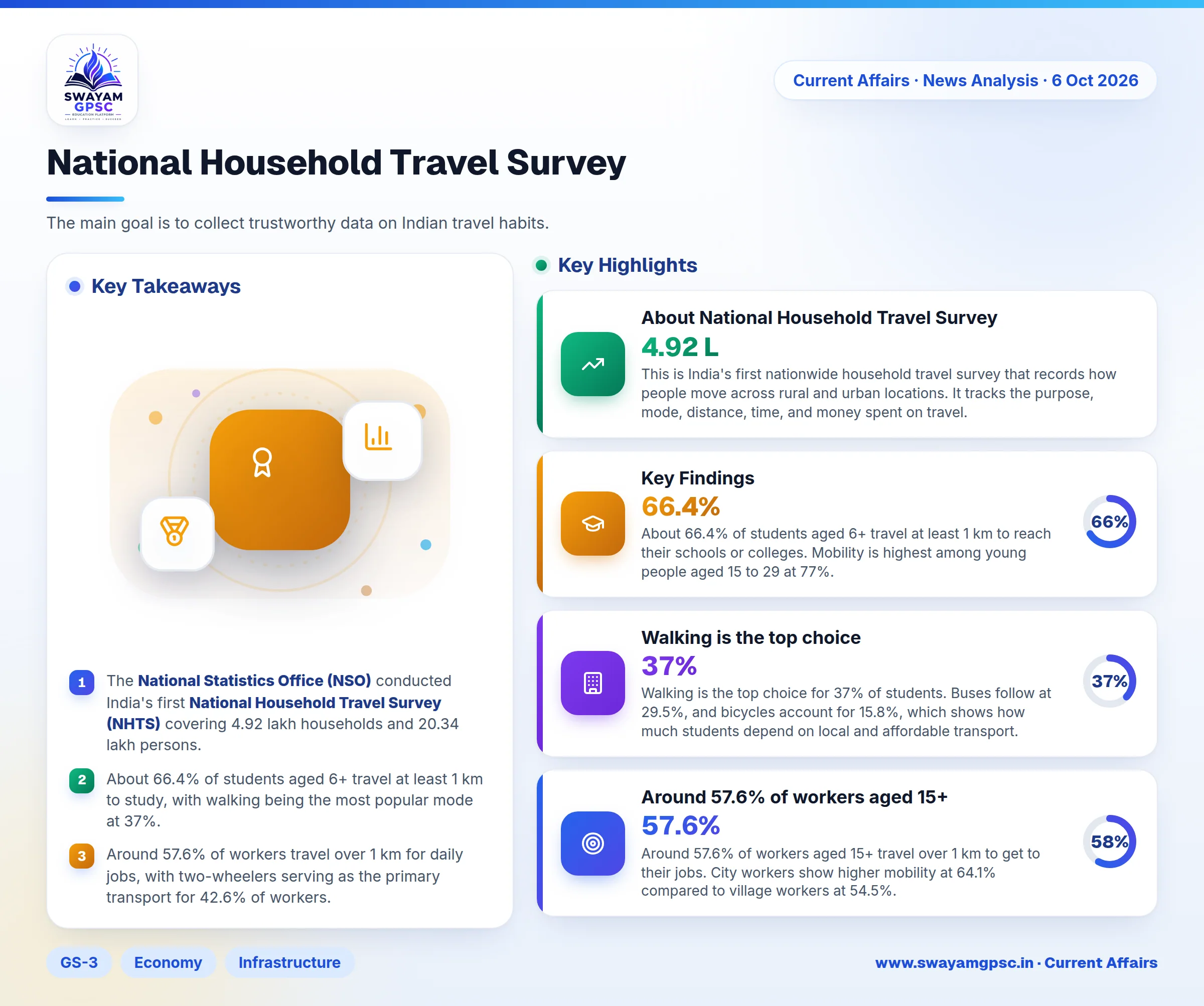
- The National Statistics Office (NSO) conducted India's first National Household Travel Survey (NHTS) covering 4.92 lakh households and 20.34 lakh persons.
- About 66.4% of students aged 6+ travel at least 1 km to study, with walking being the most popular mode at 37%.
- Around 57.6% of workers travel over 1 km for daily jobs, with two-wheelers serving as the primary transport for 42.6% of workers.
- Workers spend an average of ₹785 per month on daily commute costs, with city workers paying ₹1,044 compared to village workers paying ₹612.
Why in News
- The National Statistics Office (NSO) released findings from India's first ever National Household Travel Survey (NHTS).
- The survey work took place between July 2025 and June 2026 to map daily travel habits.
About National Household Travel Survey
- This is India's first nationwide household travel survey that records how people move across rural and urban locations. It tracks the purpose, mode, distance, time, and money spent on travel. The survey reached 4.92 lakh households and included more than 20.34 lakh people.
- The National Statistics Office (NSO) under the Ministry of Statistics and Programme Implementation (MoSPI) carried out this massive study.
- The main goal is to collect trustworthy data on Indian travel habits. This information helps the government plan better transport systems, build smart infrastructure, check public accessibility, and make smart policy decisions.
Key Findings
- About 66.4% of students aged 6+ travel at least 1 km to reach their schools or colleges. Mobility is highest among young people aged 15 to 29 at 77%.
- Walking is the top choice for 37% of students. Buses follow at 29.5%, and bicycles account for 15.8%, which shows how much students depend on local and affordable transport.
- Around 57.6% of workers aged 15+ travel over 1 km to get to their jobs. City workers show higher mobility at 64.1% compared to village workers at 54.5%.
- A big gender gap exists in daily jobs. 61.9% of male workers travel for work every day, while only 41.9% of female workers do the same.
- Two-wheelers are the most popular vehicle for workers at 42.6%. This number jumps to 52.3% in cities, while rural areas stand at 37.1%.
- Most daily trips are short. Students spend an average of 23 minutes traveling, while workers take 25 minutes. 87.6% of students and 83.4% of workers reach their destination within 30 minutes.
- Workers spend an average of ₹785 per month on travel to their regular workplaces. City workers spend ₹1,044, which is much higher than the village average of ₹612.
- Buses and trains are the top choices for long overnight journeys at 73.5%. Buses make up 55.8% of these trips, and inter-city trains account for 17.7%.
- Most overnight household trips happen for social, family, or religious reasons at 70.2%. Pure tourism and leisure trips make up only 7.4% of the total.
- The survey only counts trips that cover a distance of 1 km or more. Journeys shorter than 1 km are not counted as travel.