National Cooperative Development Corporation (Amendment) Bill, 2026
#GS-2 #GS-3 #Indian Polity & Constitution #Governance & Social Justice #Economy #Agriculture #Regulatory Bodies #Government Policies & Interventions #Non-Governmental Organisations (NGOs) #Self Help Groups (SHGs)
Key takeaways
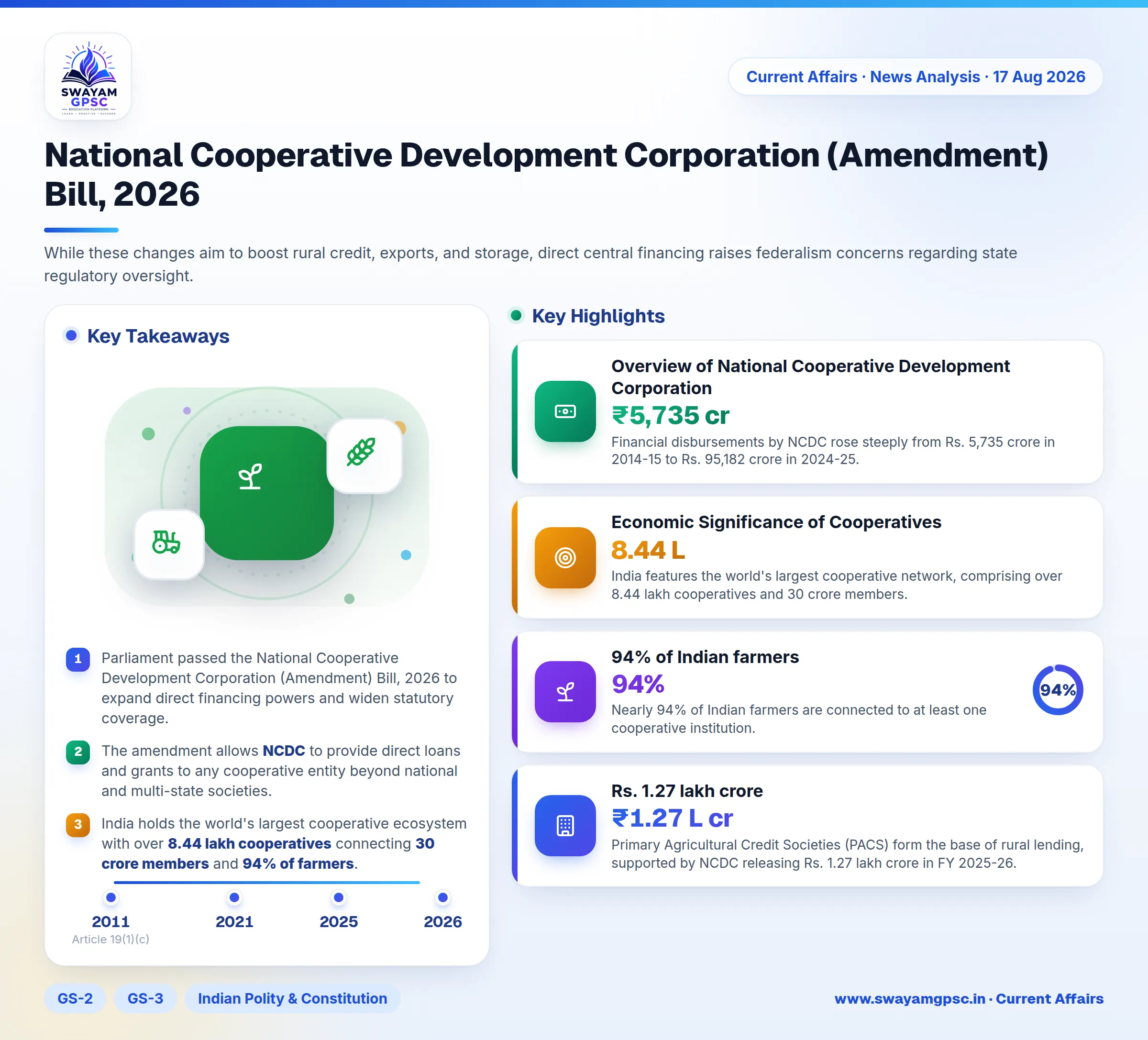
- Parliament passed the National Cooperative Development Corporation (Amendment) Bill, 2026 to expand direct financing powers and widen statutory coverage.
- The amendment allows NCDC to provide direct loans and grants to any cooperative entity beyond national and multi-state societies.
- India holds the world's largest cooperative ecosystem with over 8.44 lakh cooperatives connecting 30 crore members and 94% of farmers.
- NCDC disbursements grew significantly from Rs. 5,735 crore in 2014-15 to Rs. 95,182 crore in FY 2024-25.
- Under the storage plan, godowns in 145 PACS have created over 68,702 MT of storage capacity to curb post-harvest losses.
Why in News
- The Parliament passed the National Cooperative Development Corporation (Amendment) Bill, 2026.
- This new legislation amends the National Cooperative Development Corporation (NCDC) Act, 1962 to broaden its financial authority and scope.
- The amendment permits NCDC to offer direct loans, grants, and equity investments while expanding the definition of foodstuffs and enhancing credit information sharing.
- While these changes aim to boost rural credit, exports, and storage, direct central financing raises federalism concerns regarding state regulatory oversight.
Key Highlights of the NCDC Amendment Bill, 2026
- Previously, NCDC could only issue direct loans and grants to national-level cooperatives or those operating across multiple states.
- The NCDC Amendment Bill, 2026 expands this authority, allowing direct funding to any cooperative society or entity involved in cooperative development.
- NCDC will maintain its existing channel of sending funds through State Governments while adding a new direct funding option.
- The law broadens the legal term foodstuffs to cover processed food and any other items announced by the Central Government.
- This revised definition lets a larger group of food-related cooperative societies access NCDC financial support.
- The Bill removes the requirement that industrial, cottage, village, and allied cooperatives must operate strictly in rural regions.
- With approval from the Central Government, NCDC can now buy share capital in any cooperative enterprise.
- The legislation authorizes NCDC to collect and share credit data with the Reserve Bank of India (RBI), government bodies, and banks.
Concerns Raised Regarding the Bill
- Cooperative societies operating within a single state fall under Entry 32 of the State List in the Constitution.
- Critics worry that direct funding from NCDC might bypass state administrations and erode federal power balance.
- State governments handle critical monitoring and audit duties for local cooperatives.
- Direct central funding without state coordination could create overlapping powers and supervision gaps on the ground.
Overview of National Cooperative Development Corporation
- NCDC is a statutory organization established in 1963 under the National Cooperative Development Corporation Act, 1962.
- Parliament previously revised the Act in 1973, 1974, and 2002 to increase NCDC funding reach.
- The agency functions under the administrative direction of the Ministry of Cooperation.
- Its main objective is to assist farmer cooperatives in boosting crop production, processing, cold storage, and marketing.
- NCDC also funds non-farm activities like dairy, handloom, fisheries, and projects led by women or SC/ST communities.
- Financial disbursements by NCDC rose steeply from Rs. 5,735 crore in 2014-15 to Rs. 95,182 crore in 2024-25.
- Under the National Cooperation Policy (NCP) 2025, NCDC works toward building a modern and transparent cooperative framework for Viksit Bharat.
- This policy implementation involves partners like IFFCO, NAFED, Amul, KRIBHCO, NDDB, NCEL, and NABARD.
Constitutional and Legal Status of Cooperatives
- A cooperative is a user-owned and democratically managed business created voluntarily to support member economic needs.
- The Constitution requires the government to encourage cooperative models to decentralize economic power.
- The 97th Constitutional Amendment Act (2011) added the right to form cooperatives under Article 19(1)(c) as a Fundamental Right.
- Article 43B under Directive Principles guides the State to promote voluntary formation and professional management of cooperatives.
- The 97th Amendment also added Part IXB to create a uniform legal setup across the nation.
- In the Union of India v. Rajendra N. Shah (2021) ruling, the Supreme Court held that Part IXB applies only to multi-state cooperatives.
- Multi-state cooperatives fall under the Union List and are governed by the Multi-State Cooperative Societies (MSCS) Act, 2002.
Economic Significance of Cooperatives
- India features the world's largest cooperative network, comprising over 8.44 lakh cooperatives and 30 crore members.
- Nearly 94% of Indian farmers are connected to at least one cooperative institution.
- Primary Agricultural Credit Societies (PACS) form the base of rural lending, supported by NCDC releasing Rs. 1.27 lakh crore in FY 2025-26.
- The National Cooperative Exports Limited (NCEL) exported 15.4 Lakh Metric Tonnes of goods worth Rs. 6,295 crore by mid-2026.
- Major organizations like IFFCO and Amul keep market prices stable and prevent private business monopolies.
Social Significance of Cooperatives
- Cooperatives strengthen women's financial independence across rural regions.
- Through the Nandini Sahakar scheme, NCDC provided Rs. 4,823 crore to women-managed cooperatives between 2021 and 2025.
- Around 10 crore women connect to cooperatives through Self-Help Groups.
- NCDC provided Rs. 57 crore in dedicated loans to SC/ST cooperatives over the last four years to fight local exploitation.
- Cooperatives generate employment in allied sectors like dairy, fisheries, and handloom, with over 25,000 new societies formed under White Revolution 2.0.
Technological and Infrastructure Significance
- Cooperatives are building the world's largest grain storage setup.
- Completed storage godowns across 145 PACS offer 68,702 MT of capacity to cut crop loss.
- Local credit societies are turning into service centers providing digital tools, medicines, and farm inputs.
- The model expands into urban tech services, such as Bharat Taxi, which connects 7.76 lakh drivers with 40.84 lakh users.
Way Forward
- Adopting Model Bye-laws across all states will standardize rules and help credit societies enter new business areas.
- Following the Vaidyanathan Committee (2004) advice, cooperatives need protection from political interference.
- Following the Malegam Committee advice, urban cooperative banks should separate banking management from society ownership.
- Targeted training programs must help rural members build digital skills to use online banking platforms.
- Cooperatives should build strong unified brand names and branch out into eco-tourism, solar energy, and digital services.
Conclusion
- Achieving the vision of Sahkar-se-Samriddhi requires strong cooperatives that bring economic growth directly to rural communities.