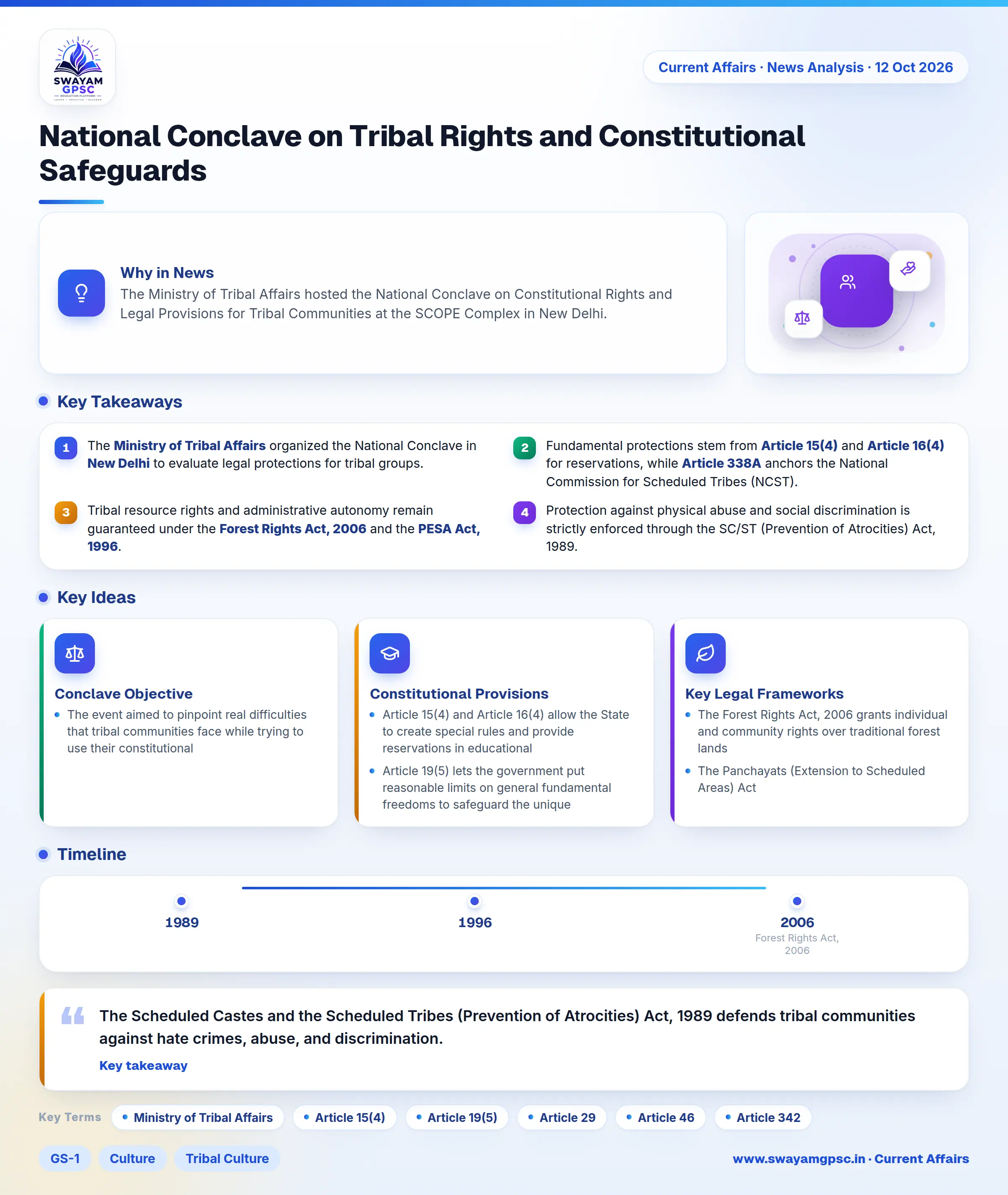
National Conclave on Tribal Rights and Constitutional Safeguards
#GS-1 #Culture #Tribal Culture #Indian Society #Vulnerable Sections #GS-2 #Indian Polity & Constitution #Constitution #Governance & Social Justice
Key takeaways
- The Ministry of Tribal Affairs organized the National Conclave in New Delhi to evaluate legal protections for tribal groups.
- Fundamental protections stem from Article 15(4) and Article 16(4) for reservations, while Article 338A anchors the National Commission for Scheduled Tribes (NCST).
- Tribal resource rights and administrative autonomy remain guaranteed under the Forest Rights Act, 2006 and the PESA Act, 1996.
- Protection against physical abuse and social discrimination is strictly enforced through the SC/ST (Prevention of Atrocities) Act, 1989.
Why in News
- The Ministry of Tribal Affairs hosted the National Conclave on Constitutional Rights and Legal Provisions for Tribal Communities at the SCOPE Complex in New Delhi.
Conclave Objective
- The event aimed to pinpoint real difficulties that tribal communities face while trying to use their constitutional rights, gathering grassroots feedback to build practical solutions.
Constitutional Provisions for Scheduled Tribes
- Article 15(4) and Article 16(4) allow the State to create special rules and provide reservations in educational institutions and government jobs for Scheduled Tribes.
- Article 19(5) lets the government put reasonable limits on general fundamental freedoms to safeguard the unique welfare of Scheduled Tribes.
- Article 29 provides protection for any distinct language, script, or cultural heritage, ensuring tribal identities stay protected.
- Article 46 guides the State to advance educational and economic opportunities for Scheduled Tribes while guarding them against exploitation.
- Article 342 lays out the process for the President to notify Scheduled Tribes in relation to specific States or Union Territories.
- Article 338A sets up the National Commission for Scheduled Tribes (NCST) to review safeguards and look into complaints about denied rights.
- The Fifth Schedule lays out special administrative rules for Scheduled Areas, creates Tribes Advisory Councils, and protects tribal land ownership.
Key Legal Frameworks
- The Forest Rights Act, 2006 grants individual and community rights over traditional forest lands, working to undo historical wrongs.
- The Panchayats (Extension to Scheduled Areas) Act, 1996 (PESA) gives genuine power to Gram Sabhas over local governance and resources in Scheduled Areas.
- The Scheduled Castes and the Scheduled Tribes (Prevention of Atrocities) Act, 1989 defends tribal communities against hate crimes, abuse, and discrimination.