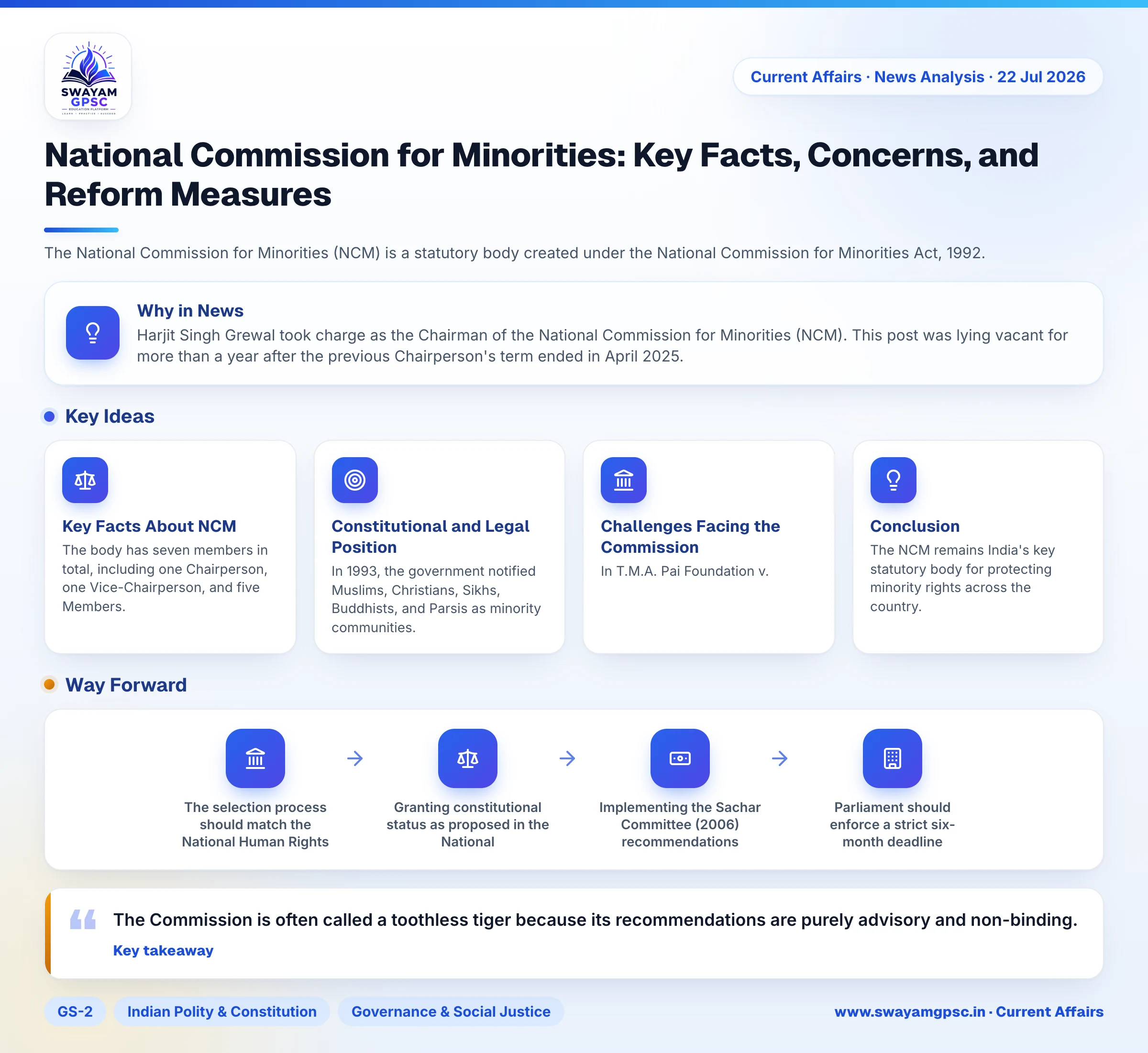
National Commission for Minorities: Key Facts, Concerns, and Reform Measures
#GS-2 #Indian Polity & Constitution #Governance & Social Justice #Constitutional Bodies #Regulatory Bodies #Vulnerable Sections #Minorities #Statutory Bodies
Why in News
- Harjit Singh Grewal took charge as the Chairman of the National Commission for Minorities (NCM).
- This post was lying vacant for more than a year after the previous Chairperson's term ended in April 2025.
- Appointing an active political leader to an independent statutory body has created debate about its neutrality and independence.
Key Facts About NCM
- The National Commission for Minorities (NCM) is a statutory body created under the National Commission for Minorities Act, 1992.
- The body has seven members in total, including one Chairperson, one Vice-Chairperson, and five Members.
- The Central Government nominates all members based on their eminence, ability, and integrity.
- At least five members, including the Chairperson, must belong to officially notified minority communities.
- The Commission evaluates minority welfare progress under Union and State governments and monitors constitutional safeguards.
- It investigates specific complaints about rights violations and undertakes research on socio-economic and educational growth.
- While investigating complaints, the Commission enjoys powers equivalent to a Civil Court.
- The Chairperson and Members hold office for a fixed term of three years.
- Members can resign at any time by sending a written notice to the Central Government.
- The Central Government can remove members for insolvency, criminal conviction, mental incapacity, unapproved absence from three consecutive meetings, or abuse of office.
- The government must give a reasonable hearing before removing a member for abusing office.
Constitutional and Legal Position of Minorities
- The Constitution of India does not define the word minority, but protects religious and linguistic minorities under Article 29 and Article 30.
- The National Commission for Minorities Act, 1992 defines a minority as any community notified by the central government.
- In 1993, the government notified Muslims, Christians, Sikhs, Buddhists, and Parsis as minority communities.
- Jains were added to this list as the sixth notified minority community in 2014.
Challenges Facing the Commission
- The Commission is often called a toothless tiger because its recommendations are purely advisory and non-binding.
- Unlike constitutional bodies like NCSC (Article 338) and NCST (Article 338A), it lacks legally enforceable powers.
- The government often uses member appointments for political rehabilitation rather than appointing independent domain experts.
- Prolonged vacant posts slow down grievance handling, prompting the Delhi High Court in 2025 to express strong concern over a headless commission.
- Delays in presenting Annual Reports and Action Taken Memorandums before Parliament weaken legislative monitoring and accountability.
- In T.M.A. Pai Foundation v. State of Karnataka (2002), the Supreme Court ruled that states are the proper unit to define minorities, creating a clash with NCM's national list.
- Key states like Gujarat and Haryana have not established State Minority Commissions, leaving local issues unaddressed.
Way Forward
- The selection process should match the National Human Rights Commission model, using a high-level committee led by the Prime Minister.
- Granting constitutional status as proposed in the National Commission for Minorities (Repeal) Bill, 2004 will strengthen its authority.
- Implementing the Sachar Committee (2006) recommendations to set up an Equal Opportunity Commission (EOC) and a National Data Bank (NDB) will improve policy decisions.
- Parliament should enforce a strict six-month deadline for the executive to table Action Taken Reports with reasons for rejecting any recommendation.
Conclusion
- The NCM remains India's key statutory body for protecting minority rights across the country.
- Enhancing its independence and powers is vital to fulfill constitutional promises under Article 29 and Article 30.