National Animal Disease Control Programme: Key Features and Impact
#GS-2 #GS-3 #Governance & Social Justice #Health #Agriculture #Government Policies & Interventions #Livestock
Key takeaways
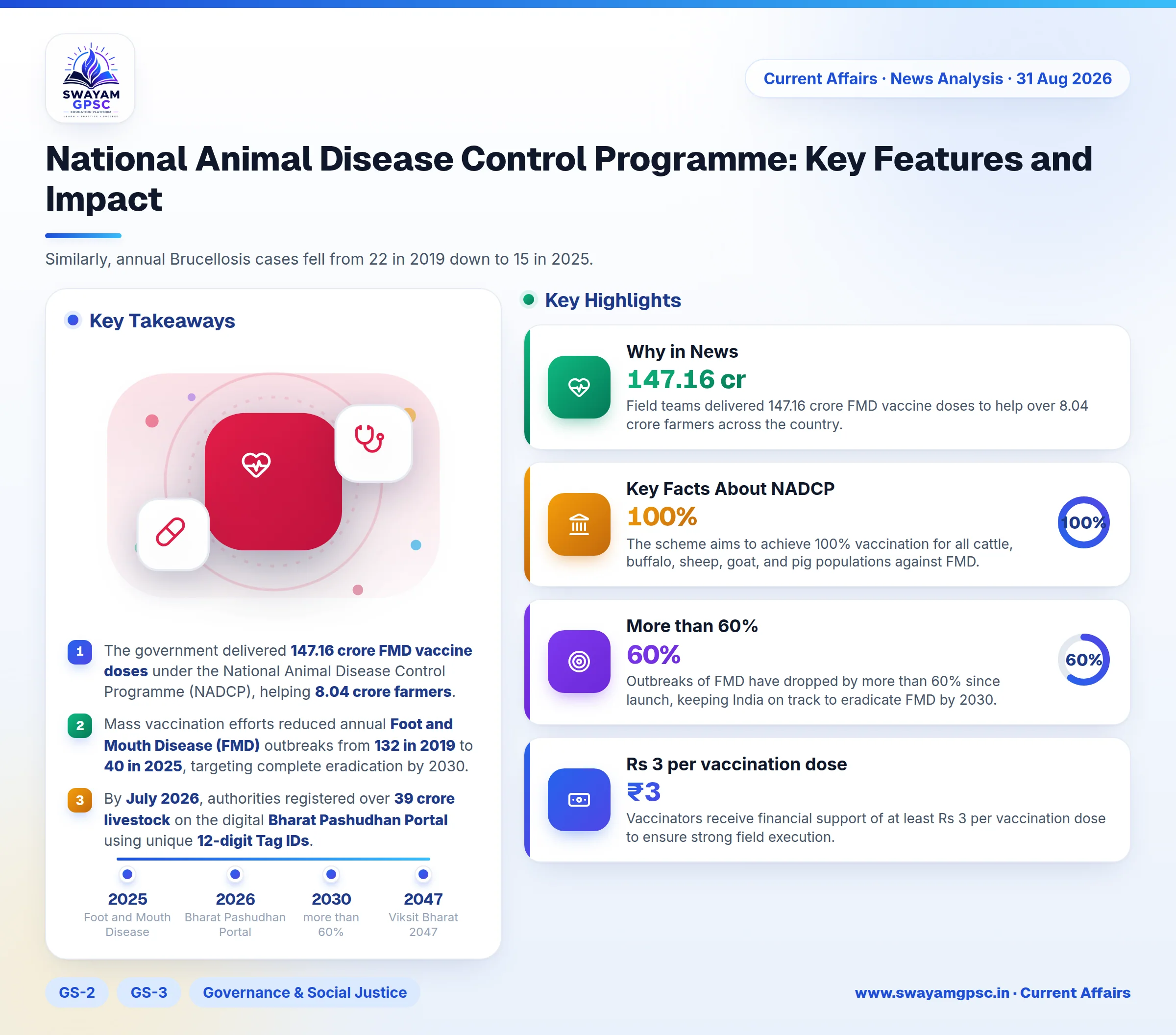
- The government delivered 147.16 crore FMD vaccine doses under the National Animal Disease Control Programme (NADCP), helping 8.04 crore farmers.
- Mass vaccination efforts reduced annual Foot and Mouth Disease (FMD) outbreaks from 132 in 2019 to 40 in 2025, targeting complete eradication by 2030.
- By July 2026, authorities registered over 39 crore livestock on the digital Bharat Pashudhan Portal using unique 12-digit Tag IDs.
- A total of 4,019 Mobile Veterinary Units (MVUs) deliver doorstep animal care across 29 States and UTs via helpline 1962, benefiting 136 lakh farmers.
- The revised Livestock Health and Disease Control Programme (LHDCP) received a budget allocation of Rs 2,010 crore for 2026-27.
Why in News
- The Indian government shared recent successes of the National Animal Disease Control Programme (NADCP) in upgrading animal health care.
- This program relies on nationwide vaccination drives, disease tracking, and digital tools to protect farm animals.
- Field teams delivered 147.16 crore FMD vaccine doses to help over 8.04 crore farmers across the country.
- Because of these mass drives, annual Foot and Mouth Disease (FMD) outbreaks dropped from 132 in 2019 to 40 in 2025.
- Similarly, annual Brucellosis cases fell from 22 in 2019 down to 15 in 2025.
Key Facts About NADCP
- The central government launched the National Animal Disease Control Programme (NADCP) in September 2019 to eliminate Foot and Mouth Disease (FMD) and Brucellosis.
- The scheme aims to achieve 100% vaccination for all cattle, buffalo, sheep, goat, and pig populations against FMD.
- It also targets 100% vaccination of female bovine calves aged 4 to 8 months against Brucellosis.
- Outbreaks of FMD have dropped by more than 60% since launch, keeping India on track to eradicate FMD by 2030.
- This project runs as a Central Sector Scheme, meaning the Union Government provides 100% funding to States and Union Territories.
- The program tracks infection rates through blood testing, outbreak checks, virus identification, and impact assessment.
- Officials tag livestock with ear tags and record their details digitally on the Bharat Pashudhan Portal.
- The scheme funds cold-chain storage, vaccine supply, awareness campaigns, official training, and quarantine checks.
- Vaccinators receive financial support of at least Rs 3 per vaccination dose to ensure strong field execution.
- The government integrated NADCP into the Livestock Health and Disease Control Programme (LHDCP) with a 2026-27 budget of Rs 2,010 crore.
Major Livestock Diseases
- Foot and Mouth Disease (FMD) is a fast-spreading viral infection in cloven-hoofed animals like cows, goats, and pigs that lowers milk production and restricts trade.
- Brucellosis is a bacterial infection caused by Brucella abortus that damages animal fertility, lowers milk output, and reduces farm productivity.
Strengthening Institutional and Infrastructure Support
- The government provides funds to ICAR institutes to research vaccines, run quality tests, and track animal disease patterns.
- The Animal Husbandry Infrastructure Development Fund (AHIDF) offers support to private companies that build veterinary vaccine and medicine factories.
- A total of 4,019 Mobile Veterinary Units (MVUs) operate across 29 States and UTs, serving 136 lakh farmers through helpline 1962.
- The digital Bharat Pashudhan Portal assigns a 12-digit Tag ID to each animal and recorded over 39 crore livestock by July 2026.
- Authorities trained 39,810 MAITRIs (Multi-Purpose Artificial Insemination Technicians in Rural India) to deliver doorstep livestock services to farmers.
National One Health Mission
- The One Health approach links human, animal, and environmental health to manage shared disease risks together.
- The PM-STIAC approved the National One Health Mission in July 2022 to coordinate disease control efforts across different ministries.
- The NDDB Brucellosis model combines animal vaccination, safe waste disposal, strict biosecurity, public awareness, and inter-departmental cooperation.
Pandemic Fund Project
- In 2024, India launched a US$ 25 million project funded by the G20 Pandemic Fund to strengthen animal health security.
- The project runs in partnership with the Asian Development Bank (ADB), Food and Agriculture Organization (FAO), and the World Bank.
- This initiative helps NADCP by expanding genomic surveillance, environmental tracking, and laboratory infrastructure for quick disease detection.
- The government issued the Standard Veterinary Treatment Guidelines (SVTG) to promote proper medicine use and support the National Action Plan on Antimicrobial Resistance.
- Officials introduced the Crisis Management Plan (CMP) for Animal Diseases to guide fast containment and recovery during major disease outbreaks.
Way Forward
- NADCP has improved animal health across India by combining mass vaccination, digital tagging, and better veterinary care.
- Connecting One Health principles, genomic tracking, and artificial intelligence will help achieve a competitive livestock sector under Viksit Bharat 2047.