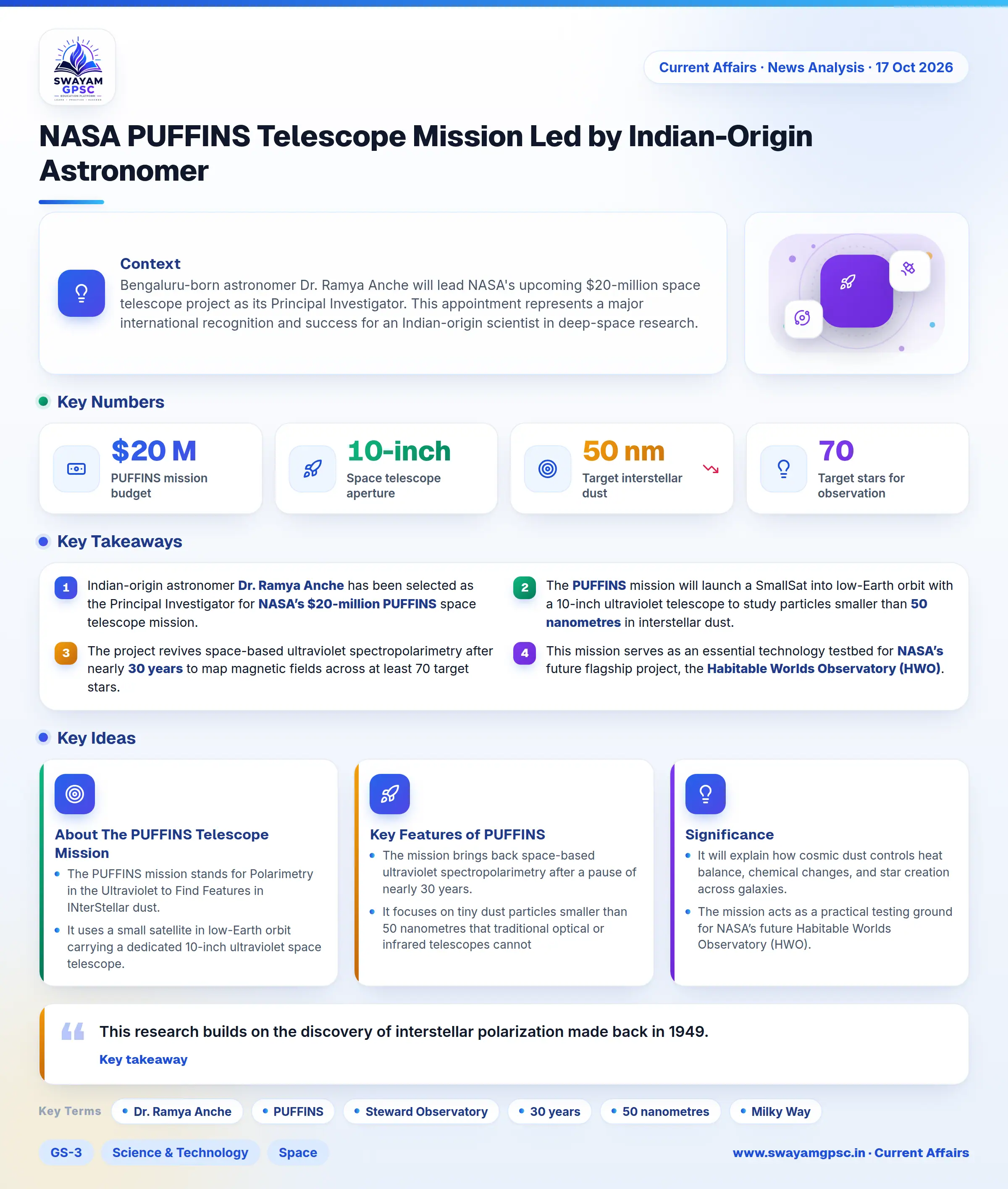
NASA PUFFINS Telescope Mission Led by Indian-Origin Astronomer
#GS-3 #Science & Technology #Space #PUFFINS Mission #NASA #Dr. Ramya Anche
Key takeaways
- Indian-origin astronomer Dr. Ramya Anche has been selected as the Principal Investigator for NASA’s $20-million PUFFINS space telescope mission.
- The PUFFINS mission will launch a SmallSat into low-Earth orbit with a 10-inch ultraviolet telescope to study particles smaller than 50 nanometres in interstellar dust.
- The project revives space-based ultraviolet spectropolarimetry after nearly 30 years to map magnetic fields across at least 70 target stars.
- This mission serves as an essential technology testbed for NASA’s future flagship project, the Habitable Worlds Observatory (HWO).
Context
- Bengaluru-born astronomer Dr. Ramya Anche will lead NASA's upcoming $20-million space telescope project as its Principal Investigator.
- This appointment represents a major international recognition and success for an Indian-origin scientist in deep-space research.
About The PUFFINS Telescope Mission
- The PUFFINS mission stands for Polarimetry in the Ultraviolet to Find Features in INterStellar dust.
- It uses a small satellite in low-Earth orbit carrying a dedicated 10-inch ultraviolet space telescope.
- This telescope measures how ultraviolet starlight becomes polarized as it passes through cosmic dust in deep space.
- The project receives funding through NASA’s Astrophysics Pioneers programme.
- The Steward Observatory at the University of Arizona leads the mission alongside the McDonald Observatory at the University of Texas.
- The mission aims to study the exact chemical makeup, physical structure, and magnetic alignment of interstellar dust grains.
- Understanding these dust properties helps scientists learn how stars and planets form and change over time.
Key Features of PUFFINS
- The mission brings back space-based ultraviolet spectropolarimetry after a pause of nearly 30 years.
- It focuses on tiny dust particles smaller than 50 nanometres that traditional optical or infrared telescopes cannot analyze well.
- It maps galactic magnetic structures by tracking how needle-shaped dust grains line up with the magnetic field of the Milky Way.
- The satellite will examine at least 70 distant stars located in star-forming regions, reflection nebulae, and the Magellanic Clouds.
- Scientists will pair these space UV readings with ground observations from the 82-inch Otto Struve Telescope at McDonald Observatory.
Significance
- This research builds on the discovery of interstellar polarization made back in 1949.
- It will explain how cosmic dust controls heat balance, chemical changes, and star creation across galaxies.
- The mission acts as a practical testing ground for NASA’s future Habitable Worlds Observatory (HWO).