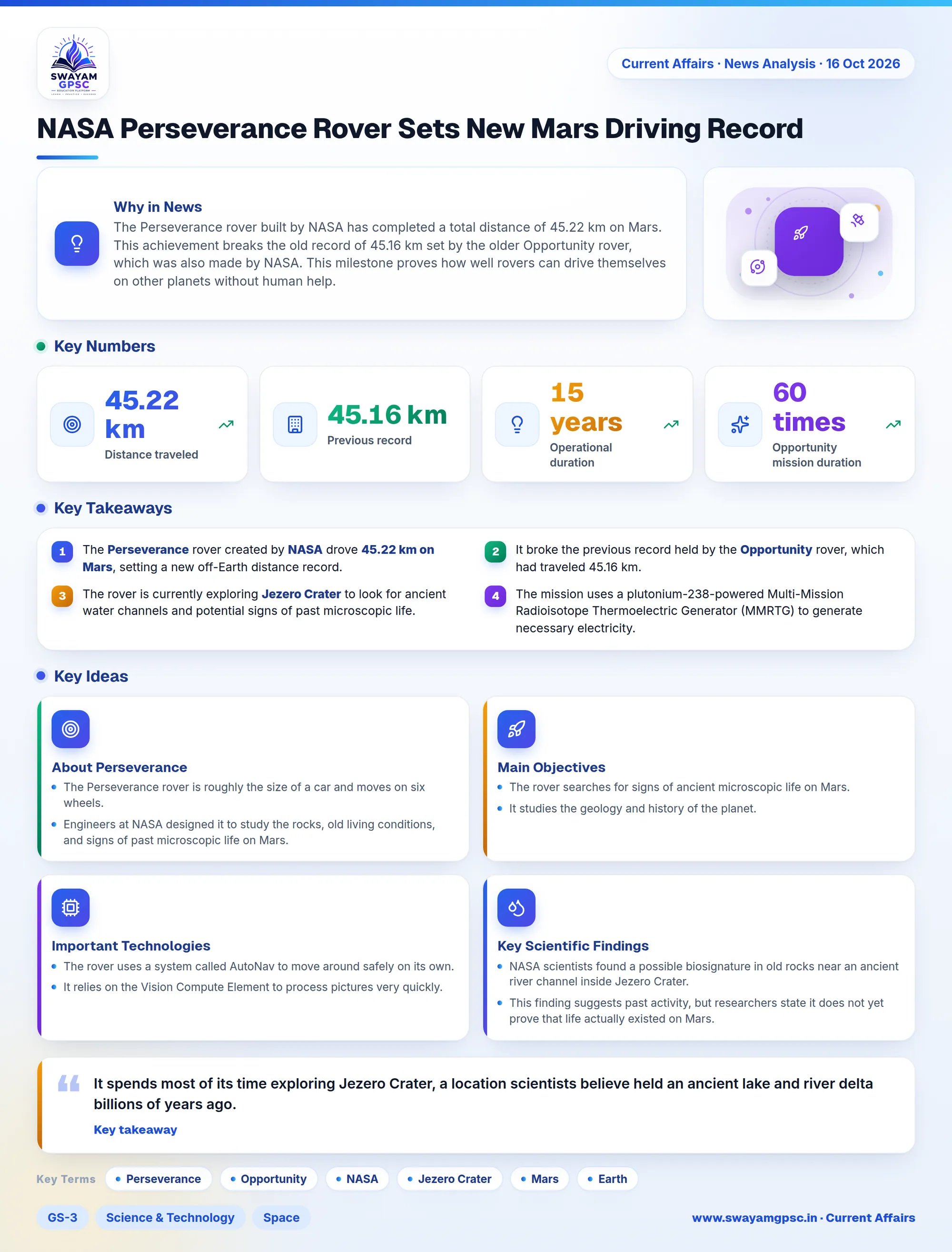
NASA Perseverance Rover Sets New Mars Driving Record
#GS-3 #Science & Technology #Space #Current Events #National
Key takeaways
- The Perseverance rover created by NASA drove 45.22 km on Mars, setting a new off-Earth distance record.
- It broke the previous record held by the Opportunity rover, which had traveled 45.16 km.
- The rover is currently exploring Jezero Crater to look for ancient water channels and potential signs of past microscopic life.
- The mission uses a plutonium-238-powered Multi-Mission Radioisotope Thermoelectric Generator (MMRTG) to generate necessary electricity.
Why in News
- The Perseverance rover built by NASA has completed a total distance of 45.22 km on Mars.
- This achievement breaks the old record of 45.16 km set by the older Opportunity rover, which was also made by NASA.
- This milestone proves how well rovers can drive themselves on other planets without human help.
About Perseverance
- The Perseverance rover is roughly the size of a car and moves on six wheels.
- Engineers at NASA designed it to study the rocks, old living conditions, and signs of past microscopic life on Mars.
- It spends most of its time exploring Jezero Crater, a location scientists believe held an ancient lake and river delta billions of years ago.
Main Objectives
- The rover searches for signs of ancient microscopic life on Mars.
- It studies the geology and history of the planet.
- It collects rock and soil samples to potentially send back to Earth later.
- It identifies areas that might have supported life in the distant past.
Important Technologies
- The rover uses a system called AutoNav to move around safely on its own.
- It relies on the Vision Compute Element to process pictures very quickly.
- It gets its electrical power from a plutonium-238-powered Multi-Mission Radioisotope Thermoelectric Generator (MMRTG).
Key Scientific Findings
- NASA scientists found a possible biosignature in old rocks near an ancient river channel inside Jezero Crater.
- This finding suggests past activity, but researchers state it does not yet prove that life actually existed on Mars.
Extended Mission
- NASA extended the working period of the mission so the rover can explore the crater rim until late 2028.
- The robotic vehicle might continue working even after this planned timeline ends.
Opportunity Rover Details
- The Opportunity rover launched into space along with its twin vehicle named Spirit.
- It landed on Mars in 2004 to study planet geology and past environments.
- It discovered proof that conditions suitable for life once existed on Mars.
- It stayed active for nearly 15 years, which is about 60 times longer than its original planned lifespan.