NASA Invites ISRO to Join Permanent Moon Base Programme
#GS-3 #Science & Technology #Space #Current Events #International #Artemis Accords #ISRO #NASA
Key takeaways
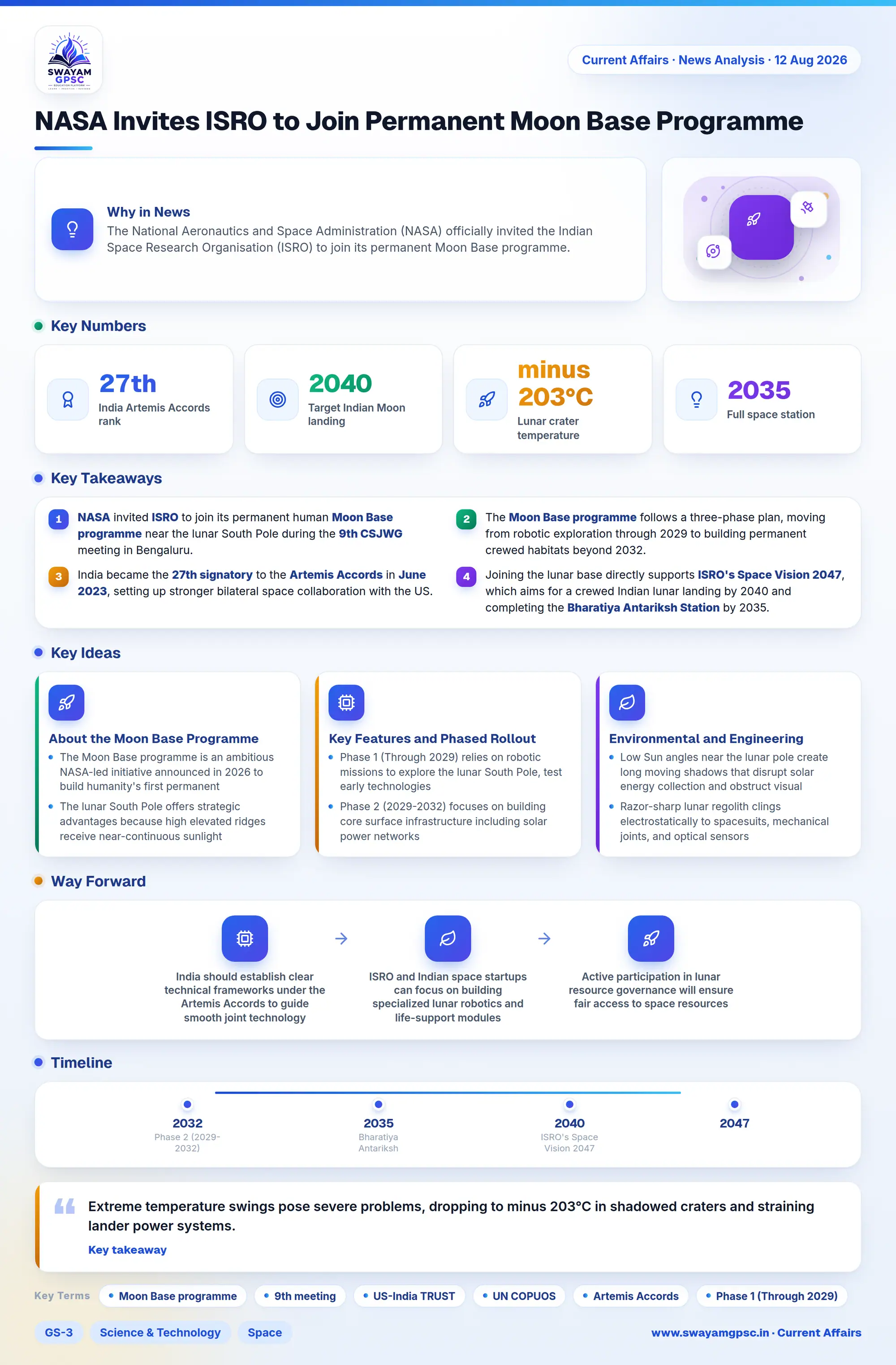
- NASA invited ISRO to join its permanent human Moon Base programme near the lunar South Pole during the 9th CSJWG meeting in Bengaluru.
- The Moon Base programme follows a three-phase plan, moving from robotic exploration through 2029 to building permanent crewed habitats beyond 2032.
- India became the 27th signatory to the Artemis Accords in June 2023, setting up stronger bilateral space collaboration with the US.
- Joining the lunar base directly supports ISRO's Space Vision 2047, which aims for a crewed Indian lunar landing by 2040 and completing the Bharatiya Antariksh Station by 2035.
Why in News
- The National Aeronautics and Space Administration (NASA) officially invited the Indian Space Research Organisation (ISRO) to join its permanent Moon Base programme.
- The invitation came during the 9th meeting of the India-US Civil Space Joint Working Group (CSJWG) held at the ISRO headquarters in Bengaluru.
- Both nations expanded civil and commercial space ties under the US-India TRUST (Transforming the Relationship Utilising Strategic Technology) initiative.
- The two space agencies also reviewed the progress of the joint NISAR (NASA-ISRO Synthetic Aperture Radar) satellite mission.
- Both countries reaffirmed their commitment to the UN COPUOS guidelines regarding sustainable outer space exploration.
- This invitation builds directly on India joining the Artemis Accords as the 27th signatory in June 2023.
About the Moon Base Programme
- The Moon Base programme is an ambitious NASA-led initiative announced in 2026 to build humanity's first permanent surface habitat near the lunar South Pole.
- The lunar South Pole offers strategic advantages because high elevated ridges receive near-continuous sunlight for solar energy generation.
- Permanently shadowed craters at the South Pole also hold vast reserves of essential water ice.
- Astronauts will live and work at this lunar outpost to conduct scientific experiments and test deep-space survival technologies.
- The experience gained on the Moon will serve as a technological stepping stone for future human missions to Mars.
Key Features and Phased Rollout
- Phase 1 (Through 2029) relies on robotic missions to explore the lunar South Pole, test early technologies, and secure reliable surface access.
- Phase 2 (2029-2032) focuses on building core surface infrastructure including solar power networks, communication systems, and lunar rovers.
- Phase 3 (Beyond 2032) starts assembling an expandable permanent outpost capable of supporting long-term human stays.
- The project heavily integrates private space companies such as Astrobotic, Blue Origin, Firefly Aerospace, and Intuitive Machines for cargo delivery and landers.
- The programme relies on In-Situ Resource Utilization (ISRU) to convert lunar soil and water ice into drinking water, oxygen, and rocket fuel.
- Scientific data and environmental observations will be shared openly with global partners under the Artemis Accords framework.
Environmental and Engineering Challenges
- Extreme temperature swings pose severe problems, dropping to minus 203°C in shadowed craters and straining lander power systems.
- Low Sun angles near the lunar pole create long moving shadows that disrupt solar energy collection and obstruct visual navigation.
- Razor-sharp lunar regolith clings electrostatically to spacesuits, mechanical joints, and optical sensors, causing fast mechanical wear.
- Rugged surface conditions like steep crater walls and boulder fields make automated landings and rover travel very dangerous.
Significance for India and Space Vision 2047
- Joining this initiative aligns directly with ISRO's Space Vision 2047, which sets a goal to land an Indian astronaut on the Moon by 2040.
- The partnership strengthens India's work on the Bharatiya Antariksh Station, aiming for its first module by 2028 and full completion by 2035.
- This project moves India beyond independent lunar missions like Chandrayaan-3 into complex, multilateral human space exploration.
Way Forward
- India should establish clear technical frameworks under the Artemis Accords to guide smooth joint technology sharing.
- ISRO and Indian space startups can focus on building specialized lunar robotics and life-support modules for polar environments.
- Active participation in lunar resource governance will ensure fair access to space resources under international norms.
Prelims in Focus
- Artemis Accords: NASA and seven partner nations launched these non-binding guidelines in 2020 for safe space use. India became the 27th signatory in June 2023.
- NISAR Mission: A joint earth-observation satellite project between NASA and ISRO using advanced radar imaging.
- UN COPUOS: The United Nations Committee on the Peaceful Uses of Outer Space creates global guidelines for sustainable space operations.
- CSJWG: The India-US Civil Space Joint Working Group coordinates bilateral space collaboration across civil and commercial domains.