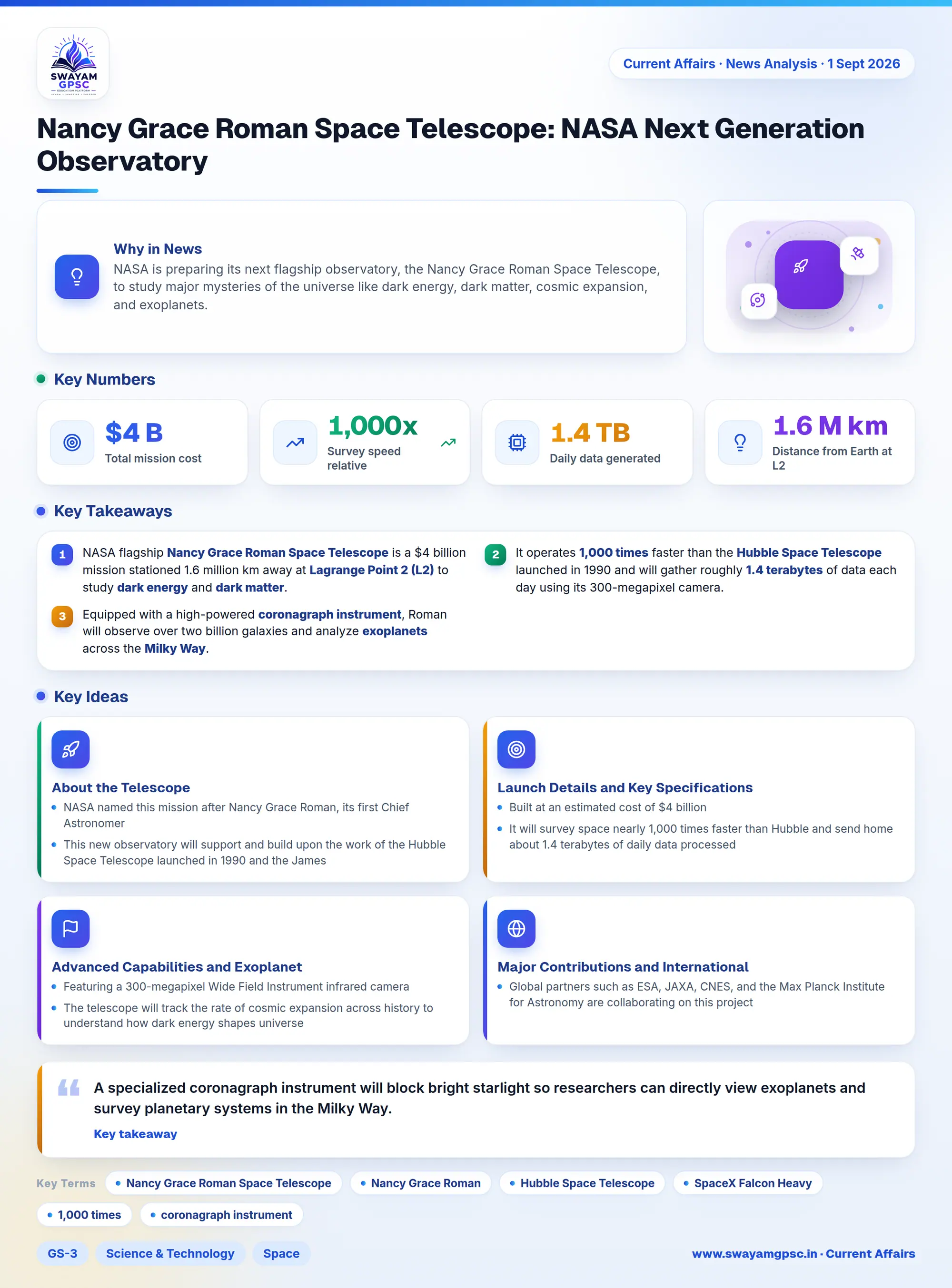
Nancy Grace Roman Space Telescope: NASA Next Generation Observatory
#GS-3 #Science & Technology #Space #Current Events #International #Rapid Fire CA #Quick Facts For Prelims
Key takeaways
- NASA flagship Nancy Grace Roman Space Telescope is a $4 billion mission stationed 1.6 million km away at Lagrange Point 2 (L2) to study dark energy and dark matter.
- It operates 1,000 times faster than the Hubble Space Telescope launched in 1990 and will gather roughly 1.4 terabytes of data each day using its 300-megapixel camera.
- Equipped with a high-powered coronagraph instrument, Roman will observe over two billion galaxies and analyze exoplanets across the Milky Way.
Why in News
- NASA is preparing its next flagship observatory, the Nancy Grace Roman Space Telescope, to study major mysteries of the universe like dark energy, dark matter, cosmic expansion, and exoplanets.
About the Telescope
- NASA named this mission after Nancy Grace Roman, its first Chief Astronomer, who is widely remembered as the Mother of the Hubble Space Telescope.
- This new observatory will support and build upon the work of the Hubble Space Telescope launched in 1990 and the James Webb Space Telescope launched in 2021 by taking wider and deeper cosmic surveys.
Launch Details and Key Specifications
- Built at an estimated cost of $4 billion, the telescope launches on a SpaceX Falcon Heavy rocket from Kennedy Space Center in Florida to operate near Lagrange Point 2 (L2), which is 1.6 million km from Earth.
- It will survey space nearly 1,000 times faster than Hubble and send home about 1.4 terabytes of daily data processed using artificial intelligence and machine learning.
Advanced Capabilities and Exoplanet Exploration
- Featuring a 300-megapixel Wide Field Instrument infrared camera, it will analyze more than two billion galaxies and chart how cosmic structures evolve.
- The telescope will track the rate of cosmic expansion across history to understand how dark energy shapes universe growth.
- A specialized coronagraph instrument will block bright starlight so researchers can directly view exoplanets and survey planetary systems in the Milky Way.
Major Contributions and International Partnerships
- Global partners such as ESA, JAXA, CNES, and the Max Planck Institute for Astronomy are collaborating on this project to advance knowledge in gravitational physics, galaxy formation, and planet dynamics.