Namami Gange Programme and Jan Ganga Public Participation
#GS-2 #GS-3 #Governance & Social Justice #Government Policies & Interventions #Environment #Climate Change #Current Events #National
Key takeaways
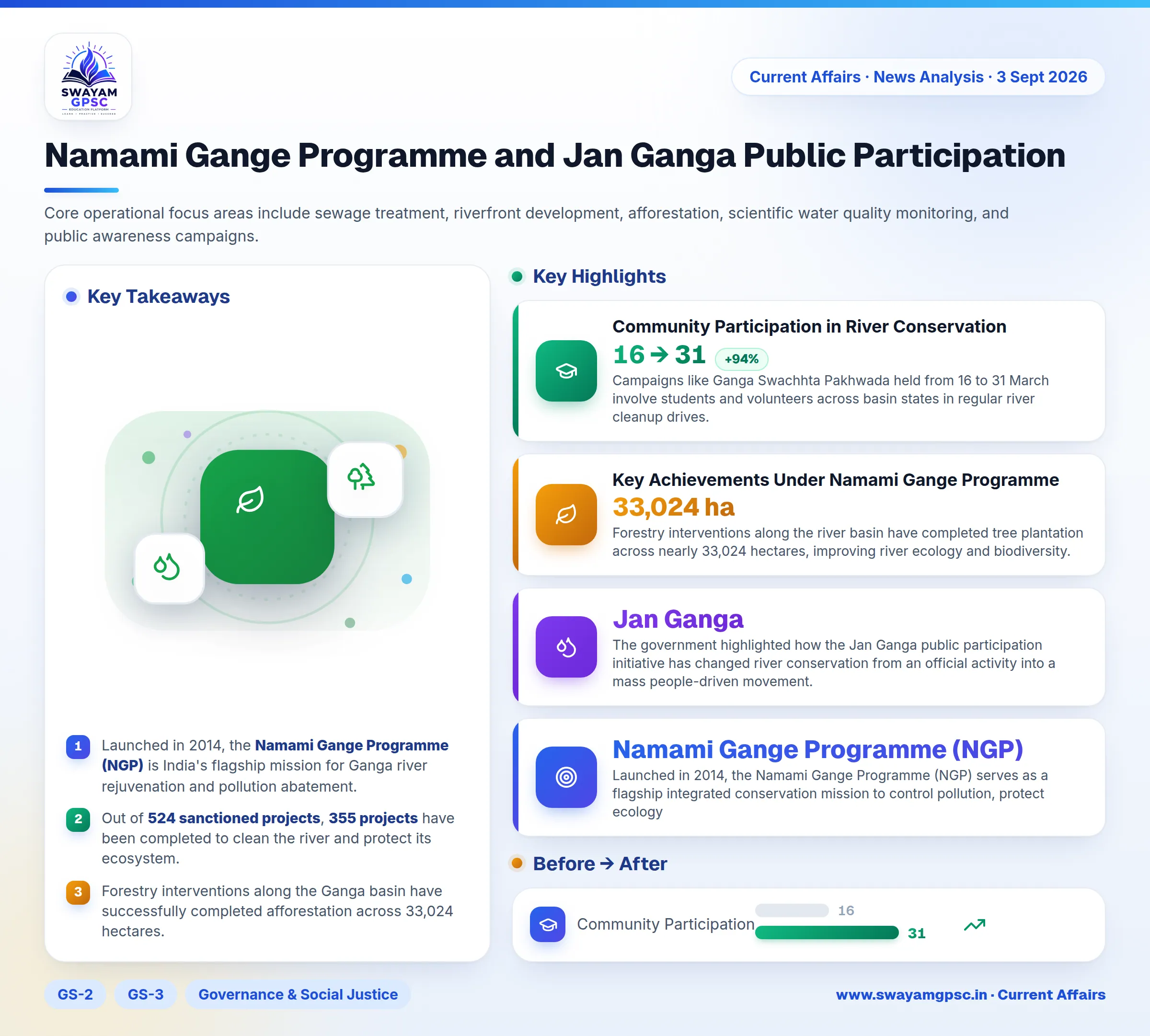
- Launched in 2014, the Namami Gange Programme (NGP) is India's flagship mission for Ganga river rejuvenation and pollution abatement.
- Out of 524 sanctioned projects, 355 projects have been completed to clean the river and protect its ecosystem.
- Forestry interventions along the Ganga basin have successfully completed afforestation across 33,024 hectares.
- The Jan Ganga pillar mobilizes communities through initiatives like Ganga Swachhta Pakhwada and volunteer networks like Ganga Praharis.
Why in News
- The government highlighted how the Jan Ganga public participation initiative has changed river conservation from an official activity into a mass people-driven movement.
Key Facts About Namami Gange Programme
- Launched in 2014, the Namami Gange Programme (NGP) serves as a flagship integrated conservation mission to control pollution, protect ecology, and rejuvenate the national river Ganga and its tributaries.
- The mission uses an integrated approach that combines pollution control with ecological restoration, biodiversity protection, sustainable management, and overall river health.
- Implementation follows a structured phased framework consisting of immediate entry-level activities, medium-term projects, and long-term rejuvenation measures.
- Under the Jan Bhagidari principle, the programme promotes Jan Ganga to transform river cleanup from a government responsibility into a community movement.
- Core operational focus areas include sewage treatment, riverfront development, afforestation, scientific water quality monitoring, and public awareness campaigns.
Key Achievements Under Namami Gange Programme
- Authorities have sanctioned 524 projects under the programme, out of which 355 projects are fully completed to restore river ecology and reduce pollution.
- Scientific efforts have strengthened the protection and rehabilitation of native aquatic species such as the Gangetic Dolphin, Gharial, turtles, Hilsa, and otters.
- Forestry interventions along the river basin have completed tree plantation across nearly 33,024 hectares, improving river ecology and biodiversity.
- Central Pollution Control Board monitoring shows improved water quality, with pH and Dissolved Oxygen (DO) levels meeting bathing standards across monitored locations.
Community Participation in River Conservation
- The Jan Ganga initiative functions as the public involvement pillar of NGP, empowering local communities through awareness and shared ownership.
- Campaigns like Ganga Swachhta Pakhwada held from 16 to 31 March involve students and volunteers across basin states in regular river cleanup drives.
- Mass plantation drives such as Ek Ped Maa Ke Naam mobilize local citizens to plant trees, stabilizing riverbanks and reducing soil erosion.
- Youth engagement through University Ganga Clubs and school eco-clubs fosters long-term environmental awareness via field visits, lectures, and competitions.
- Cultural celebrations like Ganga Utsav, Swachhta Hi Seva, and International Day of Yoga strengthen cultural bonds between citizens and the sacred river.
- Grassroots volunteer networks including Ganga Praharis and Ganga Seva Doots actively protect local biodiversity and educate communities on sustainable practices.
- Innovative outreach programs such as the BSF all-women river rafting expedition create direct public connection with conservation efforts.
Way Forward
- Long-term river rejuvenation requires combining scientific methods, sustainable development, and active public participation across all Ganga basin states.
- By shifting citizens from passive onlookers to active guardians, Jan Ganga creates a sustainable model for preserving river ecosystems across India.